
Menu Engineering 2026: Design a Menu That Sells More
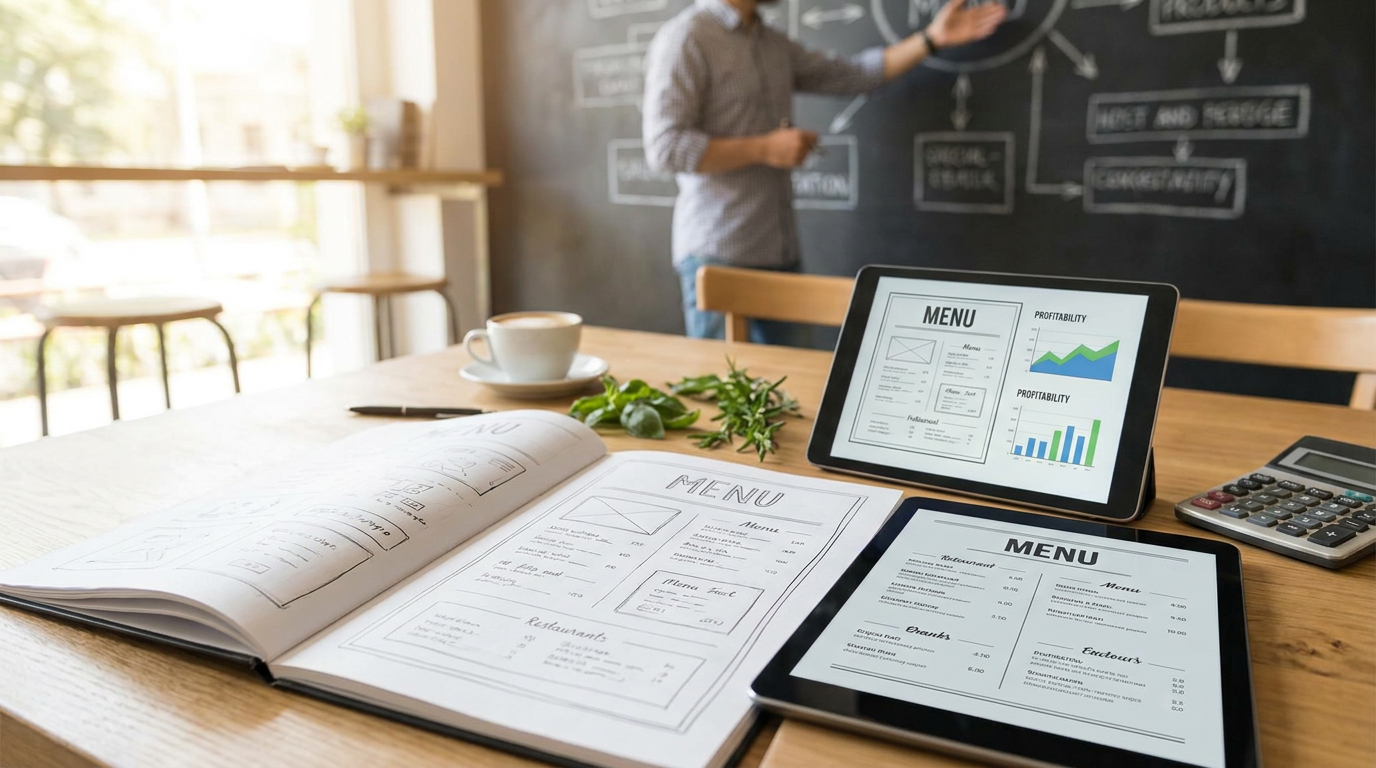
How to design a menu that sells in 2026 — the 15-minute weekly discipline that lifts AOV 8-15%.
TL;DR — Key Takeaways
Menu engineering is the systematic optimization of which dishes appear on the menu, how they're described, where they're positioned, and how they're priced — to maximize profit per cover, not just revenue.
The four-quadrant framework (stars, plowhorses, puzzles, dogs) sorts every dish by popularity and profitability. Stars get more visibility; puzzles get repositioned; dogs get cut.
The 2026 evolution of menu engineering adds real digital menu data (menu views, dish opens, the languages guests read in and where they came from) to the sales and margins from your POS, to inform decisions that printed menus could only guess at.
Photos lift conversion 25-30% on average; the right number of items per category is 5-7 (above 9, decision fatigue suppresses orders); descriptions matter more than the dish name.
Tools like Intermenu show which dishes guests open, and which nobody opens. Set that beside your POS sales and the discipline becomes a weekly review rather than a quarterly guessing game.
Why menu engineering is a 2026 discipline, not a 2010 one
Menu engineering has been a hospitality buzzword for two decades, but the practice was constrained for most of that time by a single problem: the data wasn't there. Operators tried to identify "stars" and "dogs" by guesswork, by waiter intuition, or by the very rough signal of which printed menu items had to be re-ordered most often from the kitchen. Digital menus broke that constraint in 2024-2026. Menu views, dish opens, the languages guests read in and where they came from are now recorded continuously on a QR menu. Paired with the sales your POS already records, they give the signal printed menus never could. Menu engineering has shifted from a quarterly hand-wringing project to a weekly 10-minute review with measurable lift.
This pillar is the working playbook — what to measure, how to act on it, and the patterns that consistently produce 8-15% AOV lift in 90 days.
What is menu engineering and how does it actually work?
Menu engineering is the discipline of systematically designing a restaurant menu to maximize profit per cover. The four levers:
1. Selection— which dishes appear on the menu (and which don't)
2. Pricing— what each dish costs the guest (and the relationship between dishes)
3. Layout— where on the menu each dish appears (categories, position within category)
4. Description— how each dish is named and described (the words that drive ordering)
The discipline emerged from hotel and chain restaurant operations in the 1980s — but it was based on imperfect data (operators guessed which dishes guests "almost ordered"). In 2026, digital menu data makes menu engineering far less approximate: dish opens from the menu, set beside order counts and margins from the POS, feed into informed decisions.
This pillar covers the modern discipline — what's changed since 2020, what hasn't, and how to run a menu engineering review that produces measurable AOV lift.
How do you identify your "stars" and "dogs"?
The classic four-quadrant framework, updated for 2026:
The four quadrants
Stars (high popularity, high profitability): Most-ordered dishes that also have strong margins. These are your menu's main asset. Strategy: feature prominently, photograph beautifully, protect from competitors.
Plowhorses (high popularity, low profitability): Bestsellers with thin margins. Still important — they bring guests in. Strategy: incrementally raise prices, find ways to improve margins (smaller portion, ingredient swap, paired upsell).
Puzzles (low popularity, high profitability): Dishes that earn well but don't sell often. Often the highest-leverage opportunity in a menu engineering review. Strategy: improve description, add photo, reposition prominently, train staff to recommend.
Dogs (low popularity, low profitability): Dishes that don't sell and don't earn. Strategy: cut from the menu (free up kitchen capacity for higher-leverage items).
The classification requires data: per-dish order count + per-dish margin (food cost / sale price). Order counts come from the POS and margins from your cost cards, and the operator combines them by hand (the menu itself takes no orders).
The 2026 addition: the "high-view, low-order" dish
A new category that printed menu engineering couldn't surface: dishes that are viewed often but ordered rarely.
These are diagnostic gold:
High view + low order = description, photo, or pricing problem
Specifically actionable through menu engineering changes
Often becomes a "star" once the friction is removed
A digital menu shows which dishes are opened most. Set that list beside your POS sales and these dishes stand out. A printed-menu operation has no way to know.
What's the right number of items per menu category?
The 2026 benchmarks, validated across thousands of restaurant menus:
Optimal range:5-7 items per category
Above 9 items per category: decision fatigue meaningfully suppresses orders. Guests faced with too many options often default to safe-familiar choices, undermining menu engineering.
Below 4 items per category: can feel sparse, signals limited menu, sometimes underperforms.
The category-level math: A typical sit-down restaurant menu has 5-7 categories: Starters, Pasta/Rice (in Italian), Mains, Sides, Desserts, sometimes Specials. With 5-7 items per category, the total menu is 25-50 items — a manageable size for both kitchen and guest. Delivery menus follow a different shape — see how to order your delivery menu categories.
The 2026 trend: menus have generally gotten shorter as operators optimize for profitability and operational efficiency. The era of the 100-item Cheesecake-Factory-style menu is fading; most independent restaurants are landing at 25-40 total items.
Where on the menu do customers' eyes go first?
The classic "menu sweet spots" identified through eye-tracking research:
For printed menus:
Top-right of the page (most attention)
Top-left of the page (second most)
Center of multi-column layouts (third most)
Bottom of pages (least attention)
For digital menus (QR):
Top of the menu (categories visible first)
The first 2-3 dishes in each category (most viewed)
Items with photos draw disproportionate attention
Items with badges ("chef's pick," "local favorite") draw attention
Practical implications: High-profit dishes (stars and puzzles) belong at the top of categories. Dogs belong at the bottom (they take less screen real estate from the rest). Photos placement guides guest attention; place photos on dishes you want to drive. Badges are powerful — use them sparingly and only on genuine highlights.
The 2026 reality: digital menus give operators more precise control over visual hierarchy than printed menus. Position, badges, photos, and category ordering can all be adjusted weekly based on actual analytics.
How does a digital menu change menu engineering?
The discipline becomes precise rather than approximate. Five concrete changes:
1. Real per-dish data. Dish opens and menu views from the menu (and, on some plans, views per language), set beside order counts from the POS.
2. Before-and-after testing becomes easy. Change a description, a photo or a price, then compare the dish's opens and its POS sales with the weeks before.
3. Faster iteration. Menu changes deploy instantly. The "wait until next print run" friction disappears.
4. Per-language insights. See which languages guests read your menu in and each language's share (on Intermenu's Pro and Multi plans), and adjust translations and staff phrases to match.
5. The dishes nobody opens. The menu lists the dishes no guest opened, with a reminder that dishes near the bottom of a section get opened less. These are your first candidates to reposition, rewrite or cut.
The compounding effect: menu engineering shifts from a quarterly project to a weekly discipline. A 15-minute weekly analytics review surfaces the highest-leverage changes; the operator implements them and watches the lift.
Intermenu covers the menu side of all five (dish opens, menu views, languages read and the dishes nobody opened), while order counts and margins come from your POS. That makes the modern menu engineering rhythm a normal weekly operation rather than a heavy lift.
Should menu prices have currency symbols?
The data-backed answer: it depends on the restaurant tier.
Casual restaurants: including the currency symbol ("$12.95") is fine and probably correct. Guests expect transparency, and the symbol doesn't suppress orders meaningfully.
Mid-tier and fine dining: dropping the currency symbol ("12.95" or "12,50") consistently outperforms keeping it. The mechanism is psychological — the absence of "$" reduces the "you're spending money" signal and lifts orders.
The size of the effect: typically 5-10% lift in average check size in fine-dining contexts when the currency symbol is dropped. Not enormous, but free to implement.
The international consideration: For tourist-area restaurants, the currency symbol may matter for clarity. International tourists need to know the currency to evaluate value. A possible compromise: currency symbol at the top of the menu ("All prices in EUR"), numerical prices without symbol next to each dish, symbol restored on the bill. This satisfies both the psychological "less money signaling" effect and the tourist-clarity need.
How do photos affect order patterns?
The 2026 data on menu photos:
Photos lift orders 25-30% on average for the photographed dish.
Where photos drive the most lift:
Unfamiliar dishes (visual context helps)
Higher-margin dishes (photos help the guest commit to the higher-priced option)
Specialty preparations (photos communicate technique)
Where photos sometimes hurt:
Fine dining (photos can feel down-market)
Items where the photo doesn't quite match reality (sets up disappointment)
When all dishes have photos (no signal — photos lose their attention-driving power)
The 2026 best practice: Photo coverage on 50-80% of menu items, highest-priority dishes (stars and puzzles) photographed first, avoid photos on unappealing items (some braised dishes don't photograph well), refresh photos seasonally to keep the menu feeling current.
The cost gap: In 2020, photography costs constrained which dishes got photographed (typically 5-10 per shoot). In 2026, AI dish photography ($0.40-$0.60/image) makes full menu coverage trivially affordable. The constraint shifts from cost to operator decision: which dishes deserve photo emphasis?
Intermenu's "Generate a photo" button builds a dish photo from the dish's name, description and preparation notes, with no prompt to write, drawing on your plan's monthly image allowance.
A 5-step weekly menu engineering rhythm
A practical 15-minute weekly discipline that compounds over months:
Step 1 — Pull the data (3 minutes)
Open the menu insights and your POS report side by side. Look at the five most-opened dishes and the dishes nobody opened on the menu, the top 10 most-ordered dishes in the POS, and this week's POS order count vs last week.
Step 2 — Identify one high-view-low-order dish (3 minutes)
Pick one dish that's being viewed but not ordered. Hypothesize the cause: description doesn't sell the dish? Photo missing or unappealing? Price feels off relative to the perceived value? Allergen exclusions?
Step 3 — Implement one change (5 minutes)
Make one specific change to the dish: rewrite the description, add or replace a photo, adjust the price slightly, move the dish position within its category.
Step 4 — Document the experiment (2 minutes)
Note in a log: which dish, what was changed, when, why. Set a date to review the result.
Step 5 — Review last week's experiment (2 minutes)
Look at the dish you changed last week. Did its sales in the POS move? If yes, document the win. If no, document the result and move on.
This rhythm produces 50+ menu engineering experiments per year, with ~30-40% of them moving the needle. The cumulative AOV lift over a year is typically 8-15% — meaningful at restaurant scale.
A 90-day menu engineering rollout
For a restaurant going from "we set the menu and rarely change it" to "we systematically optimize the menu": If you run more than one venue, sequence the rollout site by site — see applying this across several locations.
Days 1-15: Foundation
Implement digital menu with analytics (if not already)
Run baseline measurement: current AOV, current per-dish performance
Identify your stars, plowhorses, puzzles, and dogs
Cut 1-2 obvious dogs
Days 16-45: Optimization
Begin weekly menu engineering rhythm (15 min/week)
Generate AI photos for top puzzles
Rewrite descriptions on top puzzles
Test small price adjustments where appropriate
Days 46-75: Iteration
Review which changes moved the needle
Roll back changes that didn't work
Replicate successful patterns to similar dishes
Begin per-language analysis (which languages guests read the menu in, and how each language's share changes)
Days 76-90: Compounding
Audit the menu against the 5-7-items-per-category benchmark
Cut additional dogs as identified
Continue weekly rhythm
Document the protocol for ongoing operation
By day 90, most restaurants see measurable AOV lift (typically 8-15%) and a sustainable menu engineering discipline that runs on autopilot beyond the operator's direct attention.
Frequently Asked Questions
What is menu engineering and how does it actually work?
The systematic optimization of which dishes appear on the menu, how they're priced, where they're positioned, and how they're described — to maximize profit per cover.
How do you identify your "stars" and "dogs"?
Four-quadrant framework: stars (high popularity + high profitability), plowhorses (high popularity + low profitability), puzzles (low popularity + high profitability), dogs (low popularity + low profitability). Add the 2026 "high-view-low-order" diagnostic for digital menus.
What's the right number of items per menu category?
5-7 items. Above 9, decision fatigue suppresses orders. Below 4 can feel sparse.
Where on the menu do customers' eyes go first?
Top-right of printed menus; top of category in digital. High-profit dishes belong at the top; dogs at the bottom.
How does a digital menu change menu engineering?
Real per-dish data (dish opens from the menu, sales from the POS), before-and-after testing, faster iteration, per-language insights, and the list of dishes nobody opens. Discipline becomes weekly rather than quarterly.
Should menu prices have currency symbols?
Casual: yes. Fine dining: dropping the symbol typically lifts AOV 5-10%. International tourist context: currency symbol at the menu top, numerical prices without symbol per dish.
How do photos affect order patterns?
Photos lift orders 25-30% on average. Coverage on 50-80% of dishes is optimal. Refresh seasonally for currency.
Engineer Your Menu With Built-In Analytics
Menu engineering in 2026 is a 15-minute weekly discipline — not a quarterly guessing project. The constraint that used to be data availability has been removed by digital menus that show which dishes guests open.
Intermenu shows menu views, dish opens, where guests came from and, on Pro and Multi, the languages guests read in. Set beside your POS sales, that turns menu engineering into a sustainable weekly rhythm.
If your menu has been static for months, see what data-driven optimization looks like →
Related guides
Seasonal menu strategy: 4 updates a year without reprint costs
Upselling on a QR menu: 7 subtle techniques that don't annoy