
Seasonal Menu Strategy: Update 4 Times a Year Without Reprint Costs
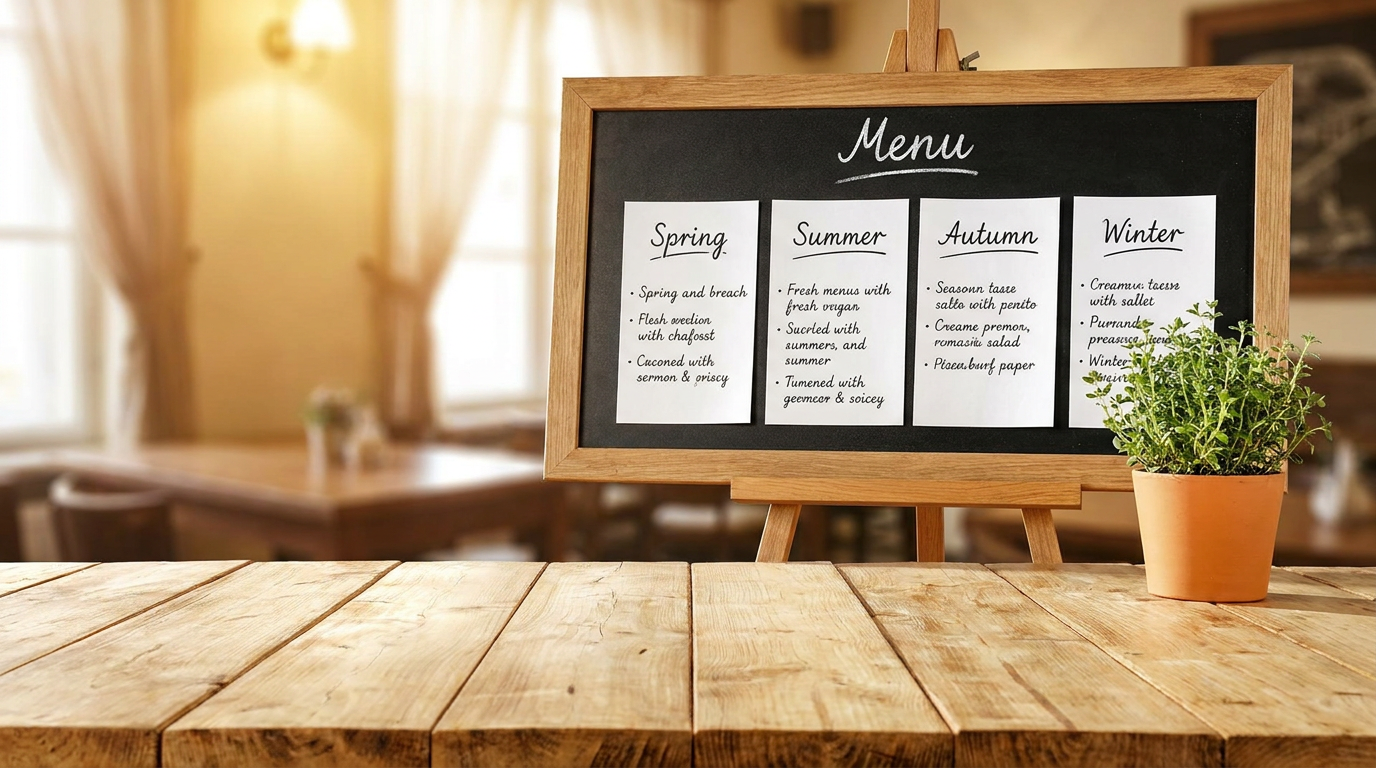
How to update a menu 4 times a year in 2026 without reprint costs.
TL;DR — Key Takeaways
Seasonal menu rotation lifts AOV and customer retention — guests visit more often when there is something new to try, and seasonal items justify higher pricing.
Printed menus impose a real friction on seasonal changes (reprint costs, distribution to all tables, version drift between languages). Digital menus eliminate this friction completely.
The 2026 best-practice cadence: minor updates monthly (1-3 dishes), major seasonal rotations quarterly (8-15 new items), full menu refresh annually.
Multilingual seasonal updates require structured menu data — translating new dishes manually each season is unsustainable; AI translation makes seasonal multilingual rotation trivial.
AI dish photography lets restaurants generate fresh seasonal photos at near-zero cost, eliminating the historical "we will wait until next photo shoot" delay.
How often should a restaurant change its menu?
The 2026 best-practice cadence:
Minor updates — every month:
1-3 dishes added or rotated
Daily and weekly specials separately
Seasonal ingredient swaps within existing dishes (different fish in season)
Major seasonal rotations — every 3 months:
8-15 new items
Aligned with seasons (spring, summer, fall, winter) or local cultural calendar
Often involves visual refresh
Annual refresh — once a year:
Full menu review
Cut underperforming dishes
Add new categories if needed
Refresh photography across the menu
Often coincides with summer or January for many markets
Why this cadence works: Frequent enough to give regulars something new. Slow enough to let dishes find their audience. Aligned with seasonal ingredient availability. Creates marketing moments (new season menu launches).
The 2020 vs 2026 contrast: In 2020, the cadence was constrained by reprint costs and the workflow burden. Many independent restaurants updated annually or biennially. In 2026, with digital menus and AI photography, the constraint is creative judgment, not operational friction. Most restaurants have meaningfully accelerated their menu rotation cadence.
What is the cost of reprinting paper menus 4x a year?
The honest 2026 numbers for a 50-cover restaurant:
Per reprint:
Design adjustments: $0-$200 (operator time or external designer)
Print run: $200-$600 (50 menus, color, decent paper stock)
Multilingual versions (if printed): $200-$600 per language
Distribution / replacement: 1-2 hours of staff time
Annual cost (4 rotations + minor monthly updates):
Single language: $1,500-$3,000
5 languages: $5,000-$15,000
Plus the friction of the workflow
The digital alternative:
Subscription cost: $200-$700/year for hospitality menu platform
Updates take seconds, not days
Languages all update simultaneously
No print runs, no staff distribution time
The cost comparison: Annual seasonal updates on print: $5,000-$15,000+ (multilingual). Annual seasonal updates on digital: ~$500 in subscription. Cost ratio: 10-30x in favor of digital. This single math justifies the digital menu transition for most multilingual restaurants.
Can I run a "seasonal" digital menu while keeping core dishes?
Yes — and this is the standard 2026 approach.
The two-layer menu structure:
Permanent core: dishes that stay year-round (typically 60-70% of the menu)
Signature dishes
Customer favorites
Operationally efficient items
Brand-defining dishes
Seasonal layer: dishes that rotate (typically 30-40% of the menu)
Spring: lighter dishes, fresh vegetables, fish
Summer: cold preparations, salads, fruit-based desserts
Fall: heartier dishes, root vegetables, wild game
Winter: braised dishes, stews, comfort food
The implementation: The digital menu has both layers visible together. Seasonal items are sometimes flagged ("New for Spring 2026" or "Summer Special"). The menu's overall structure stays consistent (same categories, same allergen tagging conventions). Only the specific dishes within categories rotate.
Why this works: Regulars get familiar dishes they can rely on. New visitors get the "something new every season" appeal. Marketing moments are clearer (spring menu launch, summer terrace specials). Operations can plan around the consistent core.
Intermenu handles this with sections rather than dates: put seasonal dishes in their own section, hide it from guests when the season ends and show it again when it returns, or mark single dishes sold out. There is no scheduling — you make the switch.
How do I handle multilingual updates for seasonal items?
The 2026 workflow:
Step 1 — Add the dish in your master language. Name, description, ingredients, allergens, price.
Step 2 — Translate with one button. One button on the Languages screen translates every new or changed dish into every language you switch on. The run happens in the background, with a progress bar.
Step 3 — Native-speaker review on top items. For Tier 1 languages, a quick review of the new dish description (10-15 minutes per language).
Step 4 — Generate seasonal photo via AI. With brand-style anchor applied for visual consistency.
Step 5 — Publish. The seasonal dish appears across all language versions of the menu simultaneously.
Total time per new seasonal dish:15-30 minutes from concept to publish across all languages.
The 2020 contrast: In 2020, adding a new dish to a multilingual menu required: translation order to agency (1-2 weeks), photography commission (1-2 weeks), reprint of all language versions, distribution to all tables. Total: 3-6 weeks. Cost: $200-$1,000 per new dish. The 2026 collapse to under 30 minutes per dish, at near-zero marginal cost, fundamentally changes what is operationally feasible.
What seasons drive the most ordering interest?
The 2026 patterns vary by region:
Mediterranean / Southern European markets: Summer is the highest-engagement season (tourist peak + warmer weather + lighter eating). Spring is second (Easter, asparagus season, lamb). Fall third (game season, mushrooms). Winter is the slowest.
Northern European markets: Christmas / winter holidays drive significant interest (multi-week menus). Spring strong (after the long winter). Summer second (terraces and outdoor dining). Fall third.
Asian markets: Seasonal eating is deeply embedded; all four seasons drive engagement. Cherry blossom season in Japan (specific 2-3 week window) drives huge demand. Lunar New Year drives major demand across East/SE Asian markets.
Middle Eastern markets: Ramadan iftar menus drive enormous demand for the month. Eid celebrations drive specific menu moments. Tourism-season variations dominate non-religious calendars.
For tourist-area restaurants: seasons matter both as ingredient availability and as cultural marketing moments. A restaurant that launches a "spring menu" gives regulars and tourists something new to discover; a restaurant that does not change its menu seasonally feels stale.
A practical seasonal rotation calendar
A reference 12-month seasonal rotation for a Mediterranean / Southern European restaurant:
January-February (Winter): Heartier braised dishes, truffle preparations (where regional), citrus-forward desserts, aged red wines featured.
March-April (Spring): Asparagus, artichokes, fava beans, lamb (Easter season), fresh herb-driven preparations, lighter aperitivi.
May-June (Late spring): First tomatoes, fresh berries, summer cocktail menu launch, outdoor terrace specials.
July-August (Summer peak): Cold soups and gazpacho, grilled fish and seafood, fresh fruit desserts, rosé and sparkling wines featured.
September-October (Fall): Mushrooms (porcini, chanterelles), game (where regional), first chestnut preparations, heartier red wines.
November-December (Holiday season): Festive multi-course menus, truffle (white truffle in November), Christmas / holiday specials, roasts and braises.
This calendar can be adapted for any regional cuisine. The structure (seasonal-aligned ingredient and dish rotation) is universal; the specifics shift based on region and cuisine.
Frequently Asked Questions
How often should a restaurant change its menu?
Minor updates monthly (1-3 dishes), major seasonal rotations quarterly (8-15 new items), full menu refresh annually.
What is the cost of reprinting paper menus 4x a year?
$1,500-$3,000 single-language, $5,000-$15,000 multilingual. Compares to ~$500/year for digital menu subscription. 10-30x cost gap in favor of digital.
Can I run a "seasonal" digital menu while keeping core dishes?
Yes — two-layer structure. 60-70% permanent core, 30-40% seasonal rotation.
How do I handle multilingual updates for seasonal items?
One button on the Languages screen translates the new dishes into every language you switch on; native-speaker review for top languages; AI photo generation for seasonal items. Total time per new dish: 15-30 minutes across all languages.
What seasons drive the most ordering interest?
Varies by region. Mediterranean: summer first, spring second. Northern European: Christmas/winter holidays. Asian: cherry blossom, Lunar New Year, Mid-Autumn. Middle Eastern: Ramadan iftar.
Update Your Menu in Seconds Across Every Language You Offer
Seasonal menu rotation has historically been a logistical project — print runs, translation cycles, photo shoots, reprint distribution. The 2026 stack collapses this into an afternoon per rotation.
Intermenu handles a seasonal rotation with what it already has: a section for the season that you hide from guests and show again when the season returns, AI translation across every language you offer, AI photo generation for new dishes, and new dishes that are live as soon as they are saved.
If your menu has been the same for two years because seasonal updates felt too operational, see what AI-driven seasonal rotation looks like →