
Upselling on a QR Menu: 7 Subtle Techniques That Don’t Annoy
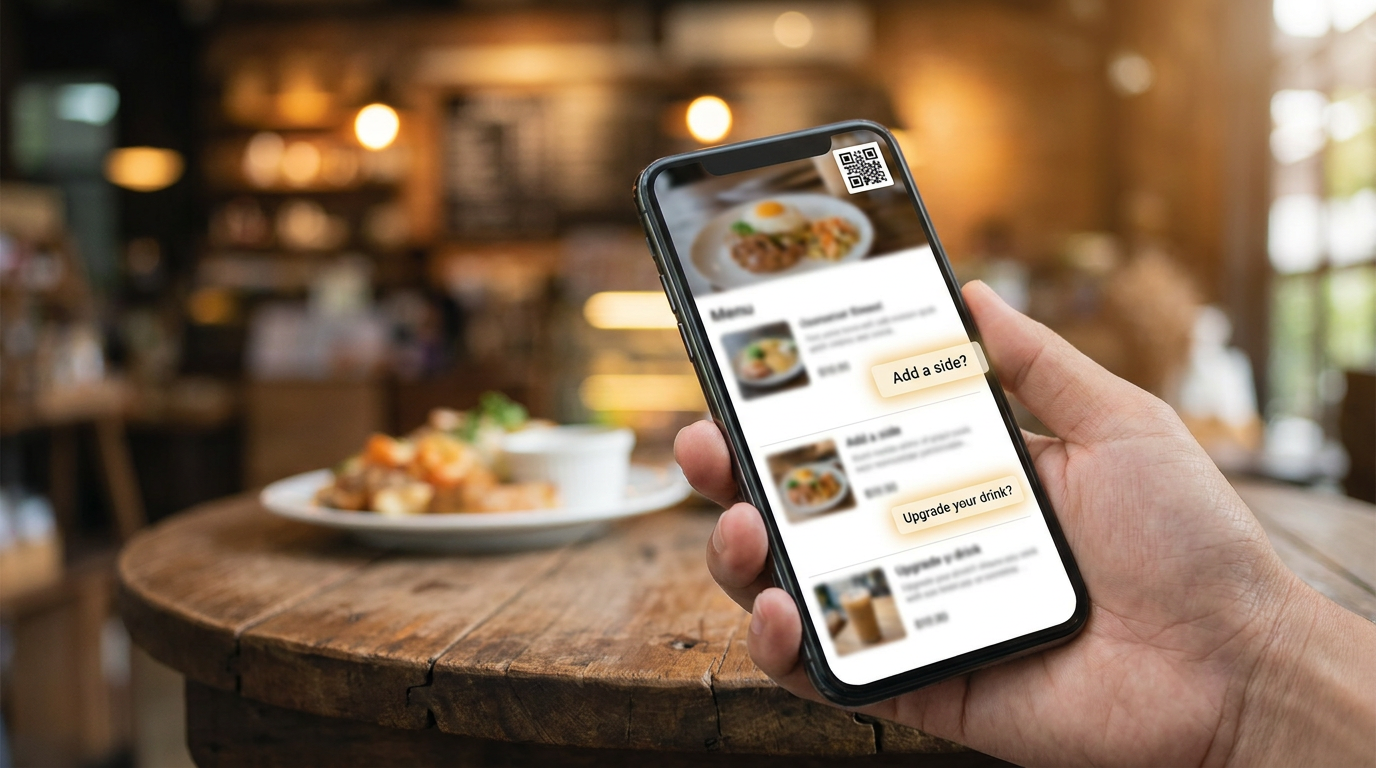
7 subtle QR menu upselling techniques that lift AOV without triggering resistance.
TL;DR — Key Takeaways
The best QR menu upsells feel like recommendations, not sales. "Pairs beautifully with..." beats "Add for $4!" — the suggestion approach lifts AOV without triggering resistance.
Seven proven upsell patterns: paired suggestions, dish-specific drink recommendations, automatic add-on prompts at checkout, "frequently ordered together" surfacing, dietary-friendly add-ons, premium ingredient swaps, and dessert prompts at meal completion.
The right upsell position is at the dish itself (suggesting compatible items), not at checkout (annoying friction at the wrong moment).
AI-driven dish recommendations — surfacing pairings based on what the guest is already ordering — outperform static "you may also like" patterns by 15-25%.
Tourist guests respond to upsells differently than locals — wine and side dish attach rates are typically 20-30% higher among international tourists when presented with pairing suggestions.
How do you upsell without sounding pushy on a digital menu?
The key insight: upselling that feels like helpful recommendation works; upselling that feels like sales pressure does not.
What works:
Recommendations framed as suggestions, not demands
Pairing logic that makes culinary sense (wine with the matching cuisine, side that complements the main)
Subtle visual cues, not aggressive pop-ups
Easy dismissal — guests can decline without friction
What does not:
Pop-up modals that block the menu view
"Limited time!" or "Last chance!" pressure language
Required-step add-on screens that block proceeding
Upsells that do not make culinary sense (random "popular item" prompts)
The framing shift: Instead of "Add fries for $4!" → "Pairs beautifully with our hand-cut fries — €4 supplement". Same offer, framed as recommendation rather than sales pressure. The conversion is typically 2-3x higher with the recommendation framing.
What is the highest-converting position for an upsell prompt?
The 2026 data on upsell positioning:
Highest-converting position: at the dish itself
"Suggested pairings" or "Often ordered with" appearing on the dish detail
Guest is already engaged with the dish; suggestions feel relevant
Adds to existing decision rather than interrupting
Medium-converting: in the dish category."Most popular sides for [main]" surfacing in the sides section. Works when the guest browses sides separately.
Lower-converting: at checkout. Last-second prompts before order placement. Often feels like friction. Sometimes works for desserts and drinks but generally less effective.
Lowest-converting: pop-ups during menu browsing. Interrupts the menu experience. Often dismissed reflexively. Can drive guests away from the menu entirely.
The 2026 best practice: Concentrate upsell logic at the dish detail level. Surface compatible items as recommendations. Avoid checkout-time interruptions and pop-ups during browsing.
Should pairings be automatic or opt-in?
Automatic suggestion (visible on every dish) generally outperforms opt-in (guest has to ask).
Why automatic works: Guests do not know to ask for pairings if they are not surfaced. Surfacing creates demand that would not exist otherwise. The default-to-suggest model feels welcoming.
Why opt-in underperforms: Most guests do not seek out pairings. The pairings get lost in the menu. Lower discovery means lower conversion.
The 2026 implementation: Every main dish shows 1-2 suggested pairings inline. Suggestions are dish-appropriate (wine pairings on dishes that need wine; side suggestions on dishes that need sides). Suggestions are subtle (small text, not bold pop-up). Easy to ignore, easy to act on.
How does AI recommend dishes that actually convert?
AI-driven recommendation systems in modern menu platforms surface pairings based on:
1. What the guest is currently viewing. A wine recommendation appears on the dish that needs wine, not on a dish that does not.
2. What other guests typically order with this dish."Frequently ordered together" patterns surface across guests.
3. The guest's dietary preferences (if known). A vegetarian guest gets vegetarian pairing suggestions.
4. Menu balance. If a guest has ordered a heavy dish, the system suggests a lighter side rather than another heavy item.
5. Time of day and service period. Lunchtime upsells differ from dinner upsells.
The conversion lift: AI-driven recommendations consistently outperform static "you may also like" by 15-25% in tested data. The mechanism: relevance.
Intermenu supports AI-driven pairing recommendations that surface contextually based on the guest's current dish view, with operator-controllable rules and override capability.
What upsells work for tourists vs locals?
The 2026 data shows meaningful differences:
Tourist upsells that convert well:
Wine pairings (tourists often want recommendations)
Side dishes (tourists often do not know what is typically ordered together)
Desserts (tourists often want to complete the experience)
Local specialty additions ("add a tasting of regional cheeses")
Cocktail and aperitivo add-ons before the meal
Tourist upsells that convert poorly:
Quantity upgrades ("super-size your dish") — feels Western fast-food
Bundled "deals" — feels like a quick-service strategy
Loyalty-based upsells (tourists are usually one-time guests)
Local upsells that work well:
Loyalty-tied perks
Bundled value (better pricing for combinations)
Seasonal specialties (locals notice seasonal changes)
Familiar add-ons (the standard sides locals expect)
The implementation: Modern menu platforms can surface different upsell strategies based on whether the guest appears to be a tourist (language other than local, recent first-scan, etc.). The result: each guest sees the upsells most likely to resonate with them.
Seven proven QR menu upsell patterns
1. Paired drink suggestions
On main courses: "Pairs with: [specific wine] / [specific beer]". Tourist effect: typically lifts wine attach 20-30%. Local effect: typically lifts wine attach 10-15%.
2. Side dish recommendations
On mains: "Often ordered with: [side dish]". Surfaces side dishes guests might not have considered. Side attach rate often lifts 15-20%.
3. Premium ingredient swap
On dishes with premium options: "Upgrade to [premium ingredient] for €4". Frame as upgrade, not extra. Conversion typically 8-12% on offered upgrades.
4. Dietary-friendly substitutions
For guests filtering for dietary preferences: "Make it gluten-free for €1" / "Add vegan cheese instead". Builds loyalty among dietary-restricted guests.
5. Frequently ordered together (cross-recommendations)
On dishes: "Guests who ordered this also enjoyed: [related dish]". Surfaces hidden pairings the menu would not otherwise suggest. Conversion lift typically 10-15%.
6. Dessert prompt at meal completion
In the order flow, after main: "Complete your meal: [dessert suggestions]". Better than dessert prompts during initial browsing. Conversion 15-25% on offered desserts.
7. Aperitivo / pre-meal prompt at QR scan
When the guest first scans: "Start with our chef's aperitivo? €8". Captures the often-skipped pre-meal moment. Conversion 5-15% in tourist-area restaurants.
How to test which upsells work in your specific restaurant
A practical 30-day testing protocol:
Week 1 — Baseline measurement
Before introducing any new upsell logic. Measure current AOV, attach rates per category, top-ordered combinations.
Week 2 — Implement first upsell
Pick one upsell pattern from the seven above. Implement on the relevant dishes. Track changes in attach rate and AOV.
Week 3 — Measure and iterate
Compare to baseline. If positive: extend the pattern to similar dishes. If neutral or negative: try a different upsell pattern.
Week 4 — Implement second pattern
Add a second non-conflicting upsell pattern. Track combined effect. Document what worked and what did not.
After 90 days of disciplined testing, most restaurants identify 3-4 upsell patterns that work specifically for their cuisine, demographic, and service style. The compounding effect on AOV is typically 10-18%.
Frequently Asked Questions
How do you upsell without sounding pushy on a digital menu?
Frame as recommendations, not sales pressure. "Pairs beautifully with..." beats "Add for $4!" The suggestion framing typically converts 2-3x better.
What is the highest-converting position for an upsell prompt?
At the dish itself. Surface compatible items as recommendations on the dish detail.
Should pairings be automatic or opt-in?
Automatic. Surfacing creates demand that would not exist otherwise.
How does AI recommend dishes that actually convert?
Based on what the guest is viewing, what other guests order together, dietary preferences, menu balance, time of day. AI-driven recommendations outperform static patterns by 15-25%.
What upsells work for tourists vs locals?
Tourists: wine pairings, side dishes, desserts, local specialties. Locals: loyalty perks, bundled value, seasonal specialties.
Add Smart Upsell Prompts to Your Menu
Upselling on a QR menu is one of the highest-leverage AOV moves available in 2026 — when implemented as recommendation rather than sales pressure.
Intermenu supports the seven upsell patterns above with structured fields per dish (suggested pairings, premium swaps, frequently-ordered-together) and AI-driven contextual recommendations.
If your menu has been static add-ons for years, see what subtle, dish-relevant upsells can do for your AOV →