
The 80/20 Menu: Cut Your Menu in Half and Increase Profit
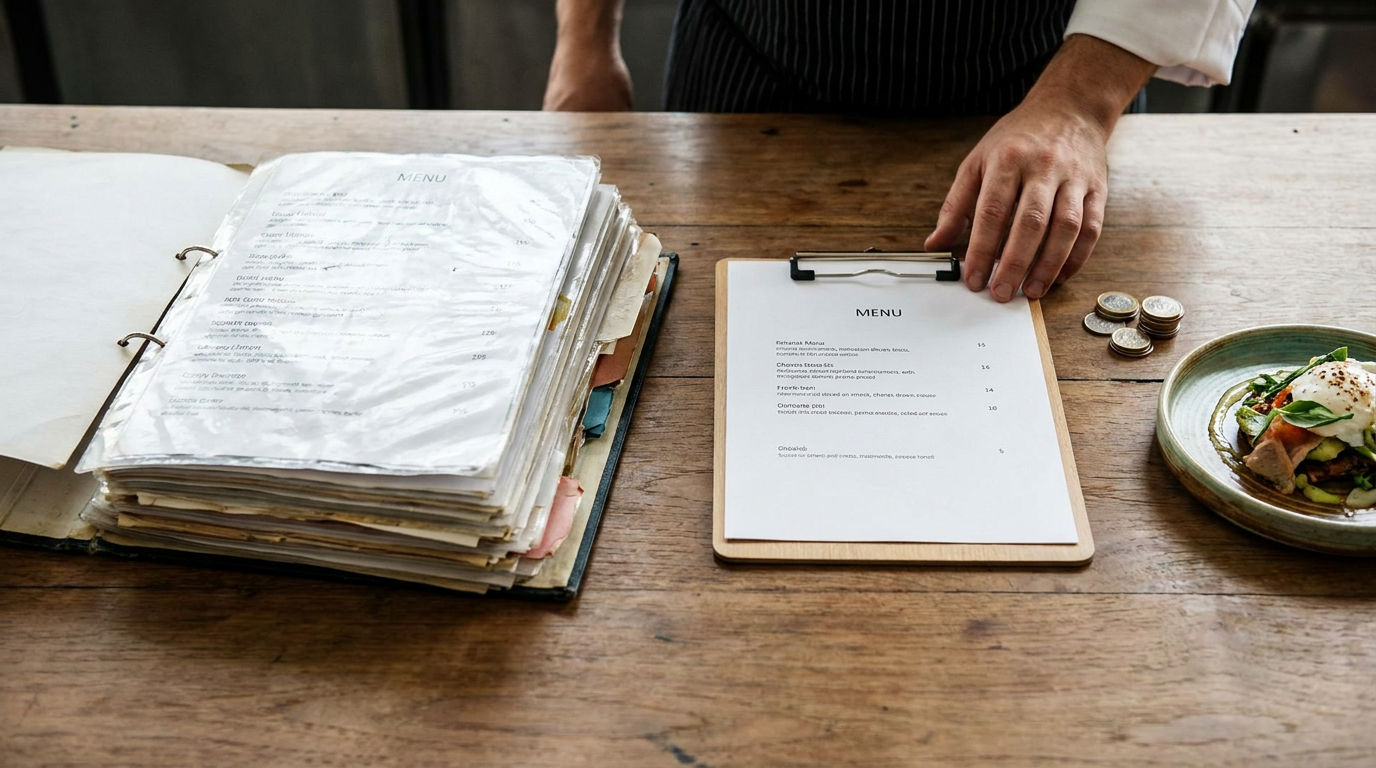
The 80/20 menu cut: how to reduce menu items, lift average check, and run a leaner kitchen. Framework, A/B protocol, and a real 60-to-30-item case study.
TL;DR — Key Takeaways
The 80/20 principle holds in restaurant menus: roughly 20% of dishes drive 80% of orders. Cutting the bottom-performing 50% of items typically lifts profit margins, kitchen efficiency, and guest experience simultaneously.
Most independent restaurants in 2026 are running menus that are too long. The optimal range is 25-40 items total; many menus carry 60-100, with the bottom half producing minimal revenue.
Shorter menus reduce decision fatigue (guests order with more confidence), improve kitchen efficiency, simplify supplier relationships, and lift average margin per cover.
The right cut decision combines popularity data (what gets ordered), profitability data (margin per dish), and strategic role (signature dish vs commodity).
A digital menu shows which dishes guests open and which nobody opens. Set that beside order counts from your POS and margins from your cost cards, and the cut candidates stand out.
Why do shorter menus often outperform longer ones?
Five specific mechanisms in 2026:
1. Decision fatigue reduction
Guests faced with 100+ items often default to safe-familiar choices, undermining the menu's revenue potential. With 25-40 well-curated items, every dish gets considered.
2. Kitchen efficiency
A kitchen running 35 dishes is meaningfully more efficient than one running 80. Less prep waste, fewer specialized ingredients, faster service times, lower labor cost per cover.
3. Quality consistency
A kitchen that runs 35 dishes well is almost always better than one running 80 inconsistently. The shorter menu enables the chef to perfect each dish.
4. Supplier consolidation
Fewer dishes means fewer specialized ingredients, simpler supplier relationships, better volume pricing, and more predictable inventory.
5. Brand clarity
A 30-dish menu communicates a clear identity. A 100-dish menu feels like a cuisine catalog rather than a curated experience.
The 2020 vs 2026 trend
The "extensive menu" model (Cheesecake Factory, IHOP, generic American chain) has lost share to focused-menu approaches across most restaurant categories. Modern operators understand that menu length correlates negatively with quality and profitability above a certain point.
Optimizing Hotel F&B Menu Management for 2026 Success
How do I decide which dishes to cut?
The 2026 decision framework combines four dimensions:
1. Popularity (orders per service period)
Look at the per-dish order count across the past 90 days. Identify dishes ordered fewer than X times — where X is your "this isn't worth running" threshold (typically 20-50 orders per quarter for a 50-cover restaurant).
2. Profitability (margin per dish)
Combine sale price with food cost. Identify dishes with margins below your threshold (typically 60-65% gross margin).
3. Strategic role
Some dishes earn their place beyond pure economics:
Signature dishes that define the restaurant's identity
Cuisine essentials that diners expect (a steakhouse must have steak)
Anchor pricing dishes that make other items look reasonable
Dietary-essential items (vegetarian options for diverse parties, gluten-free for celiac guests)
4. The "high-view, low-order" diagnostic
Some dishes get opened often on the menu but rarely show up in your POS sales. These aren't "dogs" — they're "puzzles" with description, photo, or pricing problems. Try fixing them before cutting.
The cut decision matrix
Low orders + low margin + no strategic role = cut
Low orders + low margin + has strategic role = keep but consider modification
Low orders + high margin + has strategic role = keep, improve description and visibility (likely a "puzzle")
High orders + low margin = "plowhorse" — improve margin or accept the role
Run this analysis quarterly and the menu stays optimized.
Menu Engineering 2026 — How to Design a Menu That Sells
Will customers complain when favorites disappear?
Some will. The patterns:
The honest reality
Long-time regulars notice when their dish disappears
Some loyal customers shift to competitors when favorites vanish
The complaint rate is higher than operators expect
The mitigation
1. Communicate the change. A brief note ("The summer menu is here — we've made room for new seasonal dishes by retiring some of last season's favorites") sets expectation correctly.
2. Keep true signatures. Don't cut dishes that are the reason customers come. The cut targets are low-popularity dishes, not signatures.
3. Offer occasional return engagements."We've brought back the Saturday gnocchi for one weekend only" — turns a cut dish into a marketing moment.
4. Listen to feedback. If a cut dish triggers visible customer disappointment, consider reviving it — the menu engineering math should serve the business, not override real customer preference.
5. Document the data. When a regular complains, you can show "this dish was ordered 12 times in the past quarter; we made room for [new dish] which is already at 40 orders." Data communicates better than apologetic intuition.
How do you A/B test a shorter menu?
A practical 60-day testing protocol:
Days 1-15: Document the baseline
Total menu length
Per-dish order counts (past 90 days)
Per-dish margins
Average check size
Guest count and timing patterns
Days 16-30: Identify the cut candidates
Dishes in the bottom 50% by order count
Dishes with margin below threshold
Dishes with no strategic role
Discuss with chef and front-of-house team
Days 31-45: Implement the cut
Remove 20-30% of menu items
Update digital menu (instant)
If keeping printed menus, do a fresh print run reflecting the cuts
Brief the team on the change
Days 46-60: Measure the impact
Average check size — should rise (guests order more confidently from focused menu)
Per-dish order counts — should rise on remaining items as orders concentrate
Kitchen efficiency — should improve (less prep, faster service)
Profit margin — should rise
If the metrics don't move, the cut may have been too aggressive or hit dishes with hidden strategic value. Iterate.
Restaurant AI Search Optimization: Boost Your Visibility
What's the ideal menu size by restaurant type?
The 2026 benchmarks:
Quick-service / fast-casual: 8-15 items
Limited menu enables fast preparation and service
Focus on operational efficiency
Casual neighborhood restaurant: 25-35 items
Enough variety to satisfy regulars
Manageable for kitchen quality
Mid-tier restaurant / bistro / trattoria: 30-45 items
Each category 5-7 items
Allows for daily specials beyond the main menu
Fine dining: 20-35 items
Curated, focused
High quality across the menu
Room for tasting menu / chef's table on top
Diner / 24-hour casual: 50-100 items
Breadth justified by guest expectations and time-of-day variations
Operational complexity accepted as part of the format
Specialty restaurant (single-cuisine focus): 15-30 items
Deep on the cuisine, narrow on category breadth
Quality through focus
The point: there's no universal right answer. The right size depends on the format, the guest expectations, and the kitchen's capacity for quality. Delivery is a format of its own again — see how many items each delivery category should carry.
What's almost universal: above 100 items, quality and kitchen efficiency suffer. Most restaurants in this range benefit from cutting.
How Photos on a Menu Increase Sales by 30% (And When They Hurt You)
A real case study: 60 items to 30 items
A composite case study based on multiple real restaurant transitions:
The starting state
Family-style Italian restaurant
60 dishes across 7 categories
Average check: €32
Inconsistent kitchen quality
Long ticket times during peak service
The audit findings
Top 20 dishes drove 78% of orders
Bottom 30 dishes drove only 12% of orders
8 dishes were ordered fewer than 5 times per month
Several "menu filler" dishes had below-target margins
The cuts (over 60 days)
Cut 10 lowest-volume dishes (zero impact on guest count)
Cut 6 below-margin dishes (minor positive on profitability)
Cut 4 dishes that were essentially duplicates of others
Total cuts: 20 dishes; remaining: 40
The first 90 days post-cut
Average check: €37 (+15%)
Per-dish order counts on top items: +25%
Kitchen ticket time: -18%
Food cost percentage: -3 points
Customer complaints about cuts: minimal (3-4 over the period)
The second-caycle decision
After 6 months, cut another 5 dishes that hadn't picked up
Final menu: 35 dishes
Average check sustained at €37+
This case is composite but tracks closely with reported data from multiple actual restaurants making similar transitions. The pattern: meaningful cuts (20-40% of menu items) typically produce measurable lifts in margin, AOV, and operational efficiency.
Sustainable Restaurant Menu: Save Paper and Go Digital Today
Find Your Hidden Bestsellers With QR Analytics
The 80/20 menu cut decision used to be a guessing game. In 2026, it's a measurement: which dishes earn their place, which don't.
Intermenu shows which dishes guests open, and lists the dishes nobody opened. Your POS supplies the order counts and your cost cards the margins. Put them side by side and the cut decision becomes data-driven rather than intuitive.
If your menu has been "the same for years" and you suspect some dishes are dead weight, see what data-driven menu pruning looks like.
Frequently Asked Questions
Why do shorter menus often outperform longer ones?
Decision fatigue reduction, kitchen efficiency, quality consistency, supplier consolidation, brand clarity. Five compounding mechanisms.
How do I decide which dishes to cut?
Combine popularity (orders per period), profitability (margin per dish), strategic role, and the high-view-low-order diagnostic. Cut low-popularity + low-margin + no-strategic-role dishes first.
Will customers complain when favorites disappear?
Some will. Mitigation: communicate the change, keep true signatures, offer occasional return engagements, listen to feedback, document the data.
How do you A/B test a shorter menu?
60-day protocol: document baseline, identify cut candidates, implement the cut, measure impact across check size, per-dish order counts, kitchen efficiency, profit margin.
What's the ideal menu size by restaurant type?
Quick-service 8-15, casual neighborhood 25-35, mid-tier bistro 30-45, fine dining 20-35, diner 50-100, specialty restaurant 15-30. Above 100, quality typically suffers.