
Sustainable Restaurant Menu: Save Paper and Go Digital Today
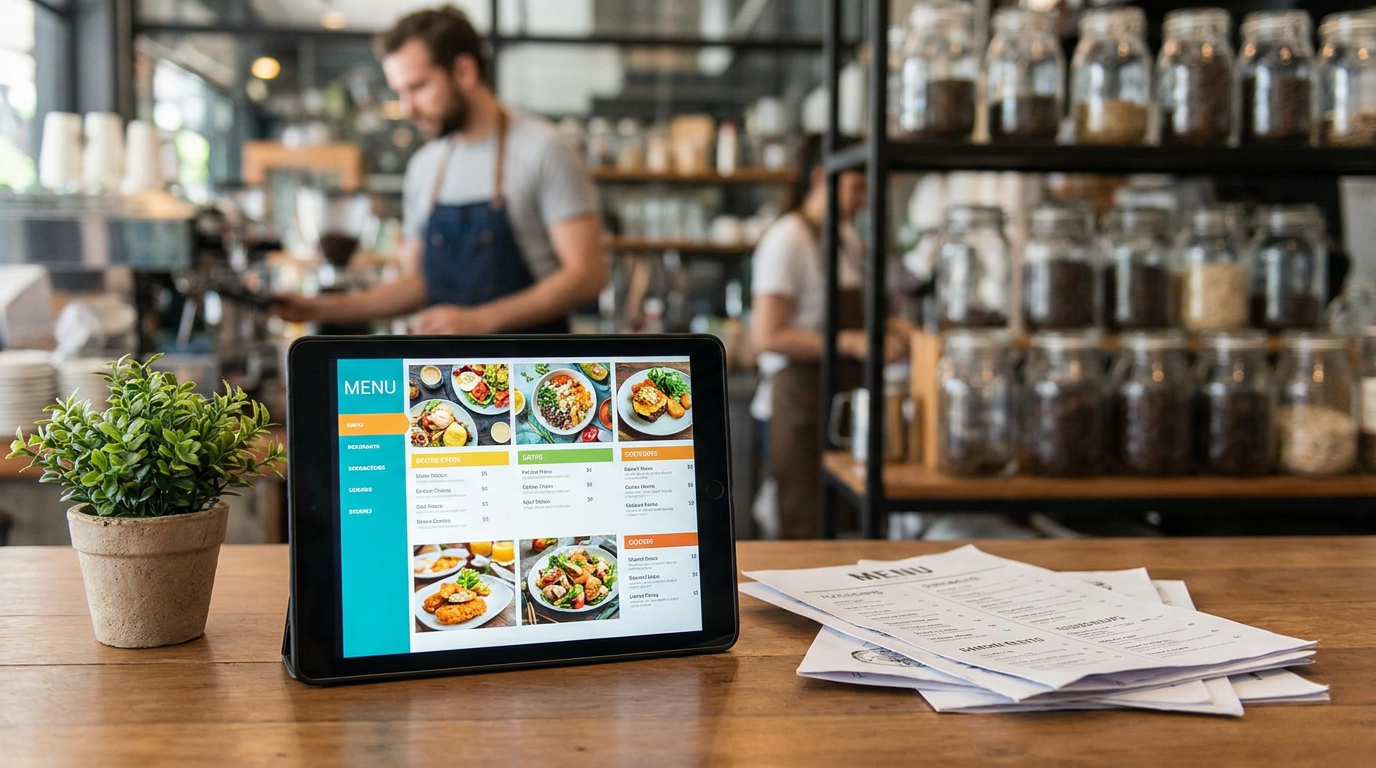
How digital menus reduce paper, carbon, and food waste — the 2026 sustainability story for restaurants.
TL;DR — Key Takeaways
A typical 50-cover restaurant in 2026 prints 2,000-5,000 menus per year for new editions, version updates, banquet events, and per-table replacements. The cumulative paper, ink, energy, and shipping carbon is significant.
Switching to digital menus eliminates 95%+ of menu-related paper consumption and meaningfully reduces the restaurant's overall carbon footprint.
Even when accounting for the energy cost of phone screens during menu reading, digital menus are dramatically more sustainable than printed menus across their lifecycle.
Guests increasingly notice and care about sustainability — 53% of diners in 2026 say they prefer restaurants with visible sustainability commitments, and 28% say it influences their booking decision.
Restaurants can showcase their sustainability efforts directly in the menu — sourcing transparency, seasonal ingredient highlights, carbon labeling on dishes — using structured menu data.
How much paper does the average restaurant print per year?
The honest 2026 numbers for a typical 50-cover sit-down restaurant:
Per-edition print run:
100-250 menus per print run (covers all tables plus host stand backup)
Multilingual versions multiply this (5 languages × 200 menus = 1,000 menus per edition)
Edition frequency:
Major menu changes: quarterly to seasonally
Minor updates: monthly to weekly
Daily specials: often printed daily on per-table cards
Annual print volume:
Single-language menu, 4 seasonal updates: 800-1,000 menus/year
Multilingual menu, 4 seasonal updates: 4,000-5,000 menus/year
Plus: daily specials, banquet menus, takeaway menus, business cards
The cumulative environmental cost: Paper: 50-200 kg of paper per year for a typical multilingual operation. Ink: 1-3 liters of ink per year. Shipping: regular delivery from print shop to restaurant. Energy for printing operation. Eventual disposal (most menus end up in landfill or incinerated).
For a single restaurant this is a small contribution to global waste; multiplied across millions of restaurants globally, it's significant.
What's the carbon footprint of a printed menu vs a QR menu?
A reasonable lifecycle analysis:
Printed menu (per menu)
Paper production: ~5-15 grams CO2e
Ink and printing: ~3-8 grams CO2e
Shipping from print shop: ~5-10 grams CO2e
Disposal: ~2-5 grams CO2e
Total per menu: ~15-40 grams CO2e
For a restaurant printing 4,000 menus/year: Annual carbon: 60-160 kg CO2e just from menus, plus the resource cost (water, trees, etc. used in paper production).
QR digital menu (per scan)
Server energy to host the menu: ~0.05-0.15 grams CO2e per scan
Network transmission: ~0.1-0.3 grams CO2e per scan
Phone display energy: ~0.5-1.5 grams CO2e per scan (allocated proportionally to menu viewing)
Total per scan: ~0.7-2 grams CO2e
For a restaurant with 24,000 covers/year (most scanning the menu): Annual carbon: 17-48 kg CO2e from menu hosting and scanning.
The comparison
Digital menus produce ~25-40% the carbon of printed menus across a typical restaurant operation, even when accounting for phone screen energy. The gap is largest for multilingual operations (where digital eliminates the need to print multiple language versions). For single-language operations the gap is smaller but still favors digital.
Is digital really more sustainable when you account for device energy?
Yes — the analysis above includes phone screen energy.
The intuition that "printing paper is bad but using phones is also bad" misses the math:
Phone screens are already on. Diners using phones during a meal would be using the phone with or without scanning a menu. The marginal energy cost of menu viewing (a few minutes of additional screen time) is small.
Paper menus require continuous production. Every menu update means new printing. Phones don't need replacement for menu use.
Disposal asymmetry. Paper menus eventually become waste. Phone-based menu access doesn't add disposal burden.
Server hosting is energy-efficient. Modern web hosting runs on increasingly renewable energy. Cloud-hosted menu data has a low and decreasing carbon footprint.
The cumulative effect: digital menus consistently produce lower lifetime carbon than printed menus across realistic restaurant operations.
Do guests care about menu sustainability?
Increasingly, yes.
The 2026 data:
53% of diners say they prefer restaurants with visible sustainability commitments
28% of diners say sustainability influences their booking decision
41% of diners say they'd pay slightly more for clearly-sustainable dining
Younger demographics (under-35) weight sustainability significantly higher than older demographics
What sustainability means to guests in 2026: sourcing transparency (where do ingredients come from?), reduced waste (food waste, packaging, paper), local/seasonal eating, animal welfare (where applicable), ethical labor practices, reduced carbon footprint.
The implication for restaurants: a sustainability story is no longer just internal good practice — it's a guest-facing brand asset.
How can a menu showcase the restaurant's sustainability efforts?
Five specific menu features that communicate sustainability:
1. Sourcing transparency
Per dish: where the key ingredients came from."Tomatoes from [local farm]," "fish from [sustainable supplier], certified by [certification body]."For coffee, cocoa, palm oil, soy and beef, that provenance is becoming a legal record as well — see the EUDR and restaurant sourcing.
2. Seasonal indicators
Per dish: which season the dish belongs to, or which ingredients are seasonal. Guests appreciate the "we're cooking what's in season" framing.
3. Carbon labeling
For sustainability-leading restaurants: per-dish carbon estimates ("low," "medium," "high"). Some restaurants are starting to add this in 2026; mainstream by 2028 likely.
4. Waste-reduction commitments
A note on menu about kitchen waste reduction:"We compost all kitchen waste; our paper menu has been replaced by this digital one."
5. Allergen / dietary filtering
Counter-intuitively, allergen and dietary filtering supports sustainability: it reduces order errors (less wasted food) and helps guests with specific dietary preferences (often plant-based) find the right dishes.
Intermenu supports sourcing fields, sustainability indicators, and structured dietary tags — all rendered in every language your guests read so a guest in any market sees the sustainability story consistently.
The 2026 sustainability story for digital menus specifically
Beyond paper reduction, digital menus support sustainability in ways printed menus can't:
Allergen and dietary filtering lets guests find suitable options without wasted ordering or comp meals.
Real-time menu updates mean the kitchen can adjust based on ingredient availability — using up surplus, avoiding waste, featuring seasonal items at peak.
Analytics-driven menu engineering identifies dishes with poor sell-through (a sustainability concern beyond pure economics) and supports the cuts.
Multilingual access means international guests order more confidently — fewer wrong orders, less wasted food.
Allergen safety prevents the food-waste cost of allergic-reaction comps and replacements.
The cumulative effect: digital menus are a sustainability tool, not just an efficiency tool. The food-waste-reduction case alone often justifies the platform cost.
Frequently Asked Questions
How much paper does the average restaurant print per year?
50-200 kg/year for typical multilingual operations. 4,000-5,000 menus/year for a 50-cover restaurant with quarterly seasonal updates in 5 languages.
What's the carbon footprint of a printed menu vs a QR menu?
Per menu: 15-40 grams CO2e for printed; 0.7-2 grams CO2e per scan for digital. Digital produces ~25-40% the carbon of printed across a typical operation.
Is digital really more sustainable when you account for device energy?
Yes. Phone screens are already on; the marginal energy cost of menu viewing is small. Paper menus require continuous production and disposal; phones don't.
Do guests care about menu sustainability?
Increasingly. 53% prefer sustainability-committed restaurants; 28% factor sustainability into booking decisions; 41% would pay slightly more for clearly-sustainable dining.
How can a menu showcase the restaurant's sustainability efforts?
Sourcing transparency per dish, seasonal indicators, carbon labeling (emerging), waste-reduction commitments, structured dietary filtering, visible icons.
Go Paperless
The sustainability case for digital menus is no longer just "trees are good." It's a multi-dimensional story: paper reduction, food waste reduction, carbon reduction, dietary inclusion, and transparent sourcing.
Intermenu supports the full sustainability story — multilingual structured menu, allergen and dietary tagging, sourcing fields per dish, real-time updates that match ingredient availability.
If sustainability is a brand priority for your restaurant, see what the digital menu can communicate →