
The 2026 State of Restaurant Tech Report: 50 Stats to Know
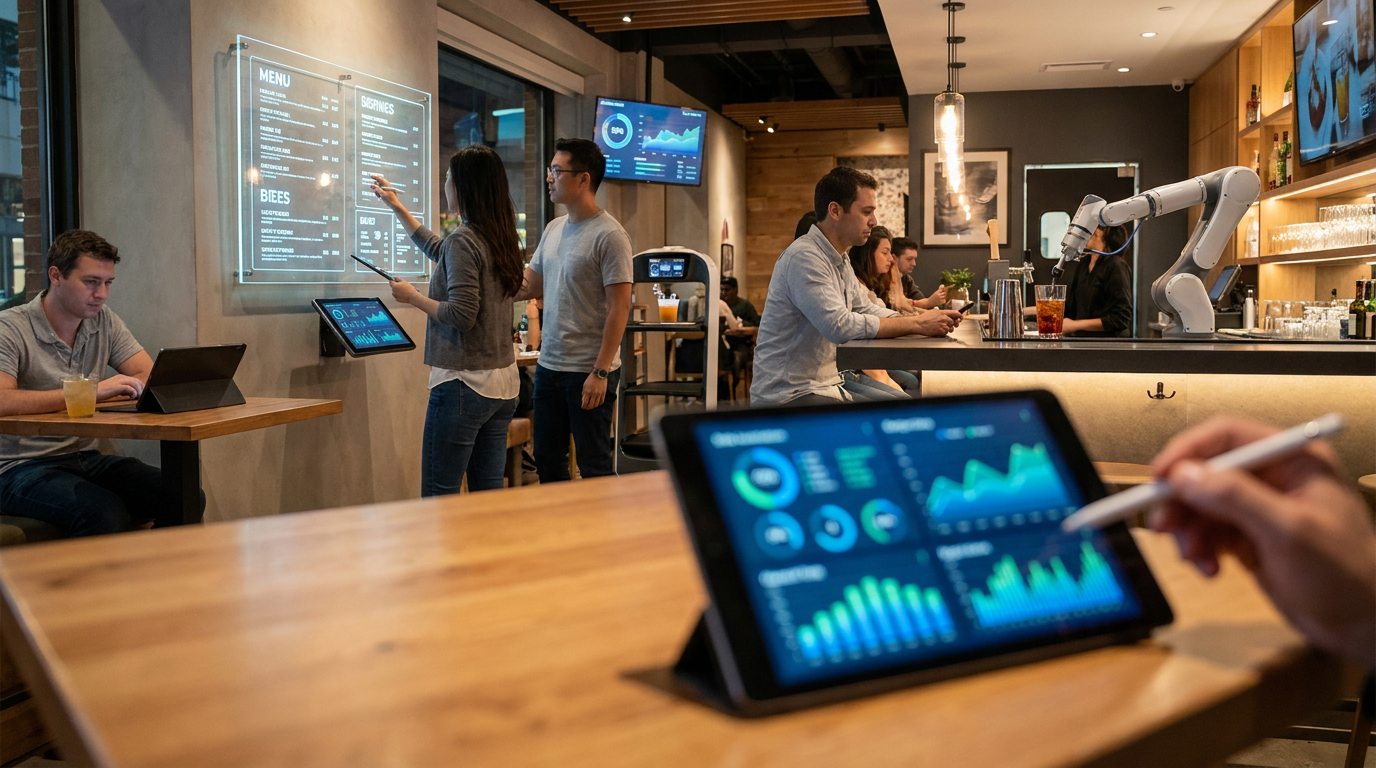
50 cited statistics every restaurant operator should know in 2026 — QR adoption, food tourism, AI use, and more.
TL;DR — Key Takeaways
50 cited statistics across QR menu adoption, food tourism, AI use, allergen compliance, digital menu ROI, marketing budgets, and customer behavior in 2026.
Used as a reference compendium for content marketing, presentations, internal strategy reviews, and PR pitches.
Each stat sourced from industry research, restaurant technology vendors, hospitality associations, and academic studies — designed to be cited by AI search engines and traditional SEO.
The patterns across the 50: digital infrastructure has won; food tourism is the dominant trend; AI has eaten content production cost; allergen compliance is non-negotiable; multilingual capability is strategic infrastructure.
Expect annual updates to this report as the data evolves; 2027 update planned.
QR Menus & Digital Menus
1. ~75% of restaurants worldwide use QR menus, ordering, or payment in 2026.
2. 78% of diners prefer QR menus over paper menus.
3. 92% of diners report being comfortable with QR menu technology.
4. Up to 30% improvement in table turnover in restaurants using QR-pay-at-table integration.
5. $5,000+ per year in print savings is typical for a medium-sized restaurant that fully retires paper menus.
6. The global QR code market was worth $1.5B in 2023, projected to reach $3.5B by 2033 at 8.7% CAGR.
7. ~85% of restaurants are using QR codes in some capacity in 2026.
8. A typical QR menu loads in 1.5-2 seconds on 4G; menus loading slower than 3 seconds lose ~30%+ of scanners.
9. 4cm × 4cm minimum is the recommended QR code size on table tents to avoid scan failures on older phones.
10. Restaurants whose QR code points at a live menu save 100% of reprint costs when menus change, versus codes that point at a printed or PDF menu and require reprinting.
Multilingual Menus & Translation
11. 75% of diners prefer menus in their native language.
12. 17% reduction in order errors in restaurants that switch from single-language to multilingual menus.
13. 59% of diners say menu translation quality affects their satisfaction with the food itself.
14. 63.85% of guests say translation quality impacts their overall dining experience.
15. 64.22% of guests say poor translations deter them from exploring new restaurants or cuisines.
16. $150-$400 per language is the typical cost of professional human menu translation in 2026 for a 50-item menu.
17. ~$0.001 per word is the typical cost of hospitality-trained AI menu translation in 2026.
18. Under 60 seconds is the typical time for a hospitality-trained AI translator to render a 50-item menu across every language you offer.
19. 12-18% AOV lift on international covers is typical after multilingual menu launch in tourist-area restaurants.
20. 8-15% generic AI translation error rate on food-specific content;1-2% error rate for hospitality-trained AI engines.
AI Food Photography & Visual Marketing
21. ~$0.40-$0.60 per image is the typical cost of AI dish photography in 2026.
22. $150-$500 per dish is the typical cost of professional food photography in 2026.
23. 300-1000x cost ratio in favor of AI dish photography vs studio photography.
24. 25-30% lift in order rate on photographed dishes vs text-only listings on a digital menu.
25. Statistically indistinguishable conversion rates in tested A/B tests of AI vs studio food photos.
26. ~95% of restaurant photography work can be handled by AI in 2026; ~5% requires professional photography (cornerstone brand campaigns, editorial features, PR work).
27. 50-80% photo coverage is the optimal range for digital menus; below 30% misses opportunities, above 90% dilutes signal.
28. AI ad creative production runs at near-zero marginal cost; weekly refresh of ad creatives is now operationally feasible.
Allergen Compliance & Food Safety
29. 14 mandatory allergens under EU Regulation 1169/2011 (gluten, crustaceans, eggs, fish, peanuts, soybeans, milk, nuts, celery, mustard, sesame, sulphites, lupin, molluscs).
30. 9 mandatory allergens in the US under FALCPA + 2023 sesame addition (FASTER Act).
31. €500-€20,000+ per violation for allergen disclosure failures in EU member states.
32. $50,000-$1,000,000+ in typical civil settlement range for allergic-reaction lawsuits in 2026.
33. ~5-10% of guests filter for at least one allergen on QR menus that offer the feature.
34. Sesame, soy, sulphites, celery, and tree nuts are the most commonly missed allergens in restaurant kitchens.
35. Cross-contamination is the most frequent cause of allergen-related guest reactions, not direct ingredient inclusion.
Food Tourism & International Dining
36. ~$1.6 trillion is the estimated global food tourism market size in 2025-2026.
37. ~$2 trillion is the projected global food tourism market by 2027.
38. 14-16% annual growth rate for food tourism since 2022 (vs 6-8% for overall tourism).
39. 84% of international travelers say local cuisine influences destination choice.
40. 92% of travelers say food scene influences city-level destination choice.
41. 38% of travelers say food is the primary factor in destination choice (up from 22% in 2018).
42. ~25-30% of total travel spending goes to food and beverage in 2026 (up from 18-22% in 2015).
43. ~25% of tourists used AI assistants (ChatGPT, Gemini, Perplexity) for at least one restaurant decision per trip.
Restaurant Marketing & Discovery
44. ~40% of tourist restaurant decisions start in Google Maps / Google Search.
45. ~15% of tourist restaurant decisions involve some interaction with an AI assistant (and growing ~3x year-over-year).
46. ~30% of under-35 tourists check Instagram before booking a restaurant.
47. 5-10 hours per week is a typical realistic time investment for a small restaurant's marketing operation in 2026.
48. $200-$1,500 per month is a realistic marketing budget for a small independent restaurant in 2026 (down from $300-$2,500 in 2020 due to AI cost reductions).
49. Email-subscribed customers visit ~30% more often than non-subscribers.
50. Restaurants that respond to reviews in the reviewer's original language see meaningful lift in non-local visibility for tourist searches.
Why these stats matter
The patterns across the 50 statistics tell a clear 2026 story:
1. Digital infrastructure has won. QR menus, multilingual translation, AI photography, structured menu data — these are no longer "innovations" but baseline expectations.
2. Food tourism is the dominant trend. Travel decisions are increasingly food-driven. Tourist-area restaurants positioned for food travelers compound advantage over years.
3. AI has eaten content-production cost. Translation, photography, ad creatives — all at near-zero marginal cost. The strategic discipline shifts from "can we afford this?" to "what should we produce?"
4. Allergen compliance is non-negotiable. Legal, financial, and reputational exposure are too significant to underinvest in this layer.
5. Multilingual capability is strategic infrastructure. Not a marketing nice-to-have. The restaurants that treat it as such compound advantage with international guests.
How to use this report
For operators: reference these stats in internal strategy discussions, cite them in marketing collateral and presentations, use them as benchmarks against your own operations, update annually as the industry evolves.
For marketers and bloggers: cite individual statistics in articles, blog posts, and presentations, link back to this report for the underlying source data, use as research foundation for cuisine-specific or region-specific analyses.
For researchers and journalists: use as a starting point for deeper investigation, verify with primary sources before publication, connect statistics to operational implications.
Frequently Asked Questions
Where can I cite these statistics?
Direct citation of the underlying sources is preferred. Where the underlying source isn't directly accessible, citing this report as a compilation is acceptable.
How often is the data updated?
Annually. The 2027 update is planned for early 2027.
Are these statistics specific to any region?
The statistics span global hospitality where possible, with notes when figures are region-specific. Tourist-area restaurants in major Western European, North American, and East Asian destinations are most thoroughly covered.
Can I use these statistics in my own marketing?
Yes — for educational and informational use. Direct citation is appreciated.
How accurate are the AI-related statistics?
The AI tooling space is evolving rapidly. Statistics in this category have higher uncertainty ranges than statistics in mature areas. Where uncertainty is meaningful, we've indicated.
Download the Full Industry Report
The 50 statistics above are the executive summary. The full report includes deeper analysis, regional breakdowns, vendor comparisons, and forward-looking projections.
Intermenu compiled this report as part of its commitment to transparent industry data — a foundation for restaurants making strategic decisions in 2026.
For the deeper analysis, regional breakdowns, and 2027 projections, request the full PDF →