
The Restaurant Technology Stack of 2026 — What's Working, What's Hype
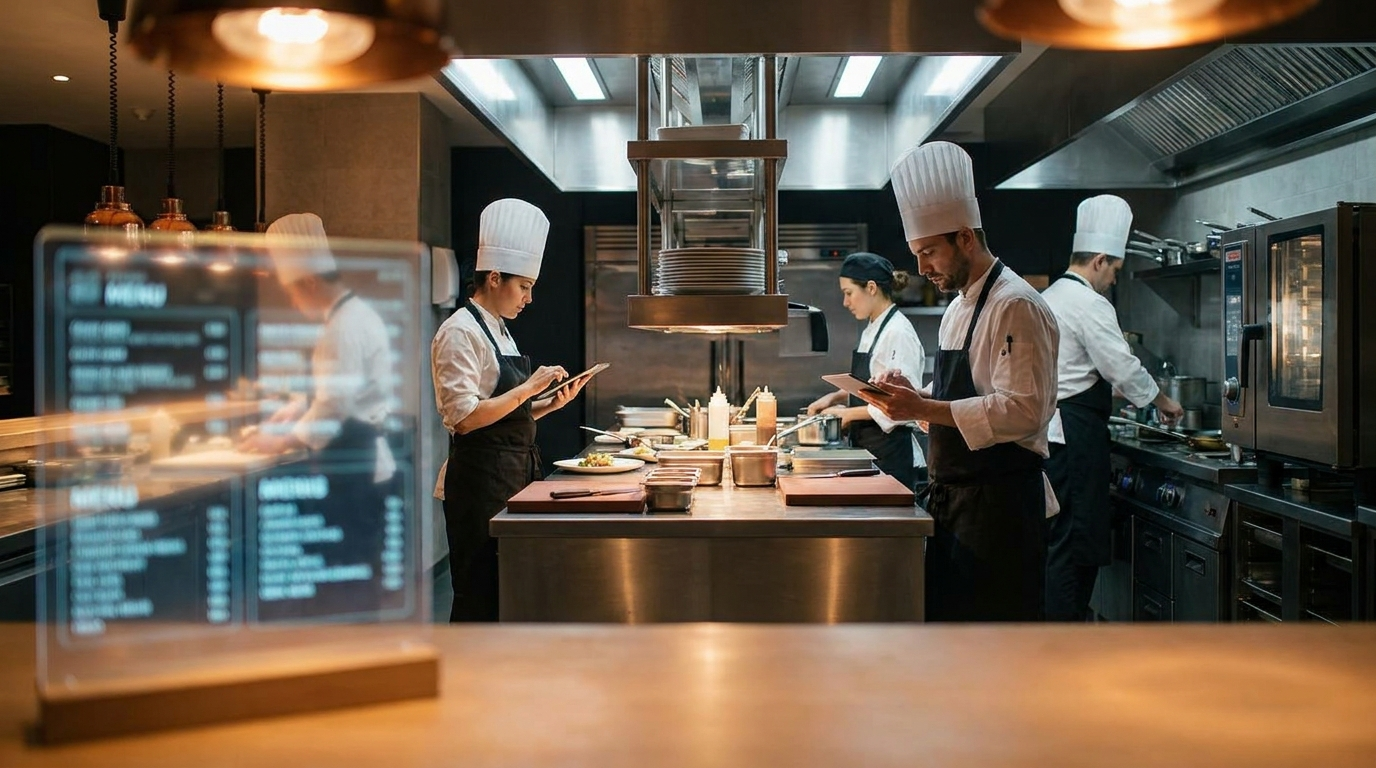
What technology does an independent restaurant actually need in 2026? Here's the working stack vs the hype.
Why the 2026 stack matters more than ever
Restaurant technology has hit an inflection point. Operators who built their stack between 2018 and 2022 typically own 8–12 separate tools that don't talk to each other — a POS, a separate menu builder, a separate translation service, a separate photography process, a separate analytics tool, a separate email tool, a separate loyalty system. The total cost of ownership is high, the integrations are fragile, and the staff training overhead grows with every new tool.
The 2026 reality is consolidation. Modern hospitality platforms now bundle 3–4 tools' worth of functionality into a single subscription, AI has eaten the content-production cost, and the tooling expectations of guests have flattened — they want fast QR menus, multilingual support, and frictionless payment regardless of which restaurant they're in. The operators who win in this environment treat technology as foundational infrastructure, not as a series of point solutions.
This pillar covers the working 2026 stack — what's essential, what's overhyped, what's worth budgeting for, and what to expect from the next 18 months of restaurant technology evolution.
TL;DR — Key Takeaways
The 2026 restaurant tech stack consolidates around 4-5 core platforms: POS, hospitality menu platform, reservations, payment processing, and accounting/analytics — down from 8-12 separate tools in the 2018 era.
The most overhyped category in 2026 restaurant tech: AI customer service chatbots. Most restaurants deploy them, find limited value, and quietly retire them within 12 months.
The most underhyped category: structured menu data (allergens, dietary tags, multilingual translation). The compounding ROI is enormous and the budget is small.
A realistic restaurant tech budget for an independent operator in 2026: $3,000-$8,000 per year for the core stack, far less than 2020 levels because consolidated platforms replace specialized point solutions.
The 2027 outlook: voice ordering, AI sommelier and dietary recommendations, and dynamic pricing become mainstream; AR menu overlays remain experimental.
What technology does an independent restaurant actually need in 2026?
The 2026 reference stack for an independent restaurant:
Core platform (must-haves)
1. Point of Sale (POS)— Toast, Square, Lightspeed, Revel, Clover, or regional equivalents. Manages orders, transactions, payments, kitchen tickets. ~$50-$200/month per terminal.
2. Hospitality menu platform— Multilingual menu, allergen filter, AI dish photography, QR delivery, analytics. Examples include Intermenu, MenuPlato, Bbot, MenuTiger. ~$15-$60/month for SMB, $200-$1,500/month for enterprise. If you are still handing out PDFs, start by digitising your menu.
3. Reservation system— OpenTable, Resy, SevenRooms, Tock, or regional equivalents. ~$50-$300/month.
4. Accounting + payroll— QuickBooks, Xero, Restaurant365 for restaurant-specific. ~$50-$200/month.
Useful extensions
5. Inventory management— Often integrated with POS; sometimes a separate tool (MarketMan, BlueCart). ~$50-$200/month.
6. Email and loyalty— Mailchimp, Sender, ConvertKit on the email side; integrated with menu platform on the loyalty side. ~$20-$100/month.
7. Marketing analytics— Google Analytics 4 (free), Meta Business Suite (free), platform-specific analytics from menu and reservation tools.
8. Online ordering / delivery— Often through Toast or Square; sometimes via UberEats Manager, DoorDash Restaurant Manager. Variable per-order fees.
Total annual cost
For a typical 50-cover independent restaurant: $3,000-$8,000 per year for the full stack.
This is dramatically lower than 2020 numbers (when comparable functionality required $8,000-$15,000 per year). The cost decline comes from platform consolidation and AI-driven cost reductions.
What's overhyped and what's essential?
Overhyped categories in 2026 restaurant tech
1. AI customer service chatbots. Most restaurants try them, find limited value, and quietly retire them. The use case (handling reservation inquiries, dietary questions) is real but the typical implementation underdelivers. Worth revisiting in 2027-2028 as the technology matures.
2. Hotel-style "everything app" interfaces. Apps that try to be the menu + ordering + loyalty + payment + everything tool typically lose to focused QR menu + specialized payment solutions.
3. Voice ordering at the table. Genuinely useful in some contexts (in-room hotel ordering) but mostly hype for restaurant dining-room contexts. Servers remain better than voice agents for table-side hospitality.
4. Blockchain-based supply chain. Real applications exist but are mostly enterprise-only. Independent restaurants get limited value.
5. AR menu overlays. Visually impressive in demos. Practically unused.
Essential categories often underspent
1. Structured menu data. Allergens, dietary tags, multilingual translation. Compounding ROI; small budget.
2. POS + menu integration. Connection between the order entry and menu management. The boundary is where most operational friction lives.
3. Email + loyalty. Algorithm-resistant retention infrastructure that compounds over years.
4. Analytics literacy. Most restaurants under-use the analytics they already have. Worth more time investment than additional tools.
5. AI dish photography. $20-$50 per year cost; produces studio-quality library. The cost-to-value ratio is overwhelming.
The 2026 strategic insight: invest in the unglamorous foundational layers; be skeptical of the buzzy frontier. The compounding leverage is in the foundational layers.
How does AI fit into the restaurant stack?
The 2026 reality: AI is everywhere, but mostly in the foundation, not the front lines.
AI applications that work and add real value:
AI dish photography— replacing professional photo shoots at 1% of cost
AI translation— replacing translation agency work for menus across every language your guests read
AI menu engineering— surfacing actionable patterns from order data
AI ad creative generation— replacing graphic design work for social media and ads
AI search optimization (GEO/AEO)— getting cited by ChatGPT/Gemini/Perplexity when tourists ask for recommendations
AI customer feedback analysis— surfacing patterns in review and survey data
AI applications that are still maturing:
AI customer service— handling routine inquiries, with escalation to human staff for complex cases
AI inventory forecasting— reducing waste, optimizing supplier orders
AI dietary recommendations— guiding guests with restrictions to safe-and-appealing options
AI applications that remain mostly hype:
AI sommelier interactions at the table— works in demos, awkward in practice
AI as a replacement for human servers— dining is a hospitality experience; humans still do this better
AI as a replacement for chefs— cooking remains a craft
The pattern: AI helps with production (translation, photography, ad creative, pattern recognition). It struggles with direct guest interaction. The 2026 stack bakes AI into the production layer; the dining experience itself remains human-led.
Intermenu sits in the production-layer AI category — AI translation, AI dish photography, AI ad templates — supporting the human work of running a restaurant rather than trying to replace it.
What's the budget breakdown for a tech-forward restaurant?
A realistic 2026 budget for an independent tourist-area restaurant:
Foundation tier ($3,000-$5,000/year total):
POS: $1,200-$2,400/year
Hospitality menu platform: $200-$700/year
Reservation system: $600-$1,800/year
Accounting: $600-$2,000/year
Active tier ($5,000-$8,000/year):
Above plus:
Email/loyalty: $300-$1,000/year
Inventory management: $600-$1,500/year
Light paid marketing: $1,000-$3,000/year
Aggressive tier ($8,000-$15,000/year):
Above plus:
Aggressive paid marketing: $3,000-$10,000/year
Specialized analytics tools: $500-$2,000/year
Customer feedback platforms: $300-$1,000/year
Enterprise / hotel tier ($50,000-$300,000/year per property):
Multi-property menu platform with brand consistency
POS + PMS integration
Compliance and audit infrastructure
Custom reporting
The pattern: the foundation tier is sufficient for most independent restaurants. The active tier is where most tourist-area restaurants land. Aggressive tier is for restaurants pursuing significant growth. Enterprise tier is for hotel groups and large operations.
What new technology will matter by 2027?
Three technology shifts likely to cross from emerging to mainstream by 2027:
1. Voice ordering for room service and quick-service
Hotel room service voice ordering (not in-restaurant table service) becomes mainstream. The use case is genuine: a guest in their room asking the in-room AI for a club sandwich is faster than scrolling a menu. By 2027, this is standard at upper-tier hotels.
2. AI-powered cuisine and dietary guidance
Tourists with dietary restrictions or unfamiliar with the cuisine will increasingly use AI assistants embedded in the menu interface. "I don't eat shellfish, I don't like spicy food, what would you recommend?" gets a curated list of 3-4 dishes from the actual menu. This is starting to deploy in 2026; mainstream by 2027.
3. Dynamic pricing at off-peak times
A small but growing share of restaurants will use dynamic pricing — slightly cheaper at off-peak times, premium at peak. Controversial when introduced. The technology works; the cultural acceptance is growing slowly.
4. Menu data as a standardized exchange format
For B2B operations (food delivery platforms, hotel concierge tools, AI search engines), structured menu data will increasingly travel as a standardized format — making restaurants discoverable across more surfaces with less per-channel work. This is already happening in 2026; expanding fast.
5. AR menu overlays — still experimental
AR menus that show dish information overlaid on physical plates remain a 2027-2030 frontier technology. Not mainstream yet.
Restaurant tech mistakes to avoid
Five expensive mistakes seen in 2026 restaurant tech adoption:
1. Buying tools that don't talk to each other. A POS that doesn't sync with the menu platform; a reservation system that doesn't sync with the POS. Each integration gap is friction that adds up.
2. Choosing tools by feature checklist rather than by core workflow fit. A tool with 50 features that doesn't fit the daily restaurant workflow loses to a focused tool that does.
3. Underinvesting in training. Tools require staff training. A $200/month menu platform that staff don't use well returns less than a $50/month tool the team uses fully.
4. Skipping consolidation when it makes sense. Some restaurants run 8-12 separate tools in 2026 because "they're already paid for." Consolidation typically saves 30-50% of total tech cost.
5. Following the latest hype. Voice ordering, AR menus, AI sommelier — interesting demos. Not always relevant for the specific restaurant. Optimize for proven categories first.
A 12-month restaurant tech audit and upgrade plan
For a restaurant going from "we have tools but they're patchy" to "we have a coherent stack": Groups with more than one venue should build the same audit around managing menus across multiple locations.
Months 1-2: Audit
Document every tool in current use (and its monthly cost)
Identify integration gaps between tools
Identify tools with overlapping functionality
Assess training adequacy on existing tools
Months 3-4: Consolidation
Identify replacement opportunities (does a single hospitality menu platform replace 3 separate tools?)
Evaluate consolidated platforms
Test integrations
Begin migration to consolidated stack
Months 5-6: Optimization
Train staff on the new stack
Document SOPs for each tool
Set up cross-tool reporting and analytics
Retire obsolete tools
Months 7-9: Leverage
Use the analytics from the new stack to drive operational decisions
Run menu engineering, pricing, and marketing experiments
Capture data to inform the next round of decisions
Months 10-12: Forward planning
Evaluate emerging tools
Plan budget for the next year
Document lessons learned
Set up annual audit cadence
This 12-month plan typically saves 20-40% on tech spend while improving operational outcomes.
Frequently Asked Questions
What technology does an independent restaurant actually need in 2026?
Core: POS, hospitality menu platform, reservation system, accounting. Useful extensions: inventory management, email/loyalty, marketing analytics, online ordering.
What's overhyped and what's essential?
Overhyped: AI customer service chatbots, hotel-style "everything app" interfaces, voice ordering at the table, AR menu overlays. Essential: structured menu data, POS+menu integration, email+loyalty, analytics literacy, AI dish photography.
How does AI fit into the restaurant stack?
AI helps with production (translation, photography, ad creatives, pattern recognition). AI struggles with direct guest interaction. Bake AI into the production layer; keep the dining experience human-led.
What's the budget breakdown for a tech-forward restaurant?
$3,000-$5,000/year foundation; $5,000-$8,000 active; $8,000-$15,000 aggressive; $50,000-$300,000 per property for enterprise/hotel. Independent restaurants typically land in the active tier.
What new technology will matter by 2027?
Voice ordering for room service and quick-service, AI dietary guidance, dynamic pricing at off-peak times, structured menu data as standardized exchange format, AR menus (still experimental).
See Where Intermenu Fits in Your Stack
The 2026 hospitality menu platform replaces 3-4 separate tools (menu builder + translation service + photography process + analytics tool) in one consolidated subscription.
Intermenu sits in the foundational layer of the modern restaurant stack — multilingual menu, allergen filter, AI dish photography, promo templates, menu insights — working alongside your POS and reservation systems rather than connecting to them.
If your tech stack feels patchy and expensive, see what consolidation looks like →
The compounding case for foundation-first investment
Notice the pattern across this guide: the technology investments that produce the highest returns are the unglamorous ones. Structured menu data. Multilingual translation. Allergen filtering. POS-menu integration. Email and loyalty. AI dish photography. None of these make headlines. All of them compound for years.
The buzzy frontier — voice ordering, AR menus, AI sommeliers, blockchain supply chain — produces compelling demos and modest production results. There's nothing wrong with watching these categories, but the ROI math overwhelmingly favors investing in the foundation first and revisiting the frontier when it has matured into reliable production tooling.
For the typical independent restaurant in 2026, this means: nail the POS + hospitality menu platform integration, set up email and loyalty, generate AI dish photos for the entire menu, ensure structured allergen and dietary tagging is in place, and treat the rest of the stack as supporting layers. The compounding advantage from these decisions is what separates restaurants that grow from restaurants that plateau.