
Contactless Payment Restaurant: Benefits for 2026 Dining
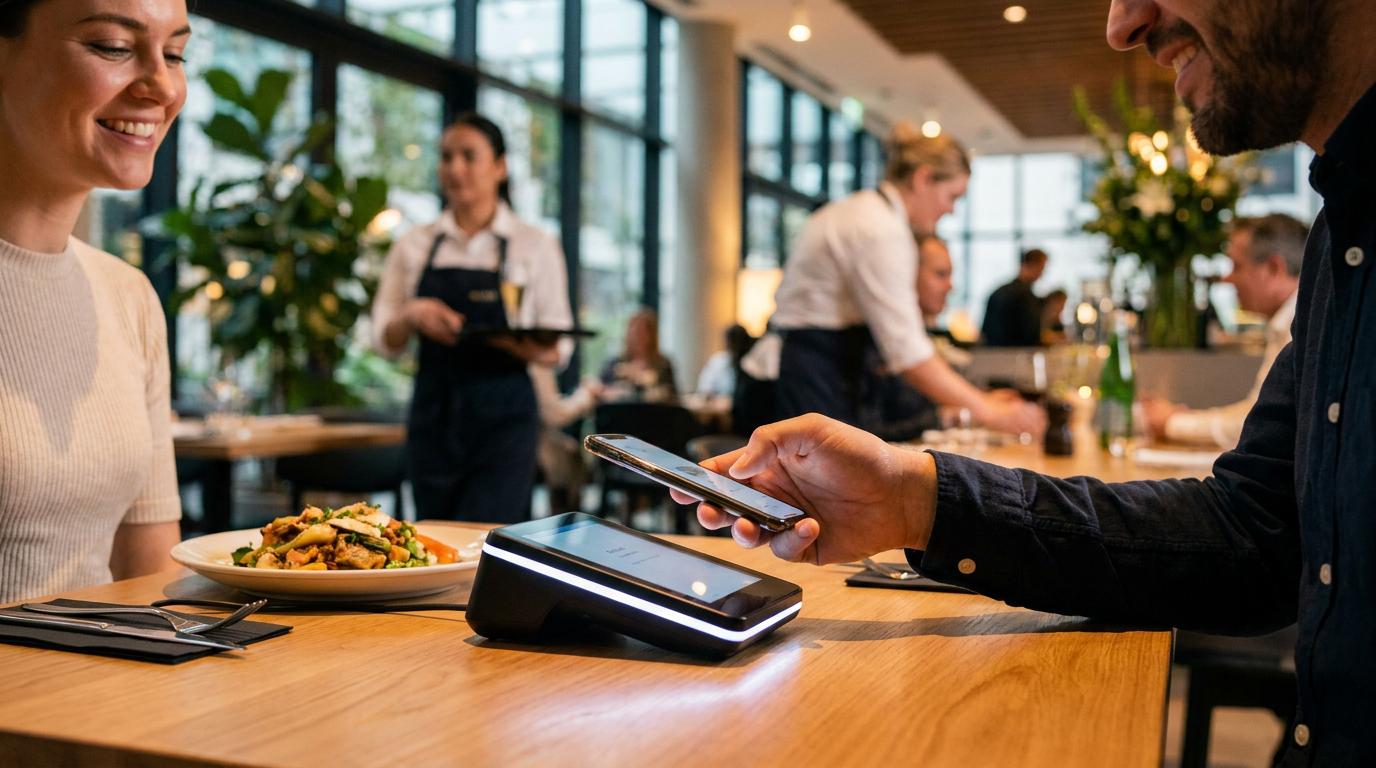
Are paper checks dead? Should you go fully cashless? How QR-pay-at-table works in 2026 restaurants.
TL;DR — Key Takeaways
Contactless payment is the dominant transaction format in 2026 restaurants — typically 60-80% of in-restaurant transactions across most developed markets, higher in major cities.
QR-based pay-at-table integrates seamlessly with QR menus: guest scans menu QR, browses, orders, pays — all without flagging a server. Lifts table turnover by up to 30%.
Going fully cashless is increasingly feasible but introduces accessibility concerns; the 2026 best-practice is "cashless preferred, cash accepted on request" rather than strictly cash-free.
Tipping in cashless transactions has reshaped tipping culture in many markets — automated tip prompts on payment terminals have raised average tip percentages but also produced "tipflation" backlash.
Modern restaurant payment processors (Toast, Square, Stripe-based systems, regional equivalents) have gotten genuinely good — most operators don't need a separate payment vendor beyond their POS.
Are paper checks dead?
Mostly, in 2026.
The 2026 reality:
Roughly 70-85% of restaurant transactions in developed markets are contactless (tap-to-pay, mobile wallet, QR payment)
Chip cards account for another 10-20%
Cash transactions are typically 5-15%, with significant variation by market and restaurant type
Paper checks are essentially extinct except in specific contexts (very high-end restaurants where a printed bill is part of the experience)
Why contactless dominates:
Faster than chip + signature
Faster than cash exchange and change-making
Lower fraud rates than older payment methods
Better hygiene perception (post-pandemic, no physical contact with staff)
Mobile wallet adoption is universal among tourists and most domestic guests
The exception remains some heritage and luxury restaurants where the printed-check ritual is part of the experience. For everyone else, contactless is the standard.
Should I go fully cashless?
A nuanced 2026 question.
Arguments for going fully cashless:
Faster service
Lower fraud risk (cash handling has its own fraud patterns)
Reduced cash-management overhead (counting, banking, theft prevention)
Cleaner accounting
Lower physical handling
Arguments for accepting cash:
Some guests genuinely prefer cash (older demographics, privacy concerns, tourists with foreign currency)
Legal requirements in some jurisdictions (some US states and EU member states restrict cashless-only models)
Accessibility concerns for unbanked customers
Goodwill with cash-preferring guests
The 2026 best-practice:
"Cashless preferred, cash accepted on request" is the working compromise — default to cashless transactions, train staff to gracefully accept cash when offered, maintain minimal cash reserves, and communicate the cashless preference subtly, not aggressively. This satisfies most guests while capturing most of the cashless benefits.
The legal note: Some jurisdictions have specifically prohibited cashless-only retail (citing accessibility for unbanked populations). Verify your local rules before going strictly cashless.
How does QR payment integrate with QR menus?
The 2026 integrated QR experience:
Guest journey:
Guest scans the menu QR at the table
Menu loads in the guest's phone language with allergen filtering
Guest browses, selects dishes, taps "add to order"
Order placed (sent to the kitchen)
Guest dines
Guest taps "pay" in the same interface
Payment processed via mobile wallet, card-on-file, or other contactless method
Receipt generated; guest leaves
The operational efficiency: Server not flagged for ordering (saves 1-2 minutes per order). Server not flagged for payment processing (saves 3-5 minutes per table). Table turnover lifts by up to 30% in well-implemented operations. Ordering is usually the step operators add first — see adding ordering to your QR menu.
The hospitality balance: This level of automation can feel impersonal at higher-end restaurants. The 2026 best-practice: casual restaurants and quick-service — full QR-pay-at-table is appropriate. Mid-tier sit-down — optional QR-pay (guest can pay through the menu or call the server). Fine dining — server-led service still preferred; QR menu without QR pay.
Intermenu doesn't take orders or payments and doesn't integrate with POS systems — the QR menu is for reading and deciding, and it runs alongside whatever POS and payment terminal (Toast, Square, Lightspeed, Revel) the restaurant already uses.
What's the right payment processor for small restaurants?
For most independent restaurants in 2026, the POS system's bundled payment processing is the right choice.
The 2026 dominant POS platforms (with bundled payments):
Toast— strong in US, decent international presence
Square— strong globally, excellent for small business
Lightspeed— strong in Europe and globally
Revel— enterprise-leaning
Clover— strong in US
Why bundled is usually right: Single vendor relationship, integrated reporting (sales + payments + analytics in one place), often better rates than negotiating separately, fewer integration points means fewer failure modes.
Typical 2026 payment processing rates:2.5-3.5% per transaction in most markets. Slightly higher for international cards. Slightly lower for high-volume merchants.
What about tipping in cashless transactions?
Tipping in cashless transactions has reshaped tipping culture in many markets.
The 2026 reality:
Most cashless payment terminals prompt for tips during the transaction
Default tip percentages have crept up (15% became 18% became 20% in many US contexts)
"Tipflation" backlash is real — some guests resent the visible default-tip prompts
Some markets have responded with "service charge included" approaches that reduce ambiguity
The operator considerations: Be transparent about tip handling (where do tips go? how are they distributed?). Don't aggressively suggest higher tip percentages. Provide clear "no tip" or "custom amount" options. Comply with local rules on service charges and tip distribution.
Frequently Asked Questions
Are paper checks dead?
Mostly, in 2026. Contactless dominates 70-85% of transactions; chip cards 10-20%; cash 5-15%. Paper checks essentially extinct except in heritage luxury contexts.
Should I go fully cashless?
Best-practice is "cashless preferred, cash accepted on request." Verify local legal requirements (some jurisdictions prohibit cashless-only retail).
How does QR payment integrate with QR menus?
Through POS integration. Guest scans menu QR, browses, orders, pays — all in one flow. Lifts table turnover by up to 30%.
What's the right payment processor for small restaurants?
The POS system's bundled payment processing is right for most independent restaurants (Toast, Square, Lightspeed, Revel, Clover). Separate processors make sense for specific regional/scale needs.
What about tipping in cashless transactions?
Default tip percentages have crept up in many markets. Be transparent, don't pressure, provide clear options, comply with local rules.
Add Pay-at-Table to Your QR Menu
QR menu integration with payment processing is one of the highest-leverage operational improvements available in 2026 — table turnover lifts, server time shifts to hospitality, and the guest experience becomes friction-free.
Intermenu handles the reading side: the multilingual menu guests scan before they order with staff. Ordering and pay-at-table run in your POS or payment provider, alongside the menu, not through it.
If your QR menu doesn't yet integrate with payment, see what the consolidated experience looks like →