
AI Food Photos and the EU AI Act: What Restaurants Must Do
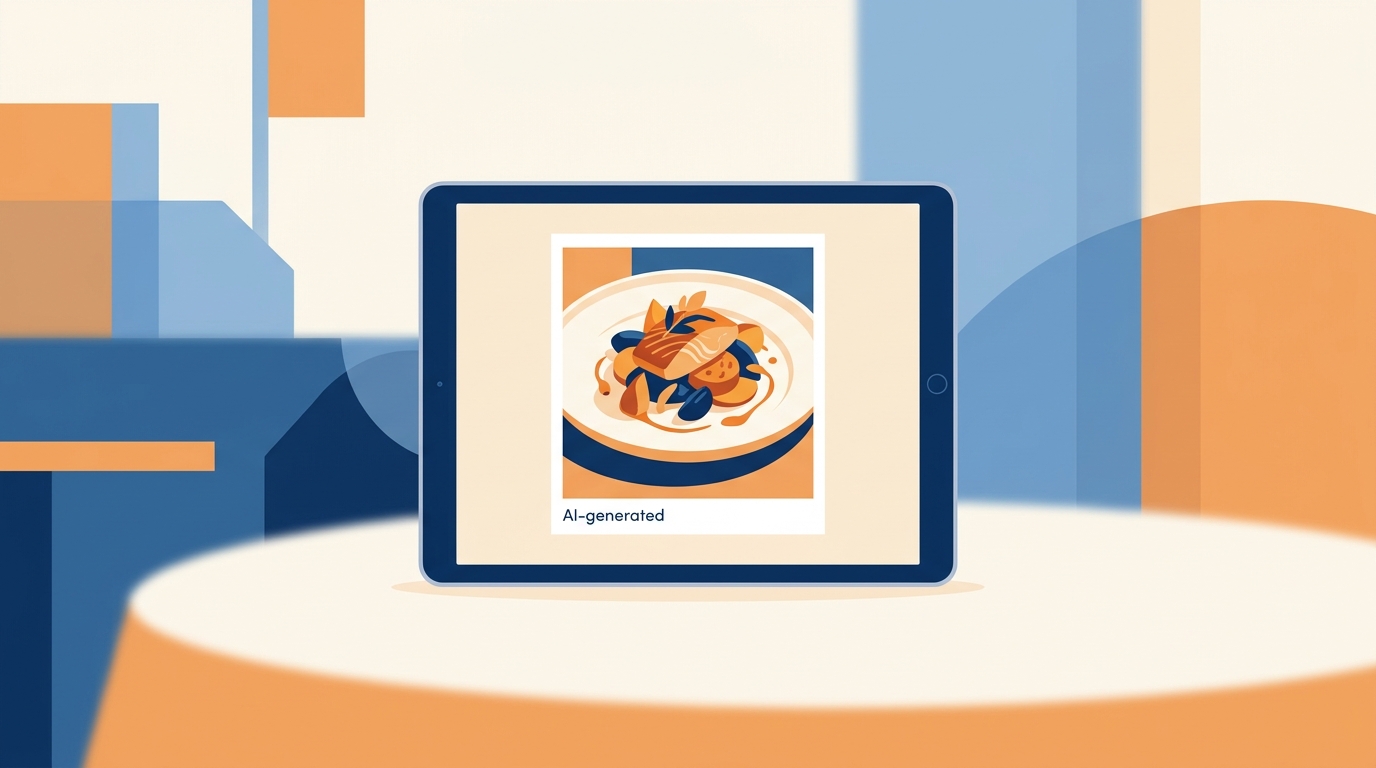
Your menu has AI dish photos. A new EU rule says some of them need a label. Here's which ones, what the label must say, and how to do it without ruining your menu.
AI food photography went from novelty to normal fast. It's cheap, it's quick, and for a small restaurant that can't justify a photographer for forty dishes, it's the difference between a menu with pictures and a menu without.
Then, on 2 August 2026, a new EU transparency rule came into effect — and some of those photos now need a label.
Here's the practical version for restaurant operators: which of your images are actually affected, what the label has to say, and how to add it without making your food look like a science experiment.
Note: this is practical guidance, not legal advice. For a binding answer about your business, speak to a qualified lawyer.
TL;DR for busy operators
Since2 August 2026, Article 50 of the EU AI Act requires businesses to disclose AI-generated visual content that looks realistic.
A photorealistic AI dish photo almost certainly needs a label. An obviously illustrated or stylised graphic almost certainly doesn't.
The label must be visible to a guest where they see the image — not buried in your website footer.
You don't need to watermark anything. That's the AI tool's job, not yours.
A small, well-placed "AI-generated" caption does not hurt appetite appeal— hiding it and getting caught does.
Budget about20 minutes to sort this for a typical restaurant.
The short answer
If you generated a food photo with AI and it looks like a photograph a camera could have taken, tell people it's AI-generated, visibly, wherever it appears.
That's the whole obligation in one sentence. Everything below is detail on the edge cases.
Where restaurants use AI images — and which ones are covered
Most restaurants we work with are using AI imagery in four places. They're not all equally affected.
AI dish photos on your digital menu
Usually covered. This is the main one. A photorealistic image of a burger, a curry or a cocktail depicts a "realistically plausible object," and a guest scanning your menu will reasonably assume a camera took it. That's the definition being met.
It matters more here than anywhere else, too — this is the image someone looks at while deciding what to order and what to pay for it.
Website hero and gallery images
Usually covered, and often overlooked. AI-generated shots of "your" dining room, terrace or kitchen are the riskiest category, because they depict a place that a guest may believe they're about to walk into. If the AI interior doesn't resemble your actual restaurant, you have a consumer-expectations problem quite separate from the AI Act.
Social posts and paid ads
Usually covered. The same test applies. Most major platforms now also have their own AI-content declaration setting — use it. And note that a label baked into your website doesn't follow the file when you re-upload it elsewhere, so declare it on each platform.
Delivery platform listings
Usually covered — and check the platform's own rules. Uber Eats, Deliveroo, Glovo and Just Eat each have their own content policies about image accuracy on top of the legal requirement. A dish photo that doesn't match what arrives in the bag causes refunds and bad ratings regardless of the law.
What's generally not covered
Illustrated or stylised menu artwork— hand-drawn-looking graphics, flat vector illustrations, obvious cartoons. Nobody mistakes these for photographs.
AI-generated patterns, textures and backgrounds with no realistic subject.
Genuine photography you edited normally. Cropping, brightening or colour-grading a real photo of your real dish doesn't make it AI-generated. Using generative fill to add food that was never on the plate is a different matter.
Does a photo of a burger really count as a "deepfake"?
This is where most operators get stuck, because "deepfake" sounds like it belongs in a story about election interference, not a lunch menu.
Under the AI Act the term is much broader than everyday usage. It covers AI-generated or manipulated image content that resembles existing or realistically plausible persons, objects, places, entities or events and that would falsely appear to be authentic.
Two consequences catch people out:
You don't have to intend to mislead. There's no requirement of bad faith. A beautiful AI photo of your signature pasta, made purely because you couldn't afford a photo shoot, can still meet the definition.
It isn't only about people. Objects and places count — which is exactly why food and interior imagery is in scope.
The test, in plain language
Would a guest glancing at this image assume someone took it with a camera?
Yes → treat it as covered. Label it.
No, it's clearly drawn, rendered or impossible → very likely not covered.
Clearly fantastical or physically impossible content sits outside the definition. A photorealistic plate of pasta is not fantastical. A dragon holding a pizza is.
Where most restaurants land
If you've used AI to fill gaps in your menu photography — the usual reason — assume most of those images need a label. If your AI usage is decorative graphics and backgrounds, you probably have very little to do.
What you have to do — and what you don't
Your job: a visible label
The disclosure has to be understandable by a person without any special tool. In practice:
Wording:"AI-generated" is clearest. "AI-generated image" and "Created with AI" work equally well. Pick one, use it everywhere.
Placement: a caption under the photo, or a small badge on the image itself.
Timing: visible when the guest sees the image — not after a click, hover or scroll.
Not your job: watermarking
You may have read that AI images must be "marked in a machine-readable format." That's true — but it's an obligation on the provider of the AI system (the company behind the image generator), not on you as the business publishing the image.
You couldn't do it even if you wanted to; you can't retro-fit cryptographic provenance into someone else's model output. Your responsibility is the visible label. If a vendor is telling you that your restaurant must watermark its images, they've misread the regulation.
The full breakdown of that distinction is in our guide to labelling AI images under the EU AI Act.
Labels that don't kill the appetite appeal
Here's the objection every operator raises, and it deserves a straight answer:"If I stamp 'AI' on my food photos, won't guests think the food is fake?"
In practice, no — provided you do it with a bit of care. What actually damages trust is a guest discovering the deception themselves, or the photo being so far from reality that the dish disappoints on arrival.
What works:
Keep it small and quiet. A 10–11px caption in your muted text colour beneath the image. It's legible, it's honest, and it isn't shouting. This is the same treatment allergen notes get, and nobody thinks those ruin a menu.
Put it under the image, not across it. Overlay badges cover food. Captions don't.
Use consistent, neutral wording."AI-generated" reads as procedural. Long apologetic sentences read as guilty.
Be accurate, and the label costs you nothing. The real risk isn't the disclosure — it's a photo that promises a burger the kitchen doesn't serve. If your AI images honestly represent your actual dishes, a small label reads as professionalism, not confession. Some operators find it reads as modern.
Don't hide it in the footer. A blanket "some images on this site are AI-generated" note buried in your terms doesn't meet the requirement and looks evasive if anyone checks.
You already do exactly this kind of disclosure for allergens — a small, standardised, legally-required note that sits quietly beside the food and hasn't hurt anybody's sales. See our EU 1169/2011 allergen compliance guide if you want the parallel. This is the same discipline applied to imagery.
A 20-minute compliance sprint
For a typical independent restaurant, this is genuinely a one-sitting job.
Minutes 0–8: find them. List every AI image you've published — digital menu, website, social profiles, delivery listings. Sort into "photorealistic" and "obviously illustrated." Only the first group needs action.
Minutes 8–12: decide your standard. Pick your wording ("AI-generated"), placement (caption beneath) and styling (small, muted). Write it down so whoever posts next week follows it.
Minutes 12–18: apply it. Add the caption to each photorealistic AI image. In Intermenu, set it once per item. On WordPress, use the plugin below. On social, switch on each platform's AI-content declaration.
Minutes 18–20: record it. One short note: the date, your rule, who did it. Ten lines in a shared doc is plenty, and it's what turns "we hadn't considered it" into "here's our process."
Then make it habitual: when you generate an AI image, label it as you publish it. The cleanup is only painful once.
How Intermenu handles this on your menu
If your menu runs on Intermenu, the disclosure lives with the dish. You set the AI note on the item once, and it displays wherever that item appears — including in every language your menu is translated into, which matters if you're serving international guests across the EU.
That last part is worth flagging: a disclosure that only exists in your local language doesn't help a guest reading the menu in German or Spanish. Because Intermenu translates the menu, the note travels with it.
On WordPress? Use our free plugin
Most restaurant websites run on WordPress, and labelling a media library by hand is the part everyone abandons.
We built KI-Transparenz-EU for exactly that: select your AI images and videos in the media library, click once, and the disclosure is applied publicly across your site. It's free.
Plugin status — updated 7 August 2026. v1.0 is finished and free to download today. We've also submitted it to the official WordPress.org directory; review usually takes a few weeks and we'll update this page the day it's approved.
Download it free → · source on GitHub
We'll update this post with the official link the day it's approved — you can also follow the WordPress.org developer profile.
To be clear about what it does: it applies the visible disclosure, at scale. It doesn't classify your images for you, and no plugin can make a business "compliant" — that's a process. It handles the tedious mechanical part well.
Frequently asked questions
Do restaurants have to label AI-generated food photos in the EU? If the photo is photorealistic — the kind a guest would assume was taken with a camera — then yes. Since 2 August 2026, businesses publishing AI-generated visual content that resembles realistically plausible objects, places or people must disclose it visibly. Clearly illustrated or stylised menu artwork generally falls outside the rule.
Does this apply to my delivery platform photos too? Yes, and the platforms have their own image-accuracy policies on top. Declare AI images wherever you upload them; a label on your own website doesn't travel with a re-uploaded file.
Will an "AI-generated" label put guests off ordering? There's no good evidence that a small, neutral caption reduces orders — and the reputational damage from a guest discovering an undisclosed AI photo is far worse. Keep it small, keep it under the image, and make sure the photo honestly reflects the dish you serve.
Do I need to watermark my AI food photos? No. Machine-readable marking is the duty of the AI provider that generated the image. Your duty as the restaurant publishing it is the visible, human-readable label.
What if I only use AI to touch up real photos of my dishes? Normal editing of a genuine photograph — cropping, lighting, colour — doesn't make it AI-generated content. Using generative AI to add or substantially change what's on the plate does.
What are the penalties? Transparency breaches under the AI Act can attract fines up to €15 million or 3% of worldwide annual turnover, whichever is higher, with proportionality applied to smaller businesses. Enforcement runs through national market surveillance authorities, and complaints from customers or competitors are the realistic trigger.
Related guides
EU AI Act: how to label AI images on your site— the full guide, for any business
AI food photography for restaurants: the complete 2026 playbook
AI food photography vs studio photography: cost and quality compared
Reference image workflows: keeping brand consistency with AI
Sources: Article 50, EU AI Act · European Commission FAQ on Article 50· Article 99, penalties. Last reviewed 7 August 2026.