
AI Food Photography vs Studio: Cost & Quality Insights
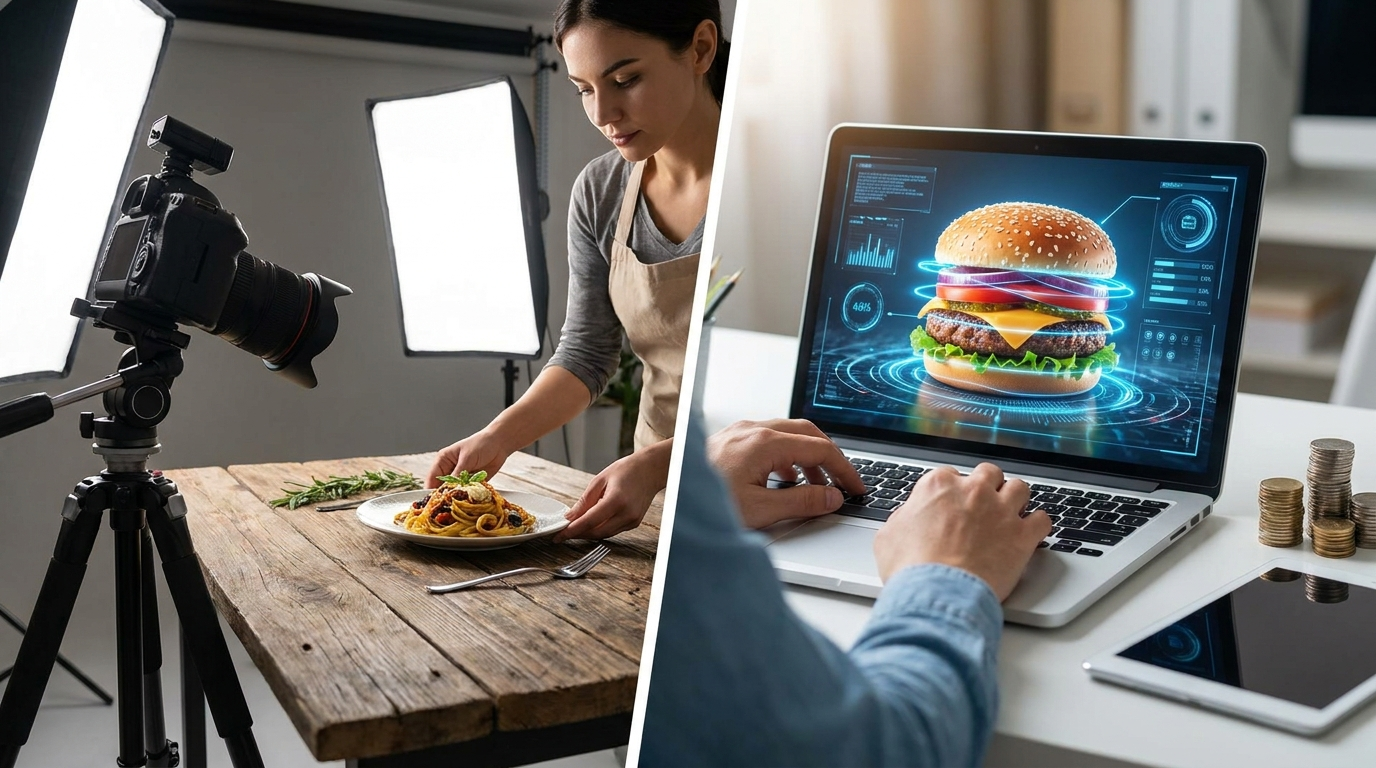
If you're spending more than $2,000 a year on food photography in 2026, you're almost certainly overspending. AI food photography is now production-grade for the bulk of restaurant imagery work — menu photos, social posts, delivery platform listings, ad creatives, in-house signage — at a cost that's roughly 1% of the equivalent professional shoot. Reserve professional photography for the cornerstone work where it still genuinely matters: signature-dish brand shots, chef portraits, atmospheric dining-room photography for PR and editorial pitches. That's it. The rest is AI.
TL;DR — Key Takeaways
A 40-item professional food photo shoot in 2026 costs $6,000–$20,000 all-in, takes 1–3 weeks, and ages the moment a dish changes. The same library generated via AI costs roughly $20–$50, takes an hour, and refreshes infinitely.
In blind A/B tests on real menus, AI photos and professional photos produce statistically indistinguishable conversion rates. Diners cannot reliably tell the difference.
The right 2026 stack for most restaurants: AI for the menu and daily content, professional photography for the 5–10 cornerstone dishes once a year, plus a separate brand-cornerstone shoot every 2–3 years.
AI handles roughly 95% of restaurant photography needs. The 5% edge cases — fine-dining kaiseki, intricate layered desserts, specific brand campaigns — still benefit from a photographer.
Hybrid is the smart middle path: spend 10% of what you would have on a full shoot, get 95% of the value, plus the flexibility to refresh forever at near-zero cost.
The decision framework in one paragraph
If you're spending more than $2,000 a year on food photography in 2026, you're almost certainly overspending. AI food photography is now production-grade for the bulk of restaurant imagery work — menu photos, social posts, delivery platform listings, ad creatives, in-house signage — at a cost that's roughly 1% of the equivalent professional shoot. Reserve professional photography for the cornerstone work where it still genuinely matters: signature-dish brand shots, chef portraits, atmospheric dining-room photography for PR and editorial pitches. That's it. The rest is AI.
This article shows the actual numbers, the actual quality comparison, and the hybrid stack that most restaurants in 2026 land on.
How much does a professional food photo shoot cost in 2026?
The honest 2026 numbers, gathered across markets and shoot types.
Independent food photographer day rate: $500–$2,500.
Top-tier food photographer day rate: $2,500–$7,500.
Food stylist day rate: $500–$1,200 (often a separate hire).
Studio rental: $0 (if you have on-site space) to $2,500/day in major cities.
Props, dishware, surfaces: $200–$1,000 if you don't have your own.
Editing and retouching: $25–$100 per final image.
Travel and logistics: variable.
Per-dish all-in cost: $150–$500.
Typical 40-item menu shoot: $6,000–$20,000.
Time from booking to delivery:1–3 weeks.
Update cost when a dish changes: the same per-dish cost, plus potentially having to schedule a fresh shoot.
These numbers vary by region. Los Angeles, New York, London, Paris are at the top end. Smaller markets are 30–50% cheaper. The all-in cost for a real, properly styled, properly edited menu shoot in 2026 is rarely below $5,000 even for a small restaurant.
How much does AI food photography cost?
The 2026 numbers:
Per-image generation cost: $0.10–$0.60.
Within a hospitality platform (bundled): included in the standard $15–$60/month subscription, which also covers translation, allergen tagging, and analytics.
Editing cost: $0–$2 per image, often handled within the same platform.
Per-dish all-in: ~$0.50.
Typical 40-item menu library: ~$20–$50.
Time from prompt to delivery: seconds to minutes per image; under an hour for a full menu library.
Update cost when a dish changes: ~$0.50 per refresh.
The cost gap is roughly 300–1,000x in favor of AI. The conversion impact, in well-controlled tests, is statistically indistinguishable.
This is the math that has reshaped the food photography industry in the past three years. The professional shoot hasn't gotten more expensive — AI has eaten its bottom 95%.
When does it make sense to hire a photographer vs use AI?
A rough decision rule, applicable to most independent restaurants in 2026:
Hire a professional photographer for:
The 5–10 signature dishes that define your restaurant brand. Once. Plus a refresh every 2–3 years.
Chef portraits and team photos.
Atmospheric dining-room photography for PR pitches, magazine features, and brand-cornerstone marketing.
Editorial features in food publications, when those publications require camera-captured imagery.
Major rebranding moments (new restaurant opening, ownership change, large refresh).
Use AI for:
The remaining 30–80 menu items.
Daily and weekly social media content.
Seasonal menu updates and rotating specials.
Delivery platform listings (Uber Eats, DoorDash, Deliveroo).
Paid ad creatives across Meta, Google, TikTok.
In-house signage, event posters, banner artwork.
A/B test variations of dish descriptions and presentations.
The split for a typical 40-item menu in 2026:
5–10 dishes with professional photography (annual cost: $1,500–$5,000)
30–35 dishes with AI photography (annual cost: ~$50)
All daily/weekly content via AI (no incremental cost beyond the platform subscription)
Total annual photography spend lands around $1,500–$5,000 for restaurants that go hybrid, vs $6,000–$20,000+ for restaurants that try to professional-photograph everything.
Can AI handle every cuisine type or are some better photographed?
Most cuisines, AI handles well. Some still benefit from a hybrid approach.
Cuisines AI handles excellently in 2026:
Italian (pasta, pizza, antipasti, dolci)
French (classic preparations, modern bistro)
Spanish (tapas, paella, charcuterie)
Mexican (tacos, ceviches, classics)
American (burgers, BBQ, comfort food)
Mediterranean (Greek, Lebanese, Turkish, Levantine)
Indian (most regional cuisines)
Most Asian noodle and rice dishes (pho, pad Thai, ramen, bibimbap)
Cuisines or dishes where AI sometimes struggles:
High-end Japanese kaiseki (intricate plating, specific seasonal aesthetics)
Chinese banquet cuisine with multiple components per plate
Translucent or layered desserts where the cross-section matters most
Very niche regional cuisines underrepresented in training data
The fix for the edge cases:
Use reference image input— feed the AI a phone photo of the actual dish, and it generates polished variations.
Or use a hybrid approach— professional photography for the 2–3 most challenging dishes, AI for the rest.
Even in the edge cases, professional photography is rarely required for the entire menu — only for specific dishes where AI consistently misses.
Will customers tell the difference between AI and real photos?
In blind A/B tests on real menus, no — and this is the finding that has reshaped the industry.
The studies that have been run since 2024:
Recognition tests: When asked to identify which of two photos is AI-generated, diners perform at roughly random chance (50% accuracy) for everyday dishes. Recognition accuracy improves only for very specific edge cases (high-end Japanese, certain dessert categories).
Conversion tests: When restaurants run AI photos vs studio photos on the same menu in a controlled split, the per-dish order rate is statistically indistinguishable.
Trust tests: When diners are told upfront that some menu photos are AI-generated, trust scores drop slightly (~5–8%) but conversion does not. Diners care about dish accuracy more than image source.
The trust impact is real but small, and it's mitigated by accuracy-driven AI use (showing what the dish actually looks like). The conversion impact is essentially zero.
This means: from a pure "does it work?" perspective, AI photos perform identically to studio photos at 1% of the cost. The remaining argument for studio photos is brand-cornerstone — the work where the photographer's name, craft, and editorial credibility matter for reasons beyond the image itself.
What's the hybrid approach successful restaurants use?
The 2026 hybrid stack, used by most independent operators that have moved beyond either-or thinking:
Layer 1 — Brand cornerstone (every 2–3 years):
Hire a top-tier food photographer for a half-day or full-day shoot
Cover: 5–10 signature dishes, chef portrait, dining room atmosphere
Cost: $2,000–$5,000 once every 2–3 years
Use: PR pitches, magazine features, website hero imagery, brand campaigns
Layer 2 — Annual refresh (once a year):
Quick photographer session (or DIY with a phone and good lighting)
Cover: any signature dishes that have evolved, new flagship items
Cost: $500–$1,500 annually
Use: keeping cornerstone library current
Layer 3 — Operational menu (continuous):
AI generation for all 30–80 menu items
AI generation for daily/weekly social content
AI generation for ad creatives and delivery platform listings
Cost: included in $15–$60/month menu platform subscription
Use: 95% of the restaurant's actual visual content needs
This three-layer stack costs roughly $1,500–$3,000 per year all-in (averaged across years), vs $6,000–$20,000+ for a full-shoot-every-year approach. It produces equivalent or better content because the operational layer refreshes infinitely.
Intermenu is built around the operational layer of this stack — AI dish photos generated from the dish editor with no prompt to write, and a promo image studio for pictures of food and event posters (you can add your own reference images or start from Trends & templates), all on your plan's monthly image allowance. The professional cornerstone shoot remains a separate annual or biannual investment.
Test 5 dish images free with the modern stack
The simplest way to evaluate AI food photography for your specific cuisine and brand is to test it on five dishes you already have professional photos of. Run them through an AI generation flow, and compare side by side. The decision becomes obvious within an afternoon.
Intermenu lets you do this without committing — describe your dishes in plain language or upload phone photos as reference, generate AI versions, compare against your existing studio shots. If the gap is small enough that your customers won't notice, the math (300x cost reduction) usually settles the decision.
Frequently Asked Questions
How much does a professional food photo shoot cost in 2026? Per-dish all-in cost is $150–$500. A 40-item menu shoot costs $6,000–$20,000 with hidden costs (food stylists, props, retouching) included.
When does it make sense to hire a photographer vs use AI? Hire for cornerstone brand work (signature dishes, chef portraits, atmospheric photography) every 2–3 years. Use AI for the operational layer — bulk menu photos, daily content, delivery platform listings, ad creatives.
Can AI handle every cuisine type or are some better photographed? AI handles 95% of cuisines excellently. Edge cases (high-end Japanese kaiseki, intricate layered desserts) benefit from reference image input or hybrid professional shots.
Will customers tell the difference between AI and real photos? In blind tests, no. Recognition accuracy is roughly random chance for everyday dishes. Conversion rates are statistically indistinguishable.
What's the hybrid approach successful restaurants use? A three-layer stack: cornerstone professional shoot every 2–3 years (~$2-5K), annual refresh (~$500–1.5K), operational AI layer (included in menu platform subscription). Total annual cost: $1,500–$3,000.
Is AI food photography worth it for fine dining? For 95% of fine-dining menu needs, yes. For the 5% of dishes where craft and authenticity must be visible (signature kaiseki, certain plated desserts, brand-cornerstone work), professional photography retains the edge.
Run the Side-by-Side Test
If you're sitting on a $10,000 photo-shoot quote and wondering whether AI is good enough, the answer takes an afternoon. Intermenu lets you generate AI versions of 5 dishes you already have studio photos of — from the dish editor, or in the promo image studio with your own photos added as reference images — and compare them side-by-side. The cost gap (300–1,000x) usually settles the decision once the visual difference becomes hard to spot.
Test 5 dish images free and decide for yourself →
Related guides
Publishing AI images in the EU now carries a disclosure duty. See our guide to labelling AI images under the EU AI Act.