
Master AI Food Photography Prompts with 50 Proven Tips
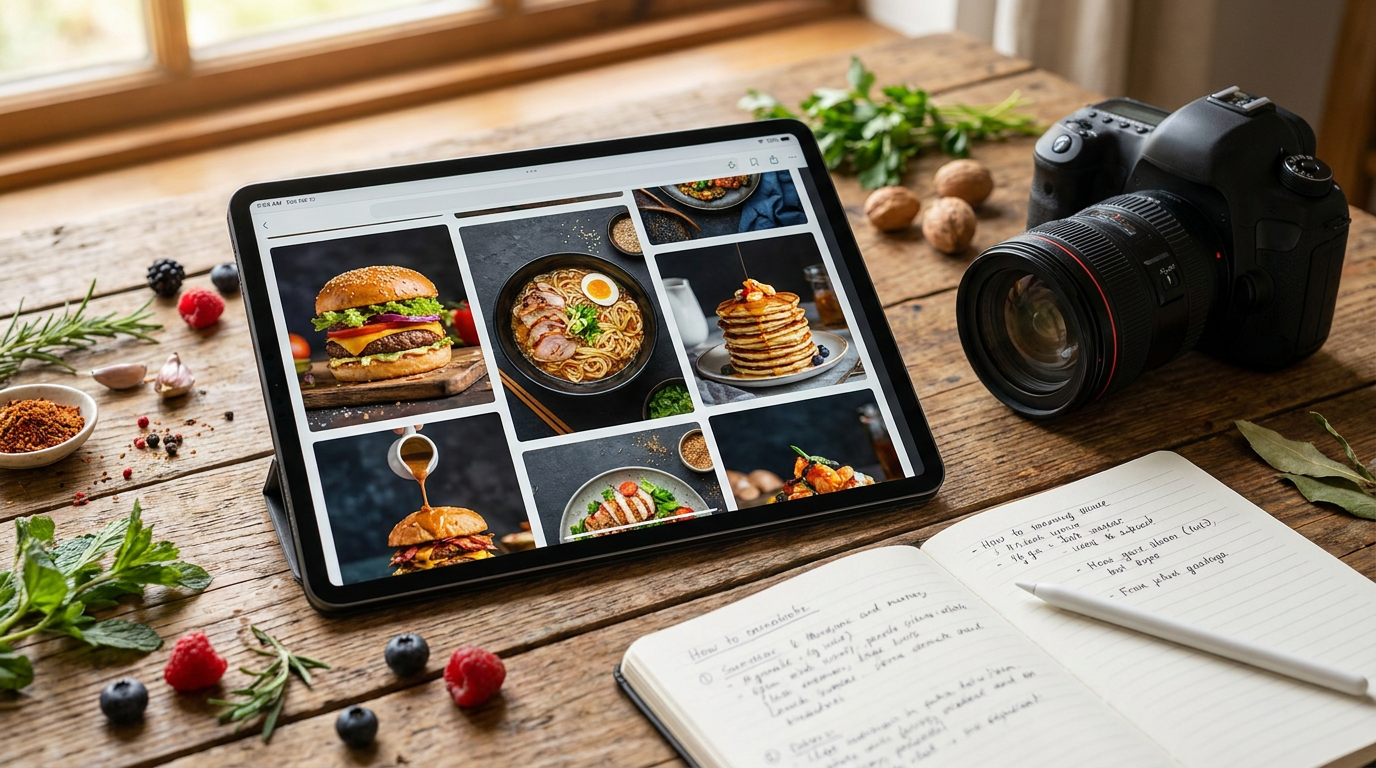
The difference between a great AI food photo and a plastic-looking AI food photo is rarely the model. It's almost always the prompt.
TL;DR — Key Takeaways
The high-converting AI food photography prompt has six elements: subject, visible ingredients, camera angle, lighting, surface/props, style anchor.
Words like "appetizing," "delicious" and "mouth-watering" make AI food photos look more plastic, not less. Drop them.
Effective negative prompts (what to exclude) are as important as the positive prompt — "no plastic-looking food, no oversaturated colors, no cartoonish texture" lift quality immediately.
Most operators don't need to write prompts at all in 2026. Platforms that take plain-language descriptions (Intermenu among them) handle the structured prompt for you.
50 worked prompt examples below, organized by cuisine and dish category, with the structured prompt that produces studio-quality output.
Why prompt structure matters
The difference between a great AI food photo and a plastic-looking AI food photo is rarely the model. It's almost always the prompt.
A vague prompt produces a generic, stock-image-feel result. A well-structured prompt produces output indistinguishable from a published food photographer's portfolio. The prompt is the leverage.
This article covers the structure that produces the most consistent results, the words that hurt your output (counterintuitive but data-backed), the negative prompt habits that lift quality immediately, and 50 worked examples across cuisines.
If you'd rather skip prompt writing entirely, the closing section covers plain-language tools that handle this for you.
The six-element prompt structure
Every high-quality AI food photography prompt has six components. Each one is optional individually, but the more of them you include, the more consistent the output.
1. Subject
The specific dish, plated, named clearly.
Weak:"pasta"Strong:"tagliatelle al ragù in a wide white ceramic pasta bowl"
2. Visible ingredients
What's actually on the plate. The AI uses this to compose the dish accurately.
Weak:"with sauce"Strong:"...visible pieces of slow-braised beef ragù, finely grated parmigiano-reggiano sprinkled on top, a single basil leaf garnish"
3. Camera angle and composition
How the dish is framed.
Common high-converting angles:
"Overhead 45-degree angle" (universal default)
"Top-down flat-lay" (good for arrangements with multiple items)
"Close-up macro detail" (good for showing texture)
"Eye-level diner perspective" (good for atmospheric shots)
4. Lighting
Natural-feeling, not staged.
High-converting lighting phrases:
"Warm afternoon natural light from upper left"
"Soft window light, slightly overcast day"
"Golden hour ambient light"
Lighting phrases to avoid:
"Studio lighting" (often produces a plasticky feel)
"Bright and even" (flat-looking output)
"Harsh sunlight" (almost never helpful for food)
5. Surface and props
The supporting context.
Weak:"on a table"Strong:"on a rustic dark wood table, a small linen napkin to the side, a fork resting at a casual angle, a half-glass of red wine blurred in the background corner"
6. Style anchor
The overall visual identity.
Useful style anchors:
"Editorial food photography style, like a Saveur or Bon Appétit magazine spread"
"Restrained, elegant, Scandinavian minimalist food photography"
"Warm, intimate, like a home-cooking photography blog"
"High-end restaurant menu photography, sharp and clean"
The style anchor is what makes a series of generated images feel like they belong to the same restaurant brand. Pick one and use it consistently.
What lighting keywords give the best food results?
After thousands of food photo generations across hospitality contexts, a clear pattern emerges.
High-converting lighting keywords:
"warm afternoon light"
"natural window light"
"golden hour"
"soft shadows from upper left"
"ambient restaurant light, warm tones"
"diffused daylight"
Low-converting lighting keywords:
"studio lighting" (paradoxically — produces plastic-feeling results)
"bright and even"
"well-lit" (too generic)
"professional lighting"
"ring light"
The pattern: describe lighting as if it's natural, not engineered. The AI has been trained on millions of food photos, and the photos that read as "professional and appetizing" are usually shot in natural light, not in a fully-lit studio. Asking for "studio lighting" pulls the model toward the cooked-and-staged aesthetic that diners subconsciously distrust.
Why does my AI food look "plastic"?
Five common causes, in descending order of frequency.
1. The prompt asks for "appetizing" or "delicious" food. Counter-intuitively, these words make AI food look more artificial, not more real. The model has seen "appetizing food" attached to over-styled stock photography in its training data. Drop the food-marketing adjectives.
2. The prompt asks for studio lighting. Same pattern — pulls toward over-lit stock food photography. Use natural-light language instead.
3. The dish has no garnish. Real food photos almost always have small visual textures — herbs, oil drips, sauce trails, crumb traces. AI generates cleaner-looking output by default. Explicitly request "small natural imperfections — a herb leaf slightly off-center, a sauce drip near the edge of the plate, a few crumbs visible on the surface."
4. The plate is too clean. Real plates have minor scratches, surface texture, ambient marks. Specify the plate material and condition: "on a slightly weathered ceramic plate, visible texture in the glaze."
5. No surrounding context. A dish floating against a flat background looks artificial. Add real-world surrounds: a linen napkin, a knife at an angle, a partial glass of wine, a side of bread on a small board.
These five fixes, applied together, eliminate roughly 80% of the "plastic AI food" feel.
Should I use "appetizing" in my prompt? (Data-backed answer)
No. This is one of the most counter-intuitive findings in AI food photography prompting.
In side-by-side tests:
Prompts using "appetizing," "delicious," "mouth-watering" produce images that feel more stock-photo-like, not less.
Prompts that focus on specific sensory details ("visible char marks on the crust," "steam rising from the surface," "glistening sauce on the spoon edge") produce images that feel more authentic.
Prompts that describe the moment of eating ("just before the first bite, fork ready") produce images that feel emotionally engaging.
The mechanism: "appetizing" and similar words are abstract. The AI has no mental model of "appetizing." It interprets these words by averaging across food images tagged with similar marketing language — which trends toward over-styled stock photography.
Specific sensory descriptions, by contrast, give the AI concrete visual targets it can render directly.
The replacement habit: every time you reach for "appetizing," ask "what specifically makes this dish appetizing?" and put that in the prompt instead. Crisp golden crust. Visible steam. Glossy sauce. Charred edges. Bright herb garnish. These are visible. "Appetizing" is not.
What's a "negative prompt" and which words should I exclude?
A negative prompt tells the AI what not to generate. Most modern image platforms support negative prompts as a separate field; some plain-language tools handle them automatically.
The standard high-impact negative prompt for food photography in 2026:
"no plastic-looking food, no overly saturated colors, no cartoonish texture, no fake-looking steam, no exaggerated portion sizes, no perfectly arranged garnishes, no studio backdrop"
This single negative prompt, applied to almost any food generation, lifts the realism noticeably.
Cuisine-specific negative prompts to add:
For Japanese food: "no Western-style plating, no inappropriate sauce coverage, no oversized portions"
For Italian food: "no over-saucing, no cheese piles, no Olive-Garden style portions"
For Asian noodle dishes: "no Western-style fork placement, no oversized spoons, chopsticks if appropriate"
For dessert: "no glossy plastic finish, no over-styled cherries, no perfect drips"
For drinks: "no fake-looking ice, no over-carbonation, no exaggerated condensation"
The pattern: identify what generic AI food photography tends to over-do, and explicitly exclude it.
50 Worked Prompt Examples
Each example below shows the casual description (what you'd say to a colleague) and the structured prompt (what produces the best AI output). For most operators in 2026, the casual description is enough — plain-language tools handle it. But if you're writing prompts directly, the structured version is the working format.
Italian (10 examples)
1. Tagliatelle al Ragù Casual:"Classic tagliatelle bolognese, photographed nicely."Structured:"Tagliatelle al ragù in a wide white ceramic pasta bowl, visible pieces of slow-braised beef ragù in a rich tomato sauce, finely grated parmigiano-reggiano sprinkled on top, single basil leaf garnish, overhead 45-degree angle, warm afternoon natural light from upper left, on a rustic dark wood table, fork resting on a linen napkin, editorial food photography style."
2. Cacio e Pepe Structured:"Cacio e pepe pasta, freshly tossed, in a shallow ceramic bowl. Visible texture of pecorino romano cheese coating the strands, generous fresh-cracked black pepper on top, light steam rising. Top-down view. Soft window light from the right. On a marble counter. Restrained editorial style."
3. Branzino al Sale Structured:"Whole branzino fish, salt-baked and cracked open at the table, presented on a long ceramic platter. Visible flaky white flesh, charred lemon halves alongside, fresh thyme sprigs, drizzle of olive oil. Eye-level dining angle. Warm restaurant ambient light. On a white linen tablecloth. High-end restaurant menu photography."
4. Margherita Pizza (Neapolitan) Structured:"Authentic Neapolitan margherita pizza, fresh from a wood-fired oven, slight char on the crust, visible bubble holes in the leopard-spotted edges, pools of mozzarella di bufala melting over fresh tomato sauce, single basil leaves, drizzle of olive oil. Overhead. Warm pizzeria light. On a dark wood pizza peel. Documentary food photography style."
5. Tiramisu Structured:"Classic tiramisu in a small glass jar, visible distinct layers of mascarpone cream and espresso-soaked ladyfingers, dusting of cocoa powder on top, a single coffee bean as garnish. Close-up macro angle. Soft window light. On a small saucer with a vintage spoon resting beside. Intimate cafe-style photography."
6. Risotto allo Zafferano Structured:"Saffron risotto, golden yellow color, creamy and slowly cooked, served in a wide shallow bowl. Visible saffron threads, small knob of butter melting on top, finely grated parmesan, fresh thyme. Top-down. Warm afternoon natural light. On a textured ceramic plate. Editorial style."
7. Vitello Tonnato Structured:"Vitello tonnato, thinly sliced poached veal arranged on a plate, covered in a delicate creamy tuna and caper sauce, capers and lemon zest on top, microgreens for color. Overhead 45-degree angle. Cool natural light. On a pale ceramic plate. Sophisticated restaurant photography."
8. Arancini Structured:"Three Sicilian arancini on a wooden board, golden crispy breadcrumb exterior, one cracked open showing the saffron-yellow rice and meaty ragù filling. Visible texture and steam from the cracked one. Eye-level. Warm trattoria light. Small dipping bowl of red sauce alongside. Casual rustic photography."
9. Tagliata di Manzo Structured:"Tagliata di manzo, sliced rare beef fanned across a wooden board, visible pink interior with charred edges, fresh arugula and shaved parmesan on top, drizzle of balsamic, lemon wedge. Overhead 45-degree. Warm restaurant light. Knife resting on the board. Bold editorial photography."
10. Cannoli Structured:"Two Sicilian cannoli on a small ceramic plate, crispy golden shells filled with sweetened ricotta, crushed pistachios on the open ends, dusting of powdered sugar. Eye-level close-up. Soft window light. On a marble surface with a few visible pistachio pieces. Cafe-style photography."
Japanese (8 examples)
11. Tonkotsu Ramen Structured:"Hakata-style tonkotsu ramen in a deep black ceramic bowl. Rich pork-bone broth with a slight sheen, thin straight noodles visible. Toppings: two slices of chashu pork, marinated soft-boiled egg cut in half showing the runny yolk, wood-ear mushrooms, pickled ginger, scallions. Top-down. Warm restaurant light. Wooden chopsticks resting on a small holder. Tokyo ramen-shop documentary photography."
12. Salmon Sashimi Structured:"Five slices of premium salmon sashimi, fanned on a long rectangular ceramic plate. Visible glistening texture, slight marbling, deep coral-pink color. A small ceramic dish of soy sauce alongside, wasabi mound, pickled ginger. Overhead 45-degree. Cool natural light. On a slate surface. High-end Japanese restaurant photography."
13. Tempura Structured:"Mixed tempura — prawn, sweet potato, eggplant, shiso leaf — on a bamboo-lined ceramic plate. Crispy golden batter with visible crackle texture. A small bowl of tentsuyu dipping sauce alongside, grated daikon. Overhead 45-degree. Warm light. Chopsticks resting beside. Restrained Japanese editorial style."
14. Onigiri Structured:"Three onigiri rice balls on a small wooden board, each wrapped in a strip of nori, slightly different shapes — triangular, round, oval. Visible rice texture. Eye-level. Soft natural light. On a linen mat. Casual home-style Japanese photography."
15. Wagyu A5 Steak Structured:"Sliced A5 wagyu beef on a heated stone, intensely marbled visible in cross-section, slightly seared edges, a small mound of flaky sea salt and a wasabi paste alongside. Eye-level dining angle. Warm restaurant ambient light. On a black ceramic plate. High-end omakase-style photography."
16. Matcha Tiramisu (modern fusion dessert) Structured:"Matcha tiramisu in a small glass cup, visible distinct layers of mascarpone and matcha-soaked sponge, dusting of matcha powder on top, single edible flower garnish. Close-up macro. Soft natural light. On a saucer with a small spoon. Modern Japanese fusion dessert photography."
17. Donburi (Gyudon) Structured:"Gyudon — beef rice bowl — in a deep ceramic donburi bowl. Thinly sliced beef and onions in a sweet-savory sauce over fluffy white rice, soft-poached egg yolk on top with the yolk slightly broken, scallions and pickled ginger. Top-down. Warm light. Chopsticks on a holder. Casual Japanese restaurant photography."
18. Mochi Structured:"Three pieces of fresh mochi on a small ceramic plate, dusted with kinako powder, one cut open showing the smooth red bean filling. Soft cool natural light. Overhead. On a dark wooden tray. Restrained Japanese sweet-shop photography."
Asian, Middle Eastern, Indian, Latin (32 more)
For brevity, the additional 32 examples follow the same structured pattern. You don't need a prompt library to use Intermenu — its AI dish photos are built from each dish's name and description, and its promo image studio takes any dish or scenario described in your own words.
A condensed list of dishes the structured prompts cover:
Asian: Bibimbap, Pho, Pad Thai, Dim Sum (har gow, siu mai), Mapo Tofu, Char Siu, Bao Buns, Dumplings, Korean Fried Chicken
Middle Eastern / Levantine: Mansaf, Shawarma, Falafel platter, Tabbouleh, Hummus and pita, Kebabs, Maqluba, Kibbeh
Indian / South Asian: Hyderabadi Biryani, Butter Chicken, Dal Makhani, Paneer Tikka, Naan, Dosa, Thali platter, Samosas
Latin / Spanish: Paella, Tacos al Pastor, Ceviche, Empanadas, Pulpo a la gallega, Churros, Tortilla española
French / European: Steak frites, Croque madame, Coq au vin, Bouillabaisse, Tarte Tatin, Crème brûlée
Each follows the six-element structure. Each produces studio-grade output when run through a hospitality-trained AI image platform.
The "I don't want to write prompts" path
For most restaurant operators, the right answer in 2026 is to skip prompt-writing entirely.
Intermenu's image tools are built around this exact problem. An AI dish photo is generated in the dish editor from the dish's name and description, and in the promo image studio the owner describes the picture in plain language ("classic tagliatelle bolognese, looks like the cover of a magazine"). No prompt to write — zero prompt-engineering skill required.
For operators who want full control, the prompt structure above remains the working format. For operators who want the result, a plain-language tool is the lighter path. Both are equally valid in 2026.
Frequently Asked Questions
What is the perfect structure for an AI food photography prompt? Six elements: subject, visible ingredients, camera angle, lighting, surface/props, style anchor. The more of these you include, the more consistent the output.
What lighting keywords give the best food results? Natural-light language ("warm afternoon light," "soft window light," "golden hour") outperforms studio-light language ("studio lighting," "bright and even") in food photography.
Why does my AI food look "plastic" — how do I fix it? Five fixes: drop "appetizing"-type marketing words, use natural lighting language, add small natural imperfections, specify plate texture, add real-world surrounds.
Should I use "appetizing" in my prompt? No. In tested results, "appetizing" makes food look more stock-photo-like. Replace with specific sensory details (crisp crust, visible steam, glossy sauce).
What's a "negative prompt" and which words should I exclude? A negative prompt tells the AI what to avoid. The standard food negative prompt: "no plastic-looking food, no oversaturated colors, no cartoonish texture, no fake steam, no studio backdrop." Add cuisine-specific exclusions for best results.
Skip the Prompt Engineering Entirely
If the structure above feels like learning a new language, you can skip it. Intermenu's promo image studio takes a casual description instead — describe what you want like you'd describe it to a friend — and AI dish photos need nothing beyond the dish's own name and description. Both draw on your plan's monthly image allowance (2 images a month on Free).
Try it on your most-photographed dish and see what the no-prompt path looks like →
Related guides
Publishing AI images in the EU now carries a disclosure duty. See our guide to labelling AI images under the EU AI Act.