
Maximize Bookings with These 12 Restaurant Ad Templates
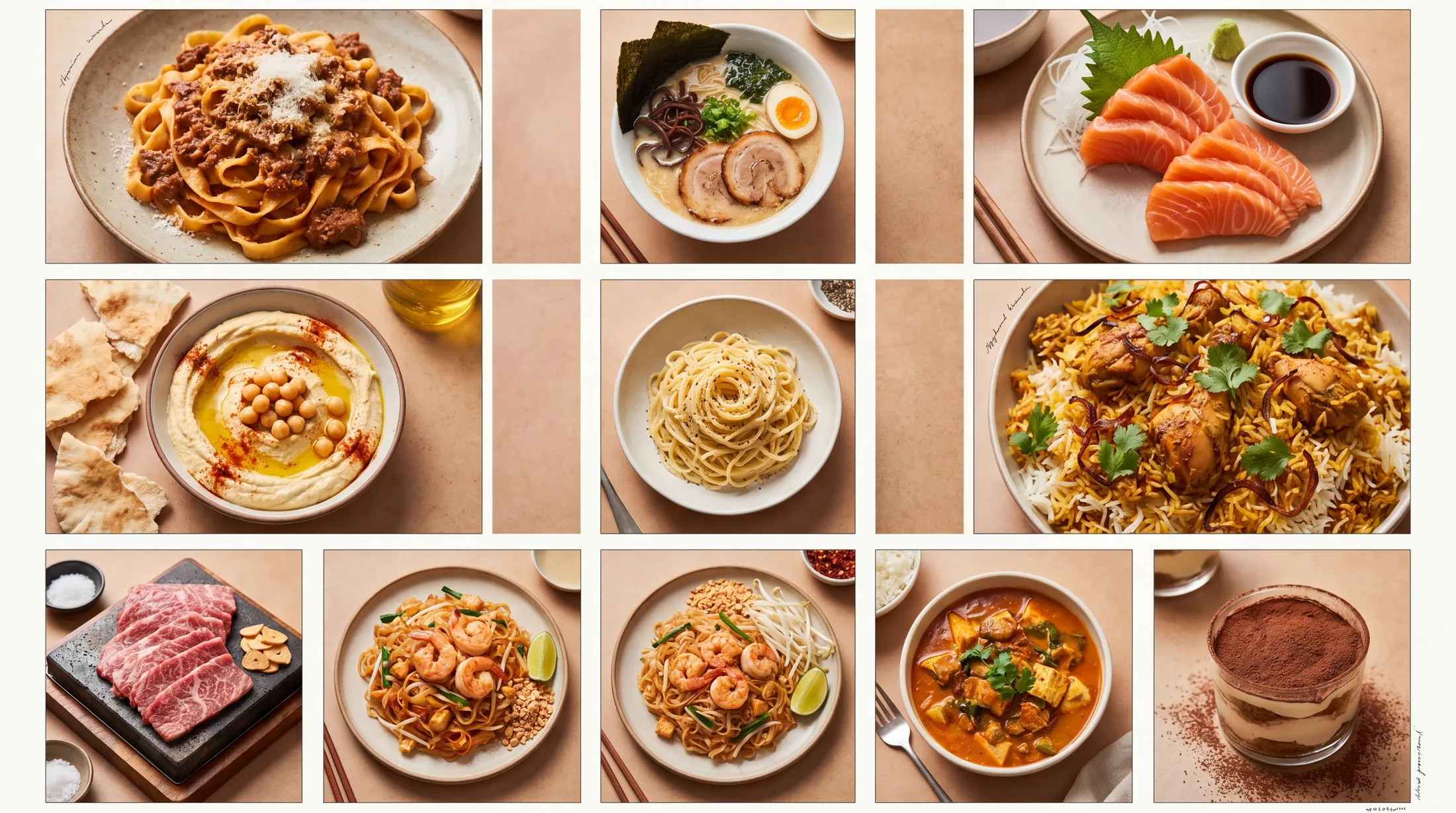
What makes a restaurant ad actually drive bookings?
TL;DR — Key Takeaways
High-converting restaurant ad templates share three traits: a single dish hero image, a clear value statement (price, time-limited, or unique), and a low-friction CTA (book, scan, order).
The best image-to-text ratio for food ads in 2026 is 80/20 — the dish dominates, the copy is minimal. Crowded ads with multiple dishes and long taglines underperform.
12 ad templates that consistently work in 2026 are listed below, organized by occasion (lunch promo, weekend booking, seasonal launch, social-media reel, delivery platform).
AI-generated dish photos perform identically to studio photos in ad-platform A/B tests. The performance gap between platforms (Meta vs TikTok vs Google) is much larger than the gap between AI and studio imagery.
Tools like Intermenu's Ad Template Library let operators fill in variables (price, dish, tagline) and drop in their reference dish image — finished, on-brand ad creative in minutes.
What makes a restaurant ad actually drive bookings?
Three things, in order of importance.
1. A specific, single dish hero. The restaurant ads that convert show one dish, photographed beautifully, that the viewer can imagine eating in the next 30 minutes. Multi-dish "see our menu" ads almost always underperform single-dish ads. The viewer's brain can't simultaneously crave four dishes.
2. A clear, narrow value statement."€12 lunch special until 3pm" beats "Authentic Italian cuisine in a warm atmosphere." Specificity is what converts. Price is the most common value statement; time-limited offers and unique dishes are the others.
3. A low-friction CTA."Book a table" with one tap to a reservation form. "Scan to view menu" with a QR. "Order now" with a tap to delivery. The path from ad to action must be one step. Two-step paths halve conversion.
Beyond these three, everything else (color palette, copy tone, design polish) is secondary. A simple ad with a great single-dish photo and a specific value statement will outperform a complex, beautifully designed ad without those elements.
What's the best image-to-text ratio for food ads?
For 2026,80% image, 20% text is the working benchmark across Meta, Google and TikTok ad placements.
The dish image dominates the frame
A short headline (5–8 words) sits in the lower third or as an overlay corner
A small CTA button is the third element
Nothing else
Three patterns to avoid:
1. Centered text over the food. Hides the most important element. Move text to a corner.
2. Multi-column layouts. Dish on the left, copy on the right looks like a menu spread, not an ad. Use one full-image with overlay copy.
3. Logos larger than the dish. Branding matters but the dish is the hook. Logo small, dish big.
Modern ad platforms (Meta in particular) historically penalized ads with more than 20% text in the image. While the strict rule has been relaxed in 2026, the performance penalty for text-heavy ads persists. Text-heavy ads cost more per click and convert worse.
How do you A/B test food ads?
The five highest-leverage A/B tests for restaurant ads in 2026:
Test 1: Single dish vs multi-dish. Same campaign, same copy, two image variants. Single-dish wins consistently, but the magnitude varies by cuisine.
Test 2: Price-led headline vs benefit-led headline."€12 lunch special" vs "Made fresh, served fast." Price-led wins for casual restaurants; benefit-led wins for fine dining.
Test 3: AI photo vs studio photo. Most operators expect studio to win; in tested results, the conversion difference is statistically insignificant. The cost difference is enormous.
Test 4: Photo style — overhead vs angled. Different cuisines respond differently. Asian noodle dishes convert better at top-down. Steaks and grilled items convert better angled.
Test 5: CTA copy — "Book now" vs "Reserve your table" vs "Tap to order."Verb choice matters. "Order" beats "view menu" when the goal is delivery; "Book" beats "Reserve" for sit-down by 5–10% in tested results.
Run each test for at least 1,000 impressions before deciding. Below that, the data is noisy.
Should an ad show the restaurant or the dish?
The dish, almost always.
Restaurant interior photography ("come for the atmosphere") underperforms dish photography on every measurable conversion dimension in 2026. The reasons:
Diners click through to find food, not architecture.
Interior photos rarely communicate cuisine specifics.
Generic "warm restaurant ambience" reads as stock imagery, even when authentic.
Competing restaurants all use similar interior aesthetics.
Two exceptions where interior photography earns its place:
1. Seasonal atmosphere campaigns (e.g., outdoor terrace in summer, fireplace in winter). The atmosphere itself is the hook.
2. Brand-cornerstone awareness ads for high-end restaurants where the experience is the product. Even here, dish-led ads usually win on conversion; interior ads win on brand recall.
The 80/20 rule: 80% of restaurant ad spend should be on dish-led creatives, 20% on atmosphere or brand work.
What seasonal ad formats work year-round?
Twelve ad templates that consistently convert across markets, organized by occasion. Each one is built around the principles above: single dish hero, narrow value statement, low-friction CTA.
Template 1: Lunch special
Image: single hero dish, overhead, warm light
Copy:"Today's lunch — [dish name] + drink — €X until 3pm"
CTA:"Book table" or "Scan menu"
Best for: Tuesday-Thursday traffic, business-district restaurants
Template 2: Weekend booking push
Image: flagship signature dish, generous portion visible
Copy:"Saturday tables filling up. [Restaurant Name] — [neighborhood]"
CTA:"Reserve now"
Best for: Thursday and Friday evening boost
Template 3: Seasonal launch
Image: new seasonal dish, ingredient-forward composition
Copy:"Summer menu — [signature seasonal dish] now serving"
CTA:"View menu"
Best for: quarterly menu transitions
Template 4: Reel / short-form video
Image: sequence of three quick dish shots, 1.5 seconds each
Copy: minimal overlay, voiceover or captions
CTA: end-card with "Reserve your table"
Best for: Instagram Reels, TikTok, YouTube Shorts
Template 5: Delivery platform creative
Image: dish in takeaway container, slightly elevated angle
Copy:"Free delivery on orders above €25 — Today only"
CTA: Platform-specific (Uber Eats, DoorDash button)
Best for: off-peak delivery push
Template 6: First-visit incentive
Image: popular comfort dish, visible portion size
Copy:"First visit? Welcome drink on the house"
CTA:"Book table"
Best for: new-customer acquisition
Template 7: Loyalty / repeat visit
Image: the customer's previously ordered favorite (personalized)
Copy:"Missed you. Your table is ready when you are"
CTA:"Reserve"
Best for: retargeting prior diners
Template 8: Holiday / event
Image: holiday-themed plating (Christmas, Valentine's, etc.)
Copy:"[Holiday] menu now booking — [date range]"
CTA:"Book holiday table"
Best for: seasonal peak weeks
Template 9: Allergen-aware ad
Image: clean dish with visible allergen-free credentials
Copy:"Gluten-free / vegan menu — filterable in our digital menu"
CTA:"Browse menu"
Best for: dietary-restricted audience targeting
Template 10: Tourist-area multilingual
Image: dish + small flag-icon array showing language support
Copy:"Menu in 15 languages — [Restaurant Name], [City]"
CTA:"Scan to view"
Best for: tourist-zone targeting, airports, hotel-area placements
Template 11: Chef's signature spotlight
Image: chef-prepared dish, slightly more artistic angle
Copy:"[Chef Name]'s signature: [dish name]"
CTA:"Reserve to try"
Best for: building chef brand and fine-dining bookings
Template 12: User-generated-content style
Image: dish photographed in a casual, "guest" style (achievable via AI Composer)
Copy: simple guest-quote framing — "Hands down the best [dish] in [city]" — [@guesthandle]
CTA:"See for yourself"
Best for: social-proof-driven Meta and TikTok ads
Each template above is a starting structure, not a fixed design. Within each, the dish, copy, and CTA can be customized for the restaurant's specifics. The pattern stays consistent.
How AI-generated dish photos perform in ad creatives
This is one of the most-tested questions in 2026 restaurant marketing. The findings:
Conversion parity: in controlled A/B tests on Meta and Google, AI-generated dish photos and studio photos convert at statistically indistinguishable rates. The performance gap is essentially zero.
Cost gap: AI photos cost roughly 1% of equivalent studio photos. The cost-per-conversion math overwhelmingly favors AI for ad creative production.
Refresh frequency: AI imagery enables ad creatives to refresh weekly or even daily — important for combat ad fatigue, which suppresses ad performance after 7–14 days of unchanged creative. Studio photography can't refresh at this cadence.
Personalization: AI can generate slight variations of the same ad (different angle, different garnish, different lighting) for personalized retargeting. Studio photography is one-and-done.
The practical implication: most restaurants in 2026 produce ad creatives entirely from AI imagery, refresh them weekly, and reserve professional photography only for cornerstone brand campaigns.
How to structure an ad creative production workflow
The 2026 reference workflow for ongoing restaurant ad production:
Step 1 — Set the brand style anchor. The same anchor used for menu photography (lighting, surface, style) carries to ad creatives.
Step 2 — Pick a template from a library. Tools like Intermenu's Ad Template Library include the 12 templates above plus dozens more, pre-built for the most common restaurant scenarios.
Step 3 — Fill in variables. Dish name, price, time-limited offer, CTA copy. The template handles layout and proportions.
Step 4 — Drop in the reference dish image. Either a phone photo of the actual dish or an AI-generated image from your menu library. The platform locks the dish identity and generates the polished ad creative.
Step 5 — Translate copy if needed. Multilingual ads run cleaner when the platform handles translation alongside ad generation. (This is one of the natural integration points between menu translation and ad production — same translated dish names, same brand voice.)
Step 6 — Push to ad platforms. Direct integrations to Meta Business Manager, Google Ads, TikTok Ads where the platform supports them; manual upload otherwise.
Step 7 — Refresh weekly. Generate 2–3 ad variants per week to combat ad fatigue.
This workflow takes 10–20 minutes per ad creative, vs hours of design time for a manually produced ad. The output is on-brand, dish-accurate, and platform-optimized.
Frequently Asked Questions
What makes a restaurant ad actually drive bookings? Three things: a single dish hero image, a clear value statement (price, time-limited, or unique), and a low-friction CTA. Skip the fluff.
What's the best image-to-text ratio for food ads?80% image, 20% text. The dish dominates; the copy is minimal. Text-heavy ads cost more per click and convert worse on every major platform.
How do you A/B test food ads? Test single-dish vs multi-dish, price-led vs benefit-led headlines, AI vs studio photography, photo angle, and CTA verb. Run each test for 1,000+ impressions for reliable results.
Should an ad show the restaurant or the dish? The dish, in 80% of cases. Interior photography earns its place only for seasonal atmosphere campaigns and brand-cornerstone awareness ads.
What seasonal ad formats work year-round? The 12 templates above (lunch special, weekend booking, seasonal launch, reel, delivery, first-visit, loyalty, holiday, allergen-aware, tourist-area, chef spotlight, UGC-style) cover most restaurant scenarios. Customize within each template.
Browse 50+ Ad Templates Ready in 15 Languages
If you've been making ad creatives in Canva or Photoshop one at a time, the modern stack collapses the work to minutes per ad. Intermenu's Ad Template Library includes the 12 templates above plus dozens more, pre-built for restaurant scenarios across 15 languages. Drop in your dish reference, fill in the variables, get a finished ad creative.
Browse the template library and run your next ad campaign in an afternoon →