
Voice Ordering, AI Concierge & What's Next for Restaurant AI
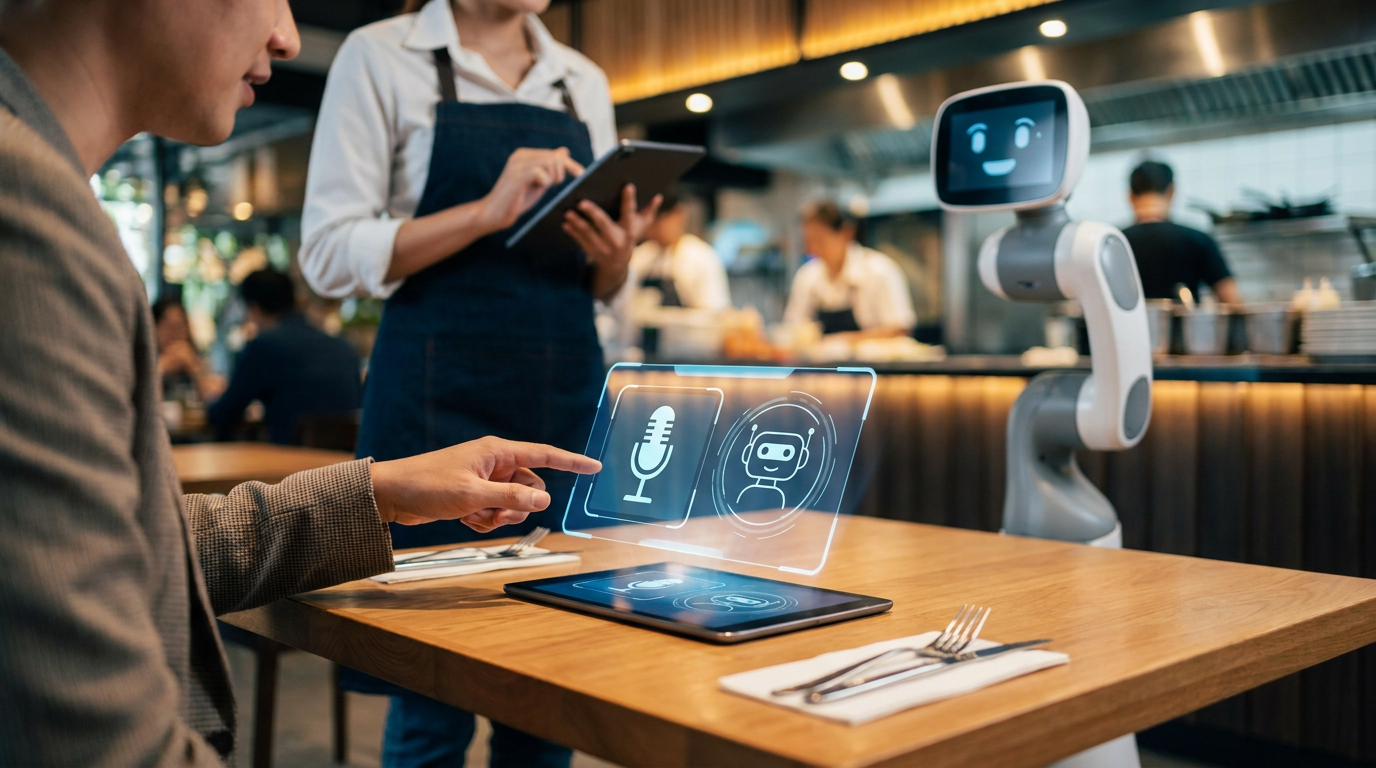
Are voice ordering and AI concierge ready for restaurants in 2026? Where AI works, where it doesn't, and what to deploy now.
TL;DR — Key Takeaways
AI in 2026 restaurants is most useful in the production layer (translation, photography, ad creatives, pattern recognition) and least useful in direct guest interaction (chatbots, voice ordering at the table).
Voice ordering works in specific contexts: hotel room service, drive-thrus, quick-service. It does not work well at sit-down restaurant tables, where servers remain better.
AI concierge — guidance for guests about cuisine, dishes, dietary recommendations — is the fastest-growing useful application of AI in 2026 restaurant operations.
Small restaurants do not need to "compete" with AI hype. The proven applications (translation, photography, marketing automation) are accessible and high-ROI; the experimental applications can wait.
AI will augment, not replace, the human dining experience. The 2030 outlook: AI does the production work, humans do the hospitality work.
Are voice-ordering systems ready for restaurants in 2026?
Partially. The use cases divide cleanly:
Voice ordering works well:
Hotel room service— guest in their room, alone, wants efficient ordering. AI understands menu queries, handles dietary preferences, places orders. Mainstream at upper-tier hotels.
Drive-thrus— fast-food and quick-service contexts where voice ordering is the natural interface. AI replacing human drive-thru order takers in many chains.
Quick-service counter ordering— kiosk or speaker-based ordering for cafes, fast-casual, food courts. Working production deployment in many chains.
Voice ordering doesn't work well:
Sit-down restaurant table service— the social hospitality of the server-guest interaction is the value; AI replacing it loses the experience.
Wine and complex dining decisions— guests want sommelier recommendations, not AI suggestions, in fine-dining contexts.
Allergen-sensitive or dietary-restriction conversations— high-stakes interactions where human judgment and reassurance matter.
The 2026 strategic reading:
Voice ordering is a useful production tool for specific contexts. It's not a universal replacement for the server-guest interaction in sit-down dining. Operators who try to deploy voice ordering broadly typically retreat after 6-12 months when guest satisfaction drops.
What does an "AI concierge" actually do?
AI concierge in 2026 restaurants typically refers to AI-powered guest guidance — recommendations, dietary support, cultural context.
Common AI concierge applications:
1. Dish recommendations. A guest tells the AI their preferences ("I don't eat shellfish, I like spicy food, I want something traditional"); the AI surfaces 3-4 dishes from the menu that match.
2. Dietary safety guidance. A guest with a severe allergy asks "which dishes are safe for me?"; the AI surfaces only allergen-safe options based on the structured allergen tagging.
3. Cultural context. A tourist asks "what's cacio e pepe?"; the AI explains the dish, its tradition, and what to expect.
4. Wine pairing. A guest tells the AI what they're ordering; the AI recommends matching wines.
5. Menu navigation in the guest's language. The AI handles cross-language guidance for tourists who don't speak the local language.
Where AI concierge works in 2026:
Within the digital menu interface (chat-style queries about the menu)
In hotel room service interfaces
As an optional guest-side tool, not a replacement for human service
The 2026 best-practice: AI concierge as an optional layer on top of human service, not a replacement for it.
Should small restaurants worry about AI hype?
No. Two reasons:
Reason 1 — The proven AI applications are already accessible.
The AI tools that genuinely lift small-restaurant operations are widely available:
AI translation in hospitality menu platforms
AI dish photography
AI ad creative generation
AI menu engineering analytics
AI customer feedback analysis
These are accessible at $15-$60/month subscription tiers and produce real, measurable returns.
Reason 2 — The hype-cycle applications are mostly enterprise-only.
The buzzy AI applications (autonomous server robots, AI sommeliers, AR menus) are mostly available only at scale, marginally useful in real operations, and experimental rather than production-grade.
Intermenu sits in the proven-applications category — accessible to independent restaurants, focused on translation, photography, and operational AI rather than experimental robotics.
What's automatable today vs in 2 years?
Automatable today (2026)
Menu translation across every language your guests read
Dish photography (AI-generated)
Ad creative generation
Email marketing personalization
Menu engineering analytics
Reservation reminder workflows
Basic customer service inquiries
Loyalty tracking
Cross-channel marketing distribution
Becoming automatable by 2028
Voice ordering for table service in casual contexts
AI sommelier interactions for wine pairing
AI-driven dynamic pricing
AI-driven inventory forecasting at small-restaurant scale
Sophisticated AI customer service for complex queries
Real-time menu personalization based on guest preferences
Likely to remain human-led through 2030
Hospitality and emotional connection at the table
Wine recommendations at fine dining
Complex dietary accommodations
Brand-defining guest interactions
Kitchen creativity and dish development
Strategic decisions about restaurant identity and direction
The pattern: AI handles the production and routine operations; humans handle the hospitality, creativity, and strategy. This division is likely stable through the late 2020s.
Will AI replace servers or augment them?
For the foreseeable future: augment.
Why servers remain essential:
The dining experience is fundamentally social
Servers handle complex, fluid, emotional situations AI struggles with
Guests value the human attention and care
Trust-building (allergen confirmation, dietary accommodation) benefits from human judgment
The shifted server role in 2026:
Less time translating menus → more time being hospitable
Less time confirming allergens → more time recommending pairings
Less time on routine inquiries → more time on memorable moments
Less time on data entry → more time on guest relationships
The result: servers in 2026 spend more of their time on the hospitality work that makes restaurants distinctive, and less on the routine work that AI handles invisibly. This is a positive shift for both servers and guests.
Frequently Asked Questions
Are voice-ordering systems ready for restaurants in 2026?
Partially. Works for hotel room service, drive-thrus, quick-service. Doesn't work well for sit-down table service where servers remain better.
What does an "AI concierge" actually do?
Dish recommendations, dietary safety guidance, cultural context, wine pairing, menu navigation in the guest's language. Best as an optional layer on top of human service.
Should small restaurants worry about AI hype?
No. Adopt the proven AI applications (translation, photography, ad creatives, analytics). Skip the hype.
What's automatable today vs in 2 years?
Today: translation, dish photography, ad creatives, marketing personalization, menu engineering analytics. By 2028: voice ordering for table service, AI sommelier, dynamic pricing, sophisticated customer service.
Will AI replace servers or augment them?
Augment, for the foreseeable future. AI handles production and routine operations; servers handle hospitality, complex situations, and emotional connection.
Ready for AI-Driven Menus Today
The accessible 2026 AI applications are the foundational ones — translation, photography, structured data, smart analytics. They're production-grade, affordable, and they compound over time.
Intermenu bundles these into one platform — multilingual menu, AI dish photography, smart allergen filtering, ad templates — for independent restaurants ready to adopt the proven AI applications without chasing the hype.
If you've been waiting for AI to "be ready" before adopting, the foundational layer is ready and worth an afternoon →