
Menu Pricing Psychology: When $9.95 Outsells $10
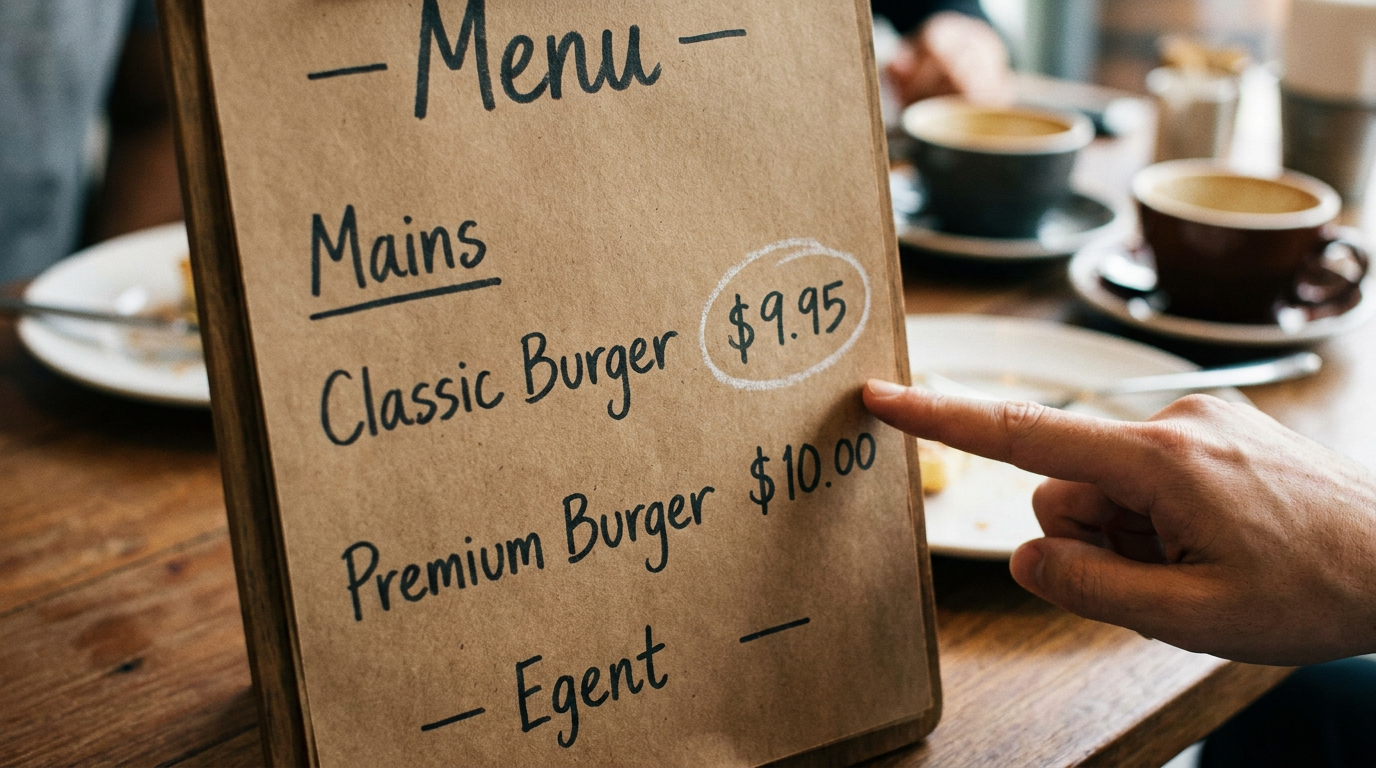
Why $9.95 outsells $10 — and when it does not. The psychology behind menu price points.
TL;DR — Key Takeaways
Charm pricing ($9.95 vs $10.00) consistently lifts perceived value at casual restaurants — typical lift on order rate is 5-15% across A/B tests in 2026.
At fine dining, charm pricing reverses: $48 outperforms $47.95. The cleaner number signals confidence and quality.
Dropping currency symbols entirely ($, €, £) lifts AOV 5-10% in fine-dining contexts.
Price anchoring works — placing a high-priced dish first in a category makes the rest of the category feel more reasonable.
Decoy items lift overall AOV when used judiciously.
Tools like Intermenu make the price change itself instant; the sales side of any pricing test comes from your POS, compared by hand before and after.
Should I drop dollar/currency signs from my menu?
The data-backed answer: depends on the restaurant tier.
Drop the currency symbol if:
Fine dining or upscale casual
Average check above $40-50 per cover
Brand positioning is "experience over transaction"
International tourist mix is high (currency clarity at the top of the menu, numerical prices without symbol)
Keep the currency symbol if:
Casual and family dining
Average check below $25 per cover
Guests value transparency and clear pricing
Quick-service or fast-casual context
The mechanism: in fine-dining contexts, the currency symbol is a "you are spending money" signal that introduces friction. Removing it reduces the friction without removing the actual price.
Why do restaurants use $9.95 instead of $10?
Charm pricing — ending prices in .95, .99, or .49 — is one of the oldest pricing tactics in restaurant operations.
The "left-digit effect": the human brain partially processes prices left-to-right. $9.95 reads as "9-something" before the "0.95" registers. The dish feels like it costs $9, not $10.
The "good deal" signal: charm prices signal that the operator priced carefully and aggressively.
The "fair price" anchor: $9.95 reads as a deliberate, calculated price. $10 reads as round and arbitrary.
The data: Across thousands of restaurant A/B tests, charm pricing typically lifts order rate 5-15% on the affected dish in casual contexts. The lift is smaller in mid-tier and reverses at fine dining (clean numbers signal confidence).
What is price anchoring and how do I use it?
Price anchoring is the practice of placing a high-priced item near other items to make those other items feel more reasonable.
The classic implementation: A category lists three pasta dishes:
$32 — Tagliatelle al Tartufo (truffle, premium)
$24 — Tagliatelle al Ragù (signature)
$19 — Spaghetti alla Carbonara (classic)
Without the $32 truffle dish, $24 might feel expensive. With the $32 dish anchoring the top, $24 reads as the reasonable middle. The truffle dish does not need to be the bestseller — its job is to make the $24 dish feel like a deal.
Practical implementation: Each menu category should have a clear high-anchor (often a specialty or premium dish). The middle range items become the "reasonable" choices. Lower-priced items become the "value" choices.
Are decoy items effective for upselling?
Yes, when used judiciously. A decoy item is deliberately priced to make another item look more attractive.
Pattern 1 — Premium decoy (most common):
Item A: $25 (the dish you want to sell)
Item B (decoy): $35 (a slightly larger or fancier version)
Result: Item A feels like the smart choice; orders concentrate on A
Pattern 2 — Bundling decoy:
"Soup" — $8
"Soup + main" — $25 (the dish you want to sell)
"Soup + main + dessert" — $40 (decoy)
Result: the middle option feels like best value
When decoys work: When they are plausibly desirable (the decoy must be a real option, not absurd). When the differential is psychologically meaningful ($3-5 differences work better than $0.50). When they are not too obvious (overuse signals manipulation).
Should pricing be different on QR vs printed menus?
Generally no — and definitely not by design. Consistency builds trust. Different pricing across formats invites complaints.
The 2026 architectural answer: The digital menu is the source of truth. The printed menu is a derivative — generated from the digital master. They should always match.
A/B testing menu prices
Modern menu platforms support A/B testing of menu prices in two modes:
Sequential testing
Run version A for two weeks, then version B for two weeks. Compare AOV, order rates across the two periods. Less rigorous statistically but easier to implement.
Split testing
50% of guests see version A, 50% see version B. Run for the same period. Higher statistical confidence. Requires the menu platform to support it.
What is worth A/B testing: Price points on key dishes ($24 vs $25 vs $26). Charm pricing vs clean pricing. Currency symbol vs no currency symbol. Description rewrites with same price.
Sample size: For statistical confidence, aim for 200+ orders of the dish per version. Below that, the data is noisy.
Intermenu makes sequential testing practical: change a price in seconds, let it run, and compare the dish's POS sales before and after — by hand, rather than guessing.
Common pricing mistakes to avoid
Five specific patterns that consistently underperform:
1. Round numbers across the board. All prices ending in clean numbers ($10, $15, $20) feels arbitrary. Mix charm pricing with clean pricing strategically.
2. Inconsistent ending digits. $9.95, $11.50, $12.99, $14.25 — random pattern signals carelessness.
3. No high-anchor in any category. Without a high-priced anchor, the middle prices feel maximally expensive.
4. Identical pricing on similar dishes. Three pastas all priced at $18 forces the guest to choose by name alone.
5. Price increases that look reactive. Going from $14 to $15, then $15 to $16 a few months later, looks like reactive pricing.
Frequently Asked Questions
Should I drop dollar/currency signs from my menu?
At fine dining, yes (typical 5-10% AOV lift). At casual, no (transparency expectations are higher).
Why do restaurants use $9.95 instead of $10?
The "left-digit effect" — $9.95 reads as "9-something" before the cents register. Charm pricing typically lifts order rates 5-15% in casual contexts.
What is price anchoring and how do I use it?
A high-priced item placed near other items makes those other items feel more reasonable.
Are decoy items effective for upselling?
Yes, judiciously. Three patterns: premium decoy, bundling decoy, asymmetric decoy.
Should pricing be different on QR vs printed menus?
Generally no. Same pricing across formats; digital is the source of truth.
A/B Test Menu Prices With QR Analytics
Menu pricing decisions used to be guesses. In 2026, they can be measured.
Intermenu lets you change prices, descriptions and positioning in seconds and shows how often each dish is opened; the sales side of the test comes from your POS, compared by hand.
If your menu prices have been the way they have always been for years, see what real pricing experimentation looks like →