
Menu Translation Software: Cost-Effective and Fast
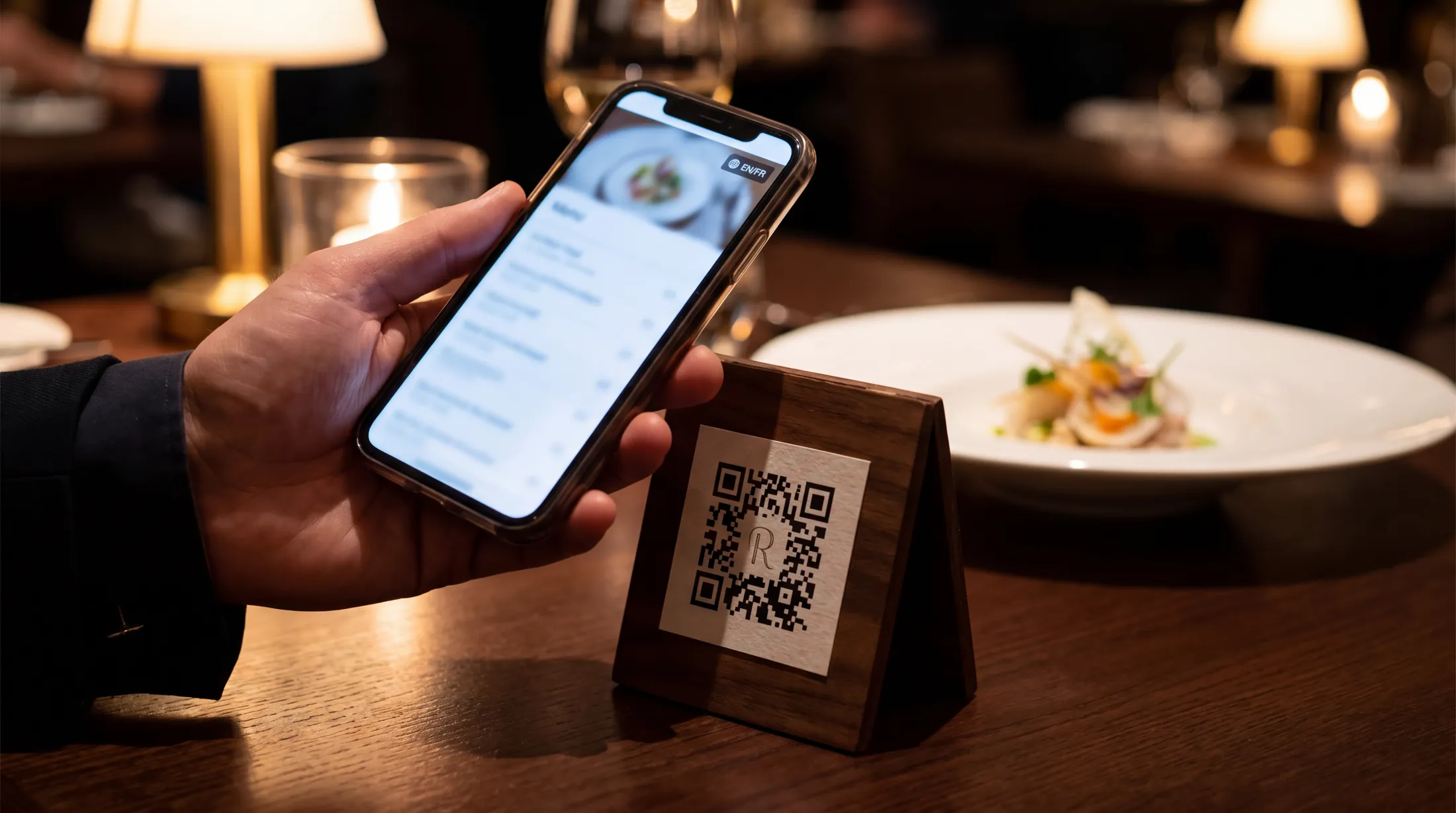
Restaurant operators evaluating menu translation in 2026 keep asking the wrong question. They want to know whether AI translation is "good enough" to replace a human translator. The honest answer is: for most of your menu, yes — but for the parts that define your guest experience, the right setup combines both.
TL;DR — Key Takeaways
Professional menu translation costs $150–$400 per language and takes 3–7 business days. Hospitality-trained AI translation costs roughly $0.001 per word and runs in under 60 seconds.
For a 100-item menu in 10 languages: a translation agency will invoice $1,500–$4,000; an AI tool with hybrid human review will cost $200–$600; pure AI alone will run under $50 a month including unlimited updates.
Generic AI tools (free Google Translate, untrained ChatGPT) have an estimated 8–15% error rate on food-specific content. Hospitality-trained AI sits at roughly 1–2%, comparable to a tired junior translator.
Hire a human translator only for the 20% of items that drive 80% of orders, plus the allergen disclosures. Run AI on the rest.
Google Translate is not a viable production tool for restaurant menus in 2026, even though it is technically free.
The real question is not "AI or human" — it's "where does each one belong?"
Restaurant operators evaluating menu translation in 2026 keep asking the wrong question. They want to know whether AI translation is "good enough" to replace a human translator. The honest answer is: for most of your menu, yes — but for the parts that define your guest experience, the right setup combines both.
This article gives you the actual numbers, the actual quality differences, and a decision framework you can use to choose the right translation method for your restaurant in under ten minutes.
How much does professional menu translation cost in 2026?
Professional human translation for restaurant menus in 2026 typically costs:
$0.15 to $0.30 per word through a translation agency
$150 to $400 per language for a typical 50-item menu (roughly 1,000 words)
$0.04 to $0.08 per word for human post-editing of an AI draft (the "hybrid" rate)
For a single 50-item menu translated into five languages, you should expect to pay between $750 and $2,000at agency rates, with a turnaround of5–10 business days. Add a rush fee of 25–50% for anything under five days.
These numbers are not negotiable in any meaningful way. Translation agencies have priced this work at this level for the past decade, and 2026 is no different. What has changed is that you no longer need to send your entire menu to an agency to get a high-quality multilingual menu. You can split the work.
How accurate is AI menu translation in 2026?
AI menu translation accuracy depends almost entirely on whether the engine is trained on hospitality content.
Generic AI tools— free Google Translate, default DeepL, ChatGPT or Claude with no system prompt — produce error rates of roughly 8–15% on food-specific content. The errors are not always wrong words. They are often correct words that are wrong in context: rendering coq au vin as "rooster wine," translating carpaccio as "thinly sliced raw beef" (which is technically correct but no Italian restaurant would ever phrase it that way), or losing the dish name entirely in a fluent-sounding paraphrase.
Hospitality-trained AI engines— tools built specifically for restaurant menus, with training data drawn from professional menu translations, allergen databases and culinary glossaries — have brought error rates down to roughly 1–2%. That sits right around the level of a junior human translator working on a tired Friday afternoon. Platforms like Intermenu sit in this category: the owner enters the menu once in their own language, and the engine handles dish-name preservation, allergen names and cuisine context across every language you switch on without manual prompting. For most of a menu, this is more than acceptable.
The gap between generic and hospitality-trained AI has actually widened in 2026, not narrowed. As more restaurants adopt hospitality-specific AI, those engines accumulate more training data, while generic models continue to optimize for general use cases that don't include "the difference between bagna cauda and fonduta."
When should restaurants hire a human translator?
You should pay a human translator for four specific cases:
1. The top 20 most-ordered dishes on your menu. These are where guest perception is concentrated. A perfect translation here lifts the perceived quality of the whole menu. An awkward translation here pulls it down.
2. Your allergen disclosures. Allergen text has legal and safety implications. Even a 1% error rate on allergen translation is an unacceptable error rate. Have a native speaker review every allergen line in every language, before it ships.
3. Culturally specific dishes with no direct translation. Cacio e pepe, bibimbap, moussaka, kibbeh nayyeh, poke, omakase— these translate poorly through any AI because they are cultural references first and recipes second. Have a native speaker write the explanatory line.
4. Your menu introduction and chef's note. This is brand voice. Brand voice is the one thing AI flattens. Pay a human to write the welcome paragraph, the chef's biography and any seasonal storytelling.
For everything else — your standard sides, your beverage descriptions, your "served with rice" supplementary text — AI translation is fine.
What's the cost difference for 5 languages vs 15?
This is where the AI cost advantage becomes overwhelming.
Languages Agency Translation (one-time) Hospitality AI (annual subscription) Hybrid (AI + human review) 5 languages $750 – $2,000 ~$150 – $600 $200 – $600 10 languages $1,500 – $4,000 ~$150 – $600 $400 – $1,200 15 languages $2,250 – $6,000 ~$150 – $600 $600 – $1,800
Three things become obvious from this table.
First, AI cost does not scale with language count in any meaningful way. The marginal cost of adding the eleventh, twelfth or fifteenth language is negligible. For agency translation, every new language is a new line item.
Second, the hybrid approach is the smart middle path for most restaurants. You get AI's cost advantage on volume plus human accuracy on the dishes that matter.
Third, agency-only translation is now reserved for premium luxury restaurants where the budget genuinely doesn't matter and the brand demands flawless prose in every language. For everyone else, hybrid wins on every dimension.
Does Google Translate work for restaurant menus?
No. And the reason is not what most operators think.
The standard objection to Google Translate is that the translations are wrong. That used to be true. In 2026, Google Translate's basic accuracy on common languages is genuinely good — comparable to other generic AI tools.
The real reasons Google Translate fails as a production tool for restaurant menus are different:
It can't tag allergens as data. Google Translate translates the words "contains nuts." It cannot translate a structured allergen tag attached to a dish, which is what allergen-disclosure compliance actually requires.
It doesn't preserve dish names. Google Translate will translate risotto allo zafferano into "saffron risotto" in English, "Safranrisotto" in German, and "番红花烩饭" in Mandarin. None of those translations help a guest order the dish. The dish name should stay in Italian, with the translation as supporting context.
It doesn't update when your menu updates. Every time you change a dish, you have to re-paste your menu into Google Translate, copy the output, paste it into your menu, and repeat for every language. Within a month, you stop doing it.
It doesn't handle currency, formatting, or layout. The output is plain text. You still have to manually format it into a menu. Multiplied across every language you offer, this is a part-time job.
It produces no analytics. You can't see which translated menu version drove the most orders, which language tourists spent longest on, or where they bounced. You're flying blind.
Google Translate is fine for a tourist asking "where is the bathroom" in Bangkok. It is not a production tool for a restaurant menu that will be the daily face of your business to international guests. The economics of running a restaurant cannot afford the cumulative friction.
A real cost comparison: 100 items × 10 languages × 4 methods
Here is what the same 100-item menu actually costs in 2026 through the four methods, including the hidden costs operators usually miss:
Method 1 — Agency translation, fully human:
Up-front: $3,000–$4,000
Per update: $30–$50 per change × every language
Annual cost (assuming 4 menu updates): $4,200–$6,000
Speed to launch: 7–10 days
Speed to update: 3–5 days per change
Method 2 — Hybrid (AI base + human review of top items):
Up-front: $400–$800 (AI subscription + initial human review)
Per update: AI handles all updates instantly; human reviews any changes to top 20 dishes
Annual cost: $700–$1,400
Speed to launch: 1–2 days
Speed to update: under a minute (AI), 1 day for top-20 review
Method 3 — Hospitality-trained AI only:
Up-front: ~$50 (one month of subscription)
Per update: included
Annual cost: $150–$600 depending on plan
Speed to launch: under 1 hour
Speed to update: under a minute
Method 4 — Generic AI (Google Translate / free tools):
Up-front: $0 in tool cost, but ~10 hours of staff time per language for formatting and pasting
Per update: another 10 hours of staff time per change
Annual cost: $0 in tools, but 100+ hours of staff time × $20/hour = $2,000+ in labour
Speed to launch: 2–3 days
Speed to update: half a day per change
Hidden cost: roughly 8–15% of dish translations are subtly wrong, which costs reputation and check-size every service
The cheapest visible option (free Google Translate) is the most expensive once you account for staff time and quality loss. The most expensive visible option (full agency) is overkill for everything except the dishes that matter most.
What's the right setup for most restaurants?
For independent restaurants serving 50–200 covers a night with international tourist exposure, the right setup in 2026 is:
A hospitality-trained AI translation engine running on a monthly subscription, generating all your translations across all your languages.
One native-speaker review pass at launch covering: dish names, descriptions of the top 20 most-ordered items, allergen disclosures, the menu introduction, and the chef's note.
An update workflow that runs AI translation automatically when the master menu changes, then flags any changes to "reviewed" items so a human can quickly re-review them.
A QR code menu as the production format, which makes everything above effortless to deploy.
This setup costs $400–$1,200 in year one and roughly $150–$600 per year after that, regardless of how often the menu changes or how many languages you add. It performs at a quality level a guest cannot distinguish from full agency translation, and it updates in seconds when you change a dish.
For hotel chains and groups with multiple outlets, the same architecture scales — add an editorial layer where corporate brand-voice is enforced across all properties before AI translation runs. This is where hospitality-specific tools differentiate from generic AI: they understand brand-voice consistency at chain scale, and platforms built for the category (Intermenu among them) carry the brand voice cleanly through every language.
Frequently Asked Questions
Will AI-translated menus look unprofessional? Not if you use a hospitality-trained engine. Generic translation tools produce visibly machine-translated output. Hospitality-trained AI produces output indistinguishable from a native human writer on most dish names and descriptions.
Should I use AI for languages I don't speak and human translators for ones I do? This intuition feels right but it's wrong. Human translators are the right call for the items that matter most — regardless of language. AI is the right call for the long tail — regardless of language. Don't filter by your own language ability.
Is hybrid translation worth the extra cost over pure AI? For most restaurants, yes. The marginal cost is small — usually a few hundred dollars at launch — and it covers the 20% of menu items where guest perception is concentrated. Pure AI is the right call only for restaurants on the tightest budgets or with menus that change weekly.
How do I find a freelance translator for the human review step? Look in two places: hospitality-school graduates in the target country (often willing to do small projects), and bilingual servers or hotel staff with kitchen experience. Both are cheaper and better than general translation freelancers, because they understand the dishes.
What about translation accuracy across right-to-left languages like Arabic and Hebrew? Hospitality-trained AI handles RTL languages correctly in 2026. The layout, the script direction and the dish-name preservation all work. Generic AI tools still occasionally break layout. This is one of the bigger reasons to use a hospitality-specific engine.
Can I switch translation methods later if I'm not happy? Yes. Your master menu is the source of truth. You can change which translation engine runs against it without rebuilding anything. Most operators start with pure AI, add human review for top items in month two, and stay on hybrid from then on.
A Quieter Way to Save $2,000–$4,000 a Year
That's the typical annual saving when an independent restaurant moves from agency translation to a hospitality-trained engine paired with a quick human review of top dishes. Intermenu was built around this workflow — translation into every language you switch on (2 on Free, 5 on Básico, unlimited on Pro and Multi), allergen tagging, calorie display and QR-code delivery all in one place.
Worth an hour of curiosity if you're sitting on a translation invoice you've been dreading. See what your menu costs to run →