
Menu Translation by Cuisine: Italian, Japanese, Chinese,
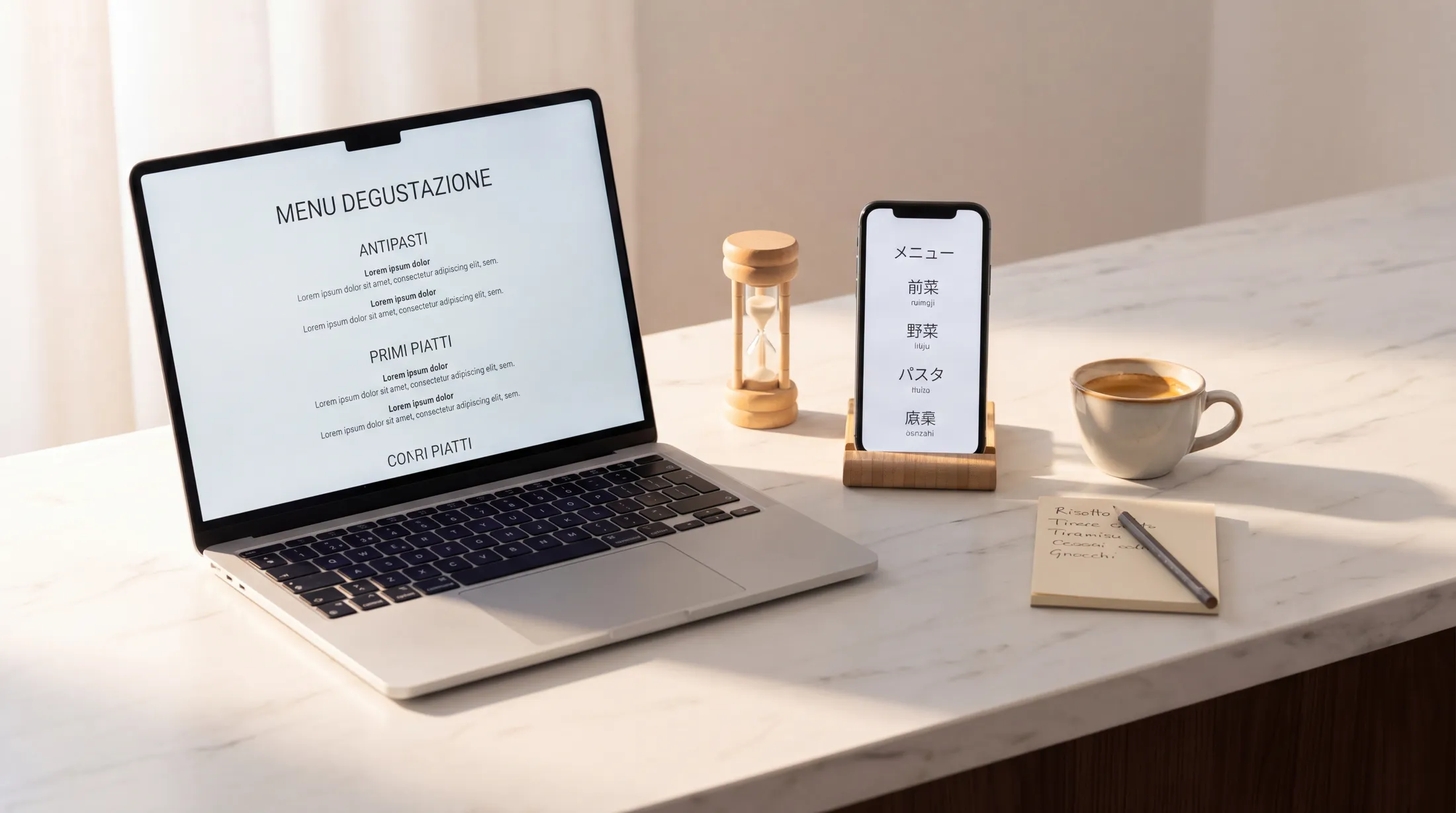
Every cuisine has its own translation traps. The five we cover in this guide — Italian, Japanese, Arabic, Chinese and Indian — are the cuisines most often tourist-served, and the cuisines most often mistranslated. The patterns below come from auditing thousands of multilingual menus and from working with native-speaker reviewers in each language.
TL;DR — Key Takeaways
Italian menus should keep dish names in Italian — translating carbonara into the target language is the most common error and the most damaging one. Add a localized description, never a translated name.
Japanese menus should preserve romaji for dish names (tonkotsu, omakase, kaiseki) with kanji shown alongside for native speakers. Translating a Japanese dish name into English is almost always a downgrade.
Arabic menu translation requires right-to-left layout support, transliteration of dish names (mansaf, kibbeh, fattoush), and respect for halal status as a structured tag rather than a translated phrase.
Chinese menu translation is where literal-translation tools fail most spectacularly — dish names like夫妻肺片and蚂蚁上树must never be rendered word-by-word. Use Pinyin + description.
Indian menu translation must distinguish vegetarian/non-vegetarian status (a deeply important religious distinction in Hindu and Jain contexts) using structured dietary tags, never free text.
Every cuisine has its own translation traps. The five we cover in this guide — Italian, Japanese, Arabic, Chinese and Indian — are the cuisines most often tourist-served, and the cuisines most often mistranslated. The patterns below come from auditing thousands of multilingual menus and from working with native-speaker reviewers in each language.
The meta-rule, which holds across every cuisine: dish names belong to the kitchen's culture, not the diner's. Translate the description, never the name.
1. Italian Menu Translation
Italy gives you the cleanest case for cuisine-respectful translation, because Italian food culture is sufficiently global that most diners already recognize the major dish names. The traps are in the minor dishes and the regional dishes.
Pitfall: translating the dish name
The single most common Italian translation error is treating the dish name as translatable text. Cacio e pepe is the dish name. "Cheese and pepper" is the literal translation. They are not the same thing. The first is what the chef cooks. The second is a customer-service mistake waiting to happen.
This rule applies to:
Pasta names (carbonara, amatriciana, alla genovese, al forno)
Sauce names (pesto, ragù, aglio e olio)
Cooking techniques (al sale, al cartoccio, alla griglia)
Cut and preparation names (scaloppine, involtini, spiedini)
Best practice: original name + localized description
The correct format for an Italian menu translation:
Carbonara Roman pasta with guanciale, egg yolk, Pecorino Romano and black pepper.
The dish name stays in Italian. The description is fully localized into the target language. A native English speaker reading this knows exactly what's coming. So does a native German speaker reading the German version below. The dish name is the same on every version of the menu, which is what makes the order-handling work.
Pitfall: regional cuisines flattened into "Italian"
Italian cuisine is highly regional. Bagna cauda is Piedmontese, not "Italian."Cassoeula is Lombard. Caponata is Sicilian. When the AI translates a regional Italian dish into a generic English description, it flattens the geography that gives the dish its identity.
Best practice: keep the regional anchor
Translate bagna cauda as "warm Piedmontese garlic-and-anchovy dip with raw vegetables" — not "Italian dipping sauce." The regional reference is part of why a guest is ordering from your menu in the first place.
Pitfall: Italian wine and beverage names
Italian wine names should always stay in Italian. "Brunello di Montalcino" is the wine. "Brown one of Montalcino" is what generic AI sometimes produces. This applies equally to amari (Fernet-Branca, Cynar, Averna), grappa types, and regional aperitivi.
2. Japanese Menu Translation
Japanese is the cuisine where Western menu translation tools fail most often, because the writing system, the dish naming conventions, and the cultural conventions for ordering are all different from Western norms. The good news is that hospitality-trained AI handles Japanese well in 2026 if it's set up correctly.
Pitfall: choosing kanji vs hiragana vs romaji vs all three
A common mistake is using only one writing system. Japanese diners often want to see the kanji (precise meaning), but a tourist with no Japanese will be lost. A romaji-only menu insults Japanese diners; a kanji-only menu is unreadable to almost everyone else.
Best practice: dish name in kanji + romaji, description in target language
The correct format for a Japanese restaurant menu, in the English version:
豚骨ラーメン (Tonkotsu Ramen) Rich pork-bone broth with thin straight noodles, chashu pork, marinated egg, and scallions. Hakata-style.
The kanji preserves the precise meaning for any Japanese-reading diner. The romaji gives the tourist a way to pronounce and order. The description in the target language tells the tourist what's arriving.
For a full multilingual setup, the kanji + romaji stays constant across every language version. Only the description rotates.
Pitfall: translating omakase, kaiseki, donburi
These are Japanese culinary categories with no direct translation. Omakase is not "chef's mercy."Kaiseki is not "a series of small dishes."Donburi is not "bowl." Translate them and they lose their meaning.
Best practice: keep the Japanese term, add explanation
Omakase Multi-course chef's tasting menu — the chef chooses each dish based on the day's freshest ingredients. Approximately 8 courses, 90 minutes.
This format treats the Japanese term as a culinary category rather than a translatable phrase, which is what it is.
Pitfall: ignoring dietary structure
Japanese cuisine has structural conventions Western menus don't share — the order of courses in kaiseki, the role of otsumami with sake, the difference between izakaya and teishoku. A translated menu that ignores these conventions confuses Japanese-aware diners who expected a particular structure.
Best practice: translate the menu structure, not just the dishes
If your Japanese menu has a zensai (appetizer) section followed by yakimono (grilled), keep those headings in romaji + translation, not as a translated section name like "starters" and "grilled dishes." This signals to the diner that you understand the cuisine you're serving.
3. Arabic Menu Translation
Arabic menu translation has technical challenges (right-to-left layout) and cultural challenges (halal disclosure, religious dietary distinctions, regional dish naming) that most generic translation tools handle poorly.
Pitfall: layout breaks in right-to-left text
The most basic technical failure: a translated Arabic menu where the text reads right-to-left but the layout, page numbering and dish ordering still flow left-to-right. The result is jarring to any Arabic reader. Generic AI tools translate the text correctly but don't reverse the layout.
Best practice: native RTL layout
A correctly translated Arabic menu has:
Text reading right-to-left
Dishes ordered right-to-left within each row
Section headings on the right edge of the page
Prices on the right side of each dish line
Page navigation flowing right-to-left
Hospitality-trained AI translation engines in 2026 handle this automatically. If your tool doesn't, the Arabic version is unprofessional even if the words are correct.
Pitfall: transliterating dish names inconsistently
Mansaf, Mensaf, Mansef, Mansaff. Kibbeh, Kibbe, Kibbi, Kubbah. Fattoush, Fatoush, Fattouche. Without a controlled transliteration system, your menu uses a different spelling for the same dish across languages — confusing for any guest who's heard of the dish.
Best practice: pick one transliteration standard and lock it
Use a standard transliteration (most commonly the Library of Congress romanization for Arabic) across every language version. Mansaf in English = Mansaf in Spanish = Mansaf in German. The dish has one name; only its description rotates.
Pitfall: halal status as translated text
Writing "halal" or "غير حلال" inside the dish description means it gets re-translated in different ways in each language. A guest filtering for halal items can't reliably search for them.
Best practice: halal as a structured dietary tag
Tag halal status as a structured dietary marker, the same way you tag vegetarian, vegan, or gluten-free. (On Intermenu, vegetarian and vegan are diet tags; halal status goes into the dish description, which is translated with the menu and can be found through menu search.) Every language version then carries the standard local term, without translation drift.
A second nuance: in regions with strict halal compliance, distinguish between "halal-certified" (formal certification) and "halal-friendly" (no pork or alcohol but no certification). These are different categories and should be tagged separately.
Pitfall: alcohol in Muslim-majority markets
If you operate in a Muslim-majority market, alcohol-containing dishes (anything with cooking wine, vinegar derived from wine, etc.) need clear disclosure that translates accurately. Generic AI tools sometimes lose the alcohol disclosure in translation.
Best practice: alcohol as a dietary tag
Same logic as halal — alcohol presence is a structured dietary tag, not free text. The menu filter then handles the disclosure consistently across languages.
4. Chinese Menu Translation
Chinese menu translation is where the most spectacular failures happen, because Chinese dish names often draw on poetic, cultural and historical references that don't survive literal translation.
Pitfall: literal translation of poetic dish names
夫妻肺片(Husband-and-Wife Lung Slices).蚂蚁上树(Ants Climbing a Tree).佛跳墙(Buddha Jumps Over the Wall). These are dish names that mean nothing literal — they're poetic. Translated word-by-word, they're absurd. Translated functionally, they lose the cultural reference that makes the dish interesting to a tourist.
Best practice: Pinyin + description, with optional folklore
Mayi Shang Shu (蚂蚁上树) Glass noodles stir-fried with seasoned minced pork — the noodles cling to the meat like "ants on a branch," giving the dish its name. A Sichuan classic.
This format gives the diner the Pinyin (so they can order), the characters (so any Chinese-aware diner sees the original), the dish description (so the tourist knows what's arriving), and the cultural reference (so the dish is memorable). It does this in three lines without flattening the dish.
Pitfall: single-character ambiguity
Chinese characters carry multiple meanings depending on context. Word-by-word translation tools frequently pick the wrong meaning.子in童子鸡is a particle meaning "young/tender," but generic AI sometimes translates it as "child" — producing the infamous "fried child" mistranslation.
Best practice: hospitality-trained translation engines
Generic translation tools cannot handle Chinese culinary vocabulary reliably in 2026. Hospitality-trained AI engines — platforms such as Intermenu— have been specifically trained to recognize culinary character combinations and produce the correct translation, while keeping the original Pinyin and characters intact. This is the cuisine where the gap between generic and specialized AI is widest.
Pitfall: regional cuisine flattened into "Chinese"
Chinese cuisine is more regional than Italian. Sichuan (spicy, ma-la), Cantonese (delicate, dim sum), Shanghainese (sweet-savory, soup dumplings), Hunan (sharp chili), Northern (wheat-based, lamb) are vastly different cuisines.
Best practice: name the region
Translate麻婆豆腐as "Mapo Tofu — Sichuan-style fermented tofu in chili-bean sauce with minced beef." The "Sichuan" anchor tells the diner what they're getting and signals that the kitchen knows what it's doing.
Pitfall: simplified vs traditional characters
Mainland China uses simplified characters; Taiwan and Hong Kong use traditional characters. A menu using the wrong system signals to native readers that the kitchen doesn't quite understand its cuisine.
Best practice: pick based on your customer mix
If your customers are mainland Chinese tourists, use simplified. If they're predominantly Taiwanese or Hong Kong visitors, use traditional. If you want to support both, your menu tool should let you display both versions and the diner can pick.
5. Indian Menu Translation
Indian menu translation must navigate a unique constraint: the vegetarian/non-vegetarian distinction is, for many Hindu and Jain diners, a deeply important religious matter — not a dietary preference. Mishandling this can drive customer loss in a way few other cuisines experience.
Pitfall: vegetarian status as free text
Writing "vegetarian" inside the dish description in English, then letting it translate freely into other languages, produces inconsistent vegetarian markers. A Hindu diner using the menu's filter to find vegetarian dishes can't reliably do so if vegetarian status is inside prose.
Best practice: vegetarian as a structured dietary tag
Indian menus require, more than any other cuisine, that vegetarian/non-vegetarian status be a structured tag. The standard symbols (green dot for vegetarian, red dot for non-vegetarian) are nearly universal in India and increasingly recognized globally.
A further refinement: distinguish vegetarian, Jain (no onion, no garlic, no root vegetables), and vegan as separate tags. These are different dietary categories and conflating them causes problems.
Pitfall: Hindi/regional script in dish names
Indian cuisine spans dozens of regional cuisines and languages. Writing every dish in Hindi script ignores Tamil, Bengali, Marathi and Punjabi diners. Writing every dish in Latin transliteration only loses richness for native-script readers.
Best practice: dish name in Latin transliteration + regional script for major regions
For most international restaurants, Latin transliteration of the dish name (Hyderabadi Biryani, Pav Bhaji, Dal Makhani) works for international diners. Indian-resident restaurants serving Indian-resident customers benefit from also showing the regional script.
Pitfall: spice-level translated as text
"Mild," "medium," "hot," "very hot" are useful in English but translate inconsistently. A "medium" Indian dish is a "very hot" dish to many European palates.
Best practice: spice level as a structured 0-5 scale
Tag spice level as a structured field (0 = no spice, 5 = extremely hot), and let the menu render this as the appropriate number of chili icons in every language. A non-Indian diner knows what 4 chilies means without needing the word "hot" translated.
Pitfall: religious dietary terms
Ahimsa (non-violence, foundational to Jain dietary rules), sattvic (pure, in Ayurvedic terms), and prasad (offered food in Hindu contexts) are religious-dietary terms with no direct equivalent in most languages.
Best practice: keep the term, add the dietary explanation
If your menu has Jain options, label them clearly as "Jain (no onion, no garlic, no root vegetables)" rather than translating "Jain" out of the menu. This respects the dietary commitment and helps non-Jain diners understand the option.
The five-cuisine meta-rules
Pulling the patterns together:
Dish names belong to the cuisine — never translate them. Keep them in the original language (or romanized for non-Latin scripts) and translate the description only.
Tag allergens, dietary status and religious requirements as structured data, not as translatable text. This is the single most important technical decision.
Use hospitality-trained AI translation, not generic tools. The gap is widest for Chinese, Japanese and Arabic.
Anchor regional cuisines in the description. Sichuan, Hakata, Hyderabadi, Levantine, Piedmontese— these regional anchors are part of the dish identity.
Have a native speaker from each cuisine review the top 20 dishes in your menu. Twenty minutes per cuisine prevents almost every viral mistranslation.
Frequently Asked Questions
How do I know if my translation tool handles each cuisine well? Test it on three deliberately tricky dishes per cuisine — for Italian, try bagna cauda and vitello tonnato. For Japanese, try omakase and donburi. For Chinese, try mapo doufu and Buddha jumps over the wall. For Arabic, try kibbeh nayyeh and mansaf. For Indian, try biryani with the regional anchor and Jain dal. If the tool keeps the dish names and writes proper localized descriptions, it's hospitality-trained.
Should I translate Chinese dish names into Pinyin or English? Both — Pinyin first (so the diner can order), description in the target language (so the diner knows what's coming), characters preserved for native readers.
How do I handle multilingual halal disclosure? As a structured dietary tag, never as text inside the description. The tag renders as the standard halal indicator in every language version of the menu.
What about cuisines not on this list — Thai, Vietnamese, Mexican, French? The five meta-rules apply universally. Keep dish names in the original language, tag dietary status as structured data, use hospitality-trained AI, anchor regional identity, and review the top 20 dishes per cuisine with a native speaker. The patterns are the same; only the specific dish names change.
Can one tool handle all five cuisines correctly? Yes. Modern hospitality-trained AI engines are trained across all major cuisines and handle them in a single workflow. The differentiation between tools is at the cuisine level — generic tools fail on Chinese, Japanese and Arabic disproportionately.
See What Your Cuisine Looks Like in Every Language Your Guests Read
Whether your kitchen is Sicilian, Sichuanese, Levantine or Hyderabadi, the translation challenge is specific to your dishes — and so is the test of whether a tool understands them. Intermenu is trained on hospitality content across every major cuisine, with regional anchors and structured dietary tags built in.
Drop in your most cultural dish and see how it reads in every supported language →