
Restaurant Types Explained: Decoding 30 Cuisine Names
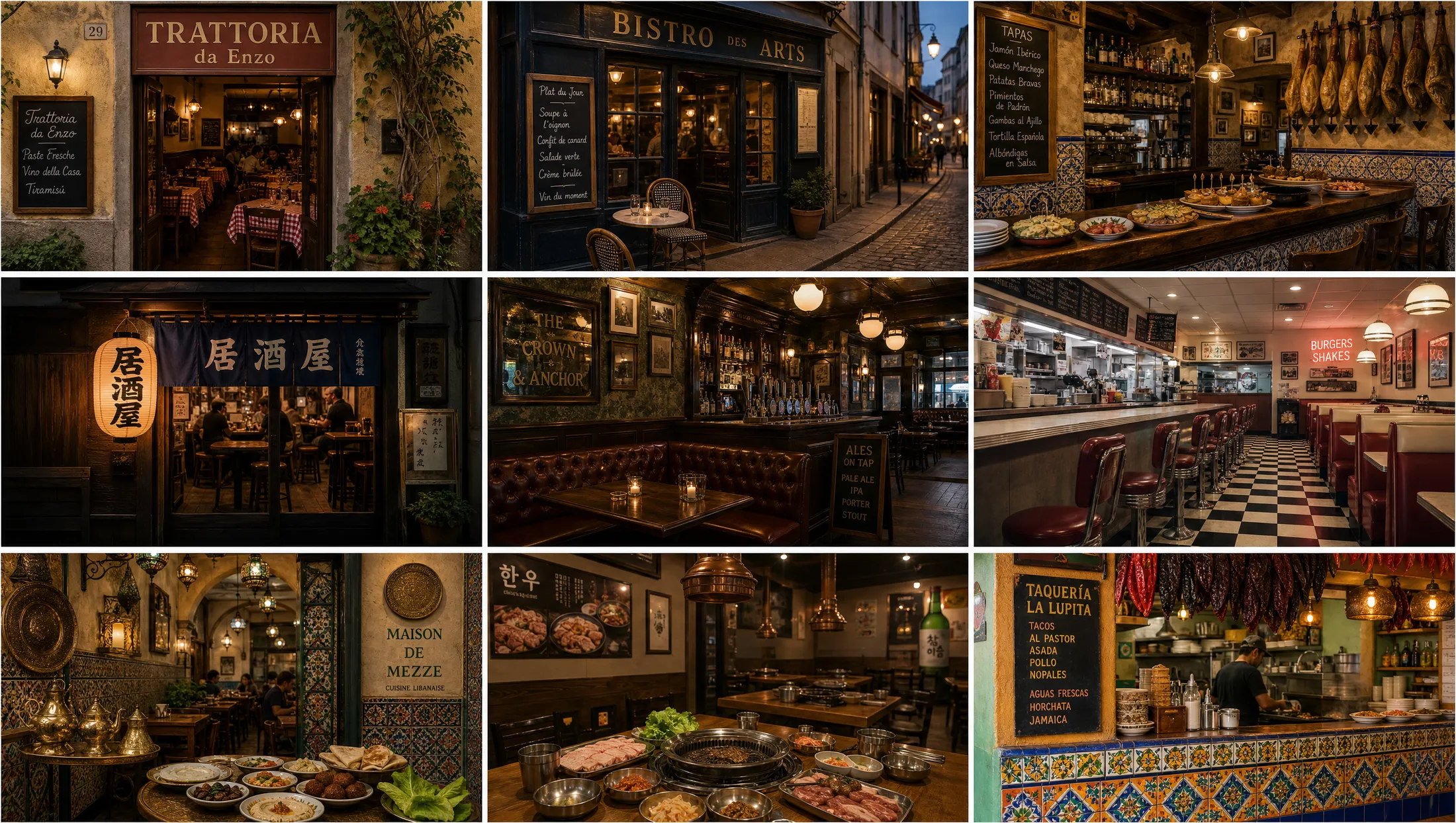
The 30 most important restaurant terms
TL;DR — Key Takeaways
Restaurant terminology varies enormously across cultures, and many tourists step into the wrong type of establishment because they don't recognize the labels.
A trattoria is not a ristorante; an izakaya is not a restaurant; a bistro is not a brasserie. Each label signals a different price tier, formality, and food style.
This guide decodes 30 restaurant-type terms from around the world, with the price tier, the format, and the etiquette for each.
For tourists planning a trip, knowing these terms in advance helps choose the right establishment for the right occasion. For restaurants, labeling your establishment correctly helps tourists find you for the experience you actually offer.
The same restaurant labeled as a trattoria in Italian, a bistro in French, and a gastropub in English communicates different things to different audiences — multilingual menus benefit from preserving the original term while explaining the format.
The 30 most important restaurant terms
Italian
1. Trattoria— a casual, family-style Italian restaurant. Mid-priced, focused on traditional regional dishes, often handwritten menu, no fuss. The default neighborhood Italian eating place.
2. Ristorante— formal Italian restaurant. Higher-priced, white tablecloths, more elaborate menu, dress code occasionally relevant. The Italian equivalent of "fine dining."
3. Osteria— historically a wine-and-snack bar; in modern usage, often interchangeable with trattoria but slightly more wine-focused. Casual, regional.
4. Pizzeria— pizza-focused, casual. Sometimes serves only pizza; sometimes serves a small Italian menu alongside.
5. Enoteca— a wine bar that often serves small Italian plates. Wine is the focus; food supports the wine.
6. Tavola calda— Italian counter-service casual eatery. Quick lunch spot. Lower-priced.
7. Caffè / Bar— confusingly, in Italy, a "bar" is what English speakers would call a café. Coffee, pastries, light snacks, wine and aperitivi. Open from morning to evening.
French
8. Brasserie— a large, lively French restaurant serving traditional dishes (often beer-related — "brasserie" originally meant "brewery"). Open all day. Mid- to upper-priced.
9. Bistro— smaller, more intimate French eatery. Traditionally simple home-style French food. Mid-priced. The everyday Parisian eating spot.
10. Auberge— a French country inn that serves food. Often regional cuisine, slower-paced. Mid- to higher-priced.
11. Crêperie— French establishment specializing in crêpes (sweet and savory). Casual, lower-priced.
12. Bouchon— Lyon-specific traditional eatery. Generally rustic, regional Lyonnaise dishes (offal, charcuterie). Mid-priced.
13. Bistronomie— modern French restaurants that combine bistro casualness with gastronomic ambition. Mid- to higher-priced.
Spanish / Portuguese
14. Tapas bar— Spanish establishment serving small plates (tapas) and drinks. Standing or stool-seated. Casual, often noisy. Order multiple plates.
15. Pintxos bar (Basque)— small plates speared with toothpicks, displayed on the bar. Common in San Sebastián. Pay per pintxo.
16. Asador— Spanish grill-focused restaurant. Often specialized in roasted lamb or fish. Mid- to higher-priced.
17. Tasca— small Portuguese family-run restaurant. Often serving regional Portuguese dishes. Casual, lower-priced.
18. Marisqueira— Portuguese seafood-specialized restaurant.
Japanese
19. Izakaya— Japanese gastropub-style. Multi-plate sharing, drinks-focused, social atmosphere. Mid-priced. The standard Japanese after-work eating spot.
20. Ramen-ya— ramen-specialized shop. Often very small, counter seating, ticket-machine ordering. Casual, lower-priced.
21. Sushi-ya— sushi restaurant. Wide range of price tiers (standing sushi bars to high-end omakase counters).
22. Yakitori-ya— grilled chicken (yakitori) specialty. Casual, often in alleys. Mid-priced.
23. Tonkatsu-ya— pork cutlet specialty. Casual to mid-priced.
24. Kaiseki ryōtei— high-end traditional Japanese restaurant serving multi-course kaiseki menus. Most formal Japanese dining experience. Expensive.
25. Kissaten— old-style Japanese coffee shop. Coffee, sandwiches, simple food. Atmospheric, low-priced.
26. Donburi-ya— rice-bowl specialty (gyudon, oyakodon, katsudon). Fast-casual. Lower-priced.
British / American
27. Gastropub— British pub serving elevated food alongside drinks. Mid-priced. Originated in 1990s London.
28. Steakhouse— American/global category specializing in steak. Wide price range; high-end is associated with fine dining.
29. Diner— American casual eatery, often 24-hour. Lower-priced. Comfort food focus.
30. Bistro (American usage)— confusingly different from French bistro. Often a casual American restaurant with a slightly French aesthetic but serving global dishes.
What's the difference between a bistro and a brasserie?
Both are French, but they're distinct.
Bistro:
Smaller, more intimate
Limited menu, often handwritten
Traditionally home-style French dishes
Generally serves specific meal periods (lunch and dinner)
Quiet to moderately busy
Brasserie:
Larger, livelier
Extensive menu
Often beer-focused (originally meant "brewery")
Open all day from morning to late evening
Busier, more energetic atmosphere
A first-time tourist in Paris should know which they're choosing. A bistro at lunch is different from a brasserie at lunch.
What is an izakaya?
An izakaya is best understood as a Japanese gastropub. The format:
Drinks-first (sake, beer, highball, sometimes wine)
Small plates ordered throughout the meal
Multiple-hour pacing (typical visit is 2-3 hours)
Social atmosphere — friends, colleagues, dates, after-work groups
Mid-priced (typically $25-50 per person for a full meal)
Often counter or low-table seating
Often loud and lively
The closest Western equivalents are gastropubs, tapas bars, and Italian osterias — all share the small-plate, drink-forward, social-pacing format.
What it's not: a fast-food spot, a fine-dining experience, or a place to order one main course and leave.
What does "gastropub" actually mean?
Originated in 1990s London. Combines:
"Pub" — British public house, traditionally a drinks-focused establishment
"Gastronomy" — elevated food
A gastropub serves food at a level higher than a traditional pub but with a more casual atmosphere than a formal restaurant. The format:
Pub-style drinks (especially craft beer and wine)
Restaurant-quality food
Casual atmosphere — you can pop in for a drink without dining
Mid-priced
Often serves traditional British comfort food elevated with care
The category has expanded globally; gastropubs now exist in most major cities. The format is recognizable: pub aesthetic + restaurant quality.
What's the right word for "casual cafe with food" in different cultures?
The closest translations across cultures:
France: bistro or café
Italy: trattoria or bar (Italian usage of bar = café)
Spain: bar de tapas or simply bar
Japan: kissaten (old-style) or café (modern Western-influenced)
Korea: cafe (Western-influenced) or bunsikjip (casual rice/noodle place)
Vietnam: quán cà phê (coffee shop) or quán ăn (eating place)
Thailand: raan kafe (coffee shop) or raan ahaan (food shop)
Mexico: fonda (casual home-style) or taquería (taco-focused) or café
Germany: Café or Imbiss (quick eatery)
UK: café (often pronounced "caff") or brasserie
US: café or diner or casual restaurant
Each carries slightly different formal expectations. A fonda is more home-style than a taquería; an Imbiss is more quick-service than a Café.
How do menu prices typically vary by establishment type?
Rough 2026 ranges, in USD-equivalent (varies dramatically by city):
Establishment type Typical price per person Diner / kissaten / bunsikjip $5-15 Casual eatery (donburi-ya, pizzeria, taquería, ramen-ya) $10-25 Bistro / trattoria / tapas bar / gastropub $25-50 Brasserie / mid-tier restaurant $40-80 Ristorante / fine bistro / good izakaya $60-120 Fine dining (formal restaurant) $100-200 Omakase / kaiseki / Michelin-tier $200-500+
These are rough guides. A pizzeria in Naples is different from a pizzeria in Tokyo's Ginza district. A bistro in rural France is different from a bistro in Manhattan.
The labels are reliable indicators of format, less reliable indicators of price in any specific location.
Why this matters for tourists
A tourist who walks into a ristorante expecting trattoria prices is in for a surprise. A tourist who walks into an izakaya expecting individual main courses is going to be confused by the small-plate format.
Knowing these terms in advance:
Sets correct price and time expectations
Helps choose the right establishment for the occasion (casual lunch vs special dinner)
Avoids disappointment when the format doesn't match the expectation
Allows faster cultural calibration on arrival
For restaurants serving tourists, the inverse insight: labeling your establishment correctly helps tourists find you for the experience you actually offer. Calling a casual neighborhood place a "ristorante" attracts disappointed guests; calling a fine-dining spot a "trattoria" attracts under-spending guests.
How a multilingual menu can carry the cultural label
A practical pattern for restaurants:
Keep the original cultural label visible: Trattoria Roma, Izakaya Ginza, Brasserie Lipp
In the menu, briefly explain the format on the first page or in the welcome text
Translate the format explanation into each menu language so tourists understand what kind of experience to expect
Example:"This is a trattoria — a casual Italian restaurant serving traditional regional dishes. The pace is relaxed; the menu changes seasonally."
This single sentence on the welcome page sets the tourist's expectations correctly across languages. It costs nothing to add and reduces the cultural friction meaningfully.
Intermenu lets you explain the format in the restaurant description, which is translated with the dishes — a small but high-leverage detail for tourist-area restaurants serving international guests.
Frequently Asked Questions
What's the difference between a bistro and a brasserie? Bistro: smaller, intimate, home-style French. Brasserie: larger, livelier, beer-focused, open all day. Both French, but distinct formats.
What is an izakaya? A Japanese gastropub-style establishment — small plates, drink-forward, social atmosphere, multi-hour pacing. Mid-priced. The standard Japanese after-work eating spot.
What does "gastropub" actually mean? A British category from the 1990s combining pub-style drinks with elevated food. Casual atmosphere, restaurant-quality food, mid-priced.
What's the right word for "casual cafe with food" in different cultures? Bistro or café (France), trattoria or bar (Italy), bar de tapas (Spain), kissaten (Japan, traditional), café (most modern usage globally).
How do menu prices typically vary by establishment type? Casual eateries $10-25 per person, bistros/trattorias/tapas bars $25-50, brasseries/mid-tier $40-80, ristoranti/fine bistros $60-120, fine dining $100-200, omakase/kaiseki/Michelin-tier $200-500+.
Help Tourists Find the Right Experience
If your restaurant has a specific cultural format (trattoria, izakaya, brasserie, gastropub, taquería), labeling it clearly in your menu and signage helps tourists find you for the experience you actually offer.
Intermenu shows the restaurant description in the menu's Details panel, translated into every language your guests read — so a French tourist visiting a trattoria reads about the casual neighborhood-Italian format in French before they sit down. The result: tourists arrive with correct expectations, and the meal goes better for both sides.
If your restaurant identity is in a culturally specific format, give the multilingual welcome a look →