
Dining Etiquette by Country: 25 Surprising Differences
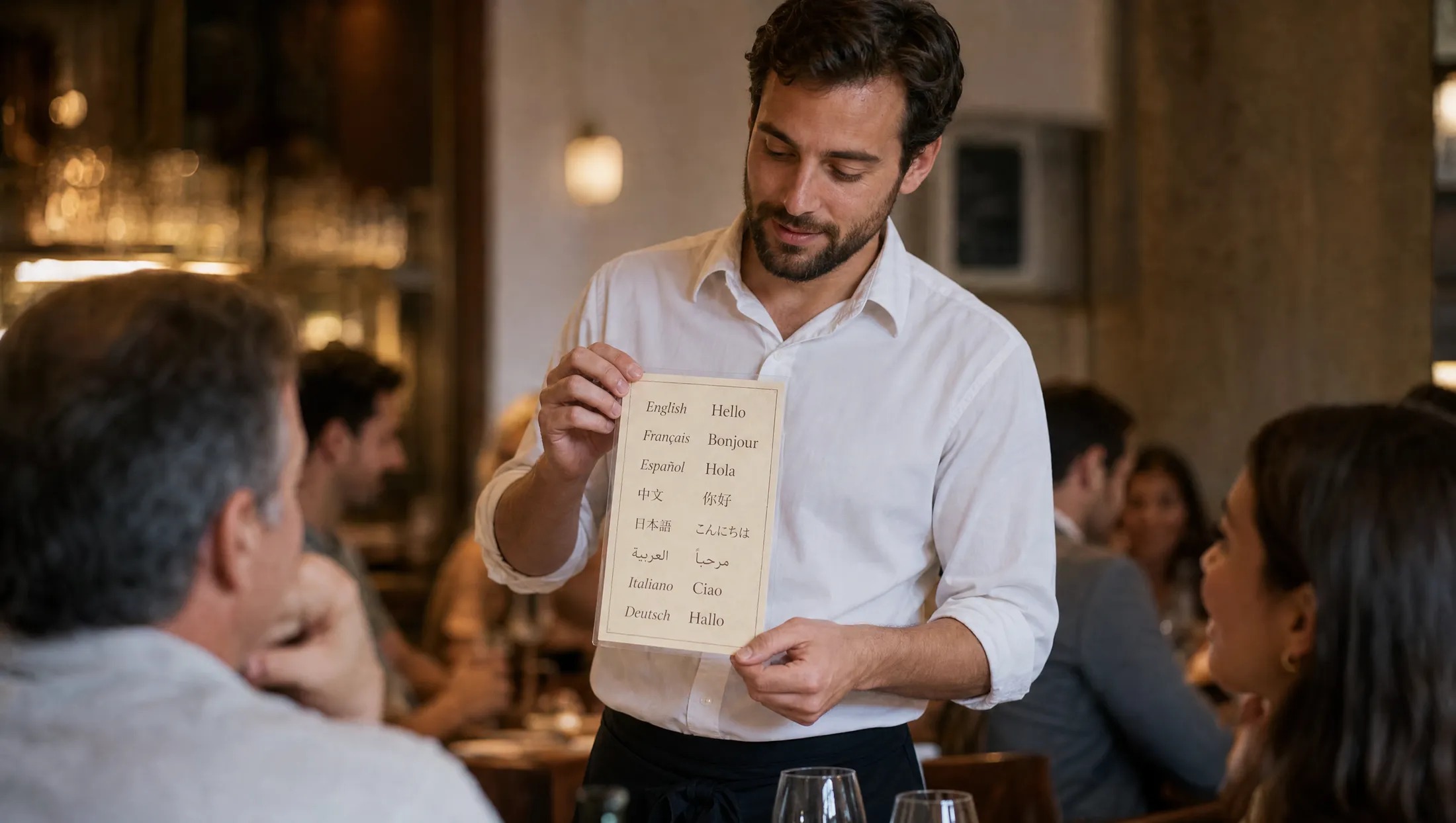
Why dining etiquette differences matter Dining etiquette is one of the most underrated friction points in international tourism. Tourists rarely realize they're committing cultural faux pas; restaurants rarely train staff to handle these moments gracefully. The result is uncomfortable interactions that neither side fully understands.
TL;DR — Key Takeaways
Dining etiquette varies surprisingly across cultures — and assumptions about "universal" dining manners often turn out to be culturally specific.
25 differences worth knowing when traveling internationally are listed below — covering tipping, slurping, asking for substitutions, leftovers, hand use, and shared-plate culture.
Restaurants serving international tourists benefit from training staff to recognize and gracefully accommodate cultural dining differences without making guests feel awkward.
The same dish can be ordered very differently across cultures — Italians don't ask for parmesan on seafood pasta, Japanese guests don't add soy sauce to fried rice, Spanish guests don't put ice in their wine.
A multilingual menu with cultural notes ("cheese not traditionally served with this dish — please ask if you'd like it") gracefully bridges the cultural gap without judging the guest.
Why dining etiquette differences matter
Dining etiquette is one of the most underrated friction points in international tourism. Tourists rarely realize they're committing cultural faux pas; restaurants rarely train staff to handle these moments gracefully. The result is uncomfortable interactions that neither side fully understands.
This article covers 25 commonly-encountered etiquette differences across major tourist destinations — useful for travelers planning trips, and for restaurant operators training staff to host international guests with cultural awareness.
25 dining etiquette differences worth knowing
Italian etiquette
1. Don't ask for parmesan on seafood pasta. Italians consider this a culinary mismatch — parmesan's flavor overpowers delicate seafood. A guest who insists is signaling "I don't quite get this cuisine."
2. No cappuccino after 11am. In Italian convention, milky coffees are breakfast drinks. Ordering cappuccino after lunch is harmless but immediately marks the guest as foreign.
3. Pasta is a course, not a side. Italian meals proceed: antipasto → primo (pasta) → secondo (meat/fish) → contorno (side) → dolce. Pasta isn't served alongside the main course.
4. Don't break long pasta in half. Spaghetti is meant to be twirled, not cut. Ask for shorter pasta if needed.
5. Tipping is not standard. A 10–15% tip is American convention; Italians round up small change or leave nothing. Service is sometimes included as coperto (cover charge).
French etiquette
6. Bread is a tool, not a starter. French bread accompanies the meal — used to push food onto the fork, used to clean the sauce. It's not appetizer-eaten before the food arrives.
7. Both hands visible at the table. French dining etiquette historically expected both hands resting on the table edge — a convention from when hidden hands suggested concealed weapons. Still considered good manners in formal settings.
8. Don't ask for salt before tasting. Considered an insult to the chef. Taste first, season after if needed.
9. Cheese course before dessert. In French convention, cheese precedes dessert. Reversing this order signals foreignness.
10. Tipping is not standard. Service is included by law in French restaurant prices (service compris). Small extra tips for excellent service are appreciated; American-style 18-20% tipping is unusual.
Japanese etiquette
11. Slurping noodles is polite. In Japan, slurping ramen, udon, and soba is a positive signal — it cools the noodles and signals enjoyment. Silent eating reads as restrained or unhappy.
12. Don't pour your own drink. In a group, pour for others; let others pour for you. Self-pouring at a formal meal is awkward.
13. Chopstick rules. Don't stick chopsticks vertically into rice (associated with funeral rituals). Don't pass food chopstick-to-chopstick (also funeral-associated). Use the holder if available.
14. No tipping. Sometimes refused if offered. Japanese restaurants generally don't accept tips and will return the money. Exceptional service is rewarded by becoming a regular.
15. Wash before eating with the oshibori. The hot towel served before the meal is for washing hands, not face.
Korean etiquette
16. Wait for the eldest to start eating. In group dining, hierarchy matters. Wait for the senior person to begin.
17. Pour for others, not yourself. Similar to Japanese convention — pour for others using both hands as a sign of respect.
18. Don't lift the rice bowl. In Korean dining (unlike Japanese or Chinese), the rice bowl stays on the table. Use the spoon.
Chinese etiquette
19. Lazy Susan rotates clockwise. In multi-person Chinese banquet seating, the lazy Susan turns clockwise; food is served in a specific order based on hierarchy.
20. Tea-tapping signal. When someone pours tea for you, tap the table twice with two fingers to thank them. (A custom traceable to imperial-era stories.)
21. Don't tip. Tipping is not customary in China and can occasionally cause confusion.
Middle Eastern etiquette
22. Eat with the right hand. In Arab and many Muslim cultures, the left hand is reserved for personal hygiene. Eating with the right hand (or with utensils when available) is correct.
23. Refusing food can be insulting. Saying "no thank you" to offered food, especially in home or hosted contexts, can read as rejection of hospitality. Accept at least a small portion.
24. Tipping varies. UAE and Saudi Arabia: 10–15% is appreciated. Egypt: 10% standard. Lebanon: included or 10% for excellent service.
General cross-cultural
25. "Free water" expectations. Americans expect free still water; Europeans expect to pay for bottled water (still or sparkling). Asking for "tap water" in much of Europe gets a confused server.
Why these differences matter for restaurant operators
When a tourist commits a cultural faux pas at your restaurant, the situation can go three ways:
1. The server doesn't notice or doesn't care. The tourist proceeds, possibly aware they did something foreign, possibly not. The interaction is neutral.
2. The server visibly judges. The tourist feels embarrassed. The meal is colored by the moment. Reviews suffer.
3. The server gracefully accommodates. The tourist orders parmesan on their seafood pasta; the server smiles and says "of course," brings the parmesan, and the meal proceeds happily.
The third response is the trained behavior worth aiming for. Tourists are not the cultural experts on the cuisine they're visiting. Their job is to enjoy their meal; your team's job is to host.
Practical training:
Brief staff on the most common etiquette gaps your tourist demographic produces
Train them to gracefully accommodate without judgment
For dishes with strong traditional conventions, add a small note in the menu ("Cheese is not traditionally served with this dish — please ask if you'd like it")
Never correct a tourist's etiquette unprompted; respond to their requests as given
A restaurant that treats cultural etiquette as a host-side responsibility (rather than a guest-side failing) builds the kind of reputation that drives international word-of-mouth.
How a multilingual menu can bridge etiquette gaps
The menu itself can reduce friction by communicating cultural context.
Examples that work:
"Spaghetti alle vongole — traditionally served without cheese, but available on request"
"Pad Thai — traditionally not eaten with the hands; chopsticks or fork provided"
"Sushi — served with a small bowl of soy sauce; please dip lightly to taste the fish, not the rice"
"Tea is poured for the table by the host; please tap twice on the table to thank the pourer"
These notes work in two ways: they teach the convention to curious guests, and they set the operator's expectation that guests who break the convention won't be judged. Both effects compound.
Intermenu lets you write that cultural context into the dish description, which is translated with the rest of the menu, so the framing reaches each language version of the menu.
A tipping primer (because this is the most-asked question)
A practical tipping summary for major tourist destinations in 2026:
Country / Region Standard tip Notes United States 18–20% Service often not included; tip explicitly Canada 15–20% Similar to US United Kingdom 10–12.5% Often included as "service charge" France 0–5% Service compris; small extra tips for excellent service Italy 0% (round up) Service or coperto often included Spain 0–5% Service often included; small tips appreciated Germany / Austria 5–10% Round up to a clean number; tell server the total amount including tip Netherlands 5–10% Service often included; small tips appreciated Japan 0% Tipping is not customary, sometimes refused China 0% Tipping uncommon and sometimes confusing Korea 0% Service included Thailand 5–10% Welcome at higher-end venues; not expected at street food Australia / NZ 0–10% Service included; small tips for excellent service UAE / Saudi Arabia 10–15% Appreciated even when service is included Brazil 10% Often added automatically Mexico 10–15% Standard
The variation is wide enough that a tourist who expects American tipping conventions globally will both over-tip (in Japan, China) and risk under-tipping (in some European venues where 10% is standard but the tourist tips 5% expecting American baseline). Operators serving international tourists benefit from making the local expectation clear ("Service included" or "Tipping appreciated, 10% standard") on the receipt.
Frequently Asked Questions
Do you tip in Japan / Italy / Korea? Generally no. In Japan tipping is uncustomary and sometimes refused. In Italy, service or coperto is often included; rounding up small change is common. In Korea, service is included.
What's "no" to leftovers in different cultures? In China, finishing every grain of rice can signal that the host didn't provide enough. In Japan, leaving a small amount can signal modest fullness. In the US, takeaway containers are normal; in much of Europe, requesting one is unusual but not impolite.
How do I avoid offending hosts at a meal abroad? The universal rule: be slow to refuse, quick to thank, and willing to try. Cultural specifics matter, but warmth and curiosity bridge most gaps.
Why does asking for sauce on pasta upset Italians? Most pasta dishes already have their proper sauce on the plate; adding extra sauce or cheese (especially to seafood pasta) signals to Italians that the diner doesn't understand the dish.
When is slurping polite vs rude? Polite: in Japan when eating ramen, udon, or soba; in some Korean and Chinese noodle traditions. Rude: in Western European dining; in Italian pasta eating; in formal Western contexts.
Help Your Customers Feel at Home
Cultural etiquette differences are an opportunity for hospitality, not a source of friction. A multilingual menu with cultural-context notes guides guests gracefully — and a trained staff handles requests without judgment.
Intermenu lets you write cultural notes into each dish description, which is translated into every language your guests read, so the small touches that make tourists feel welcomed travel through every language version of the menu.
If you've ever had a moment with a guest who didn't know the local etiquette, see what a culturally-aware menu looks like →