Restaurant Staff Multilingual Training: 8 Language Scripts
What 20 phrases should every server know in tourist languages?
TL;DR — Key Takeaways
A server doesn't need fluency to make international guests feel welcome — they need ~20 phrases in the top 5–8 tourist languages and the warmth to deploy them.
The phrases that move the needle most: greetings, "do you speak [English]?", "I'll get someone who does," "is everything okay?", "thank you," and dietary confirmation phrases.
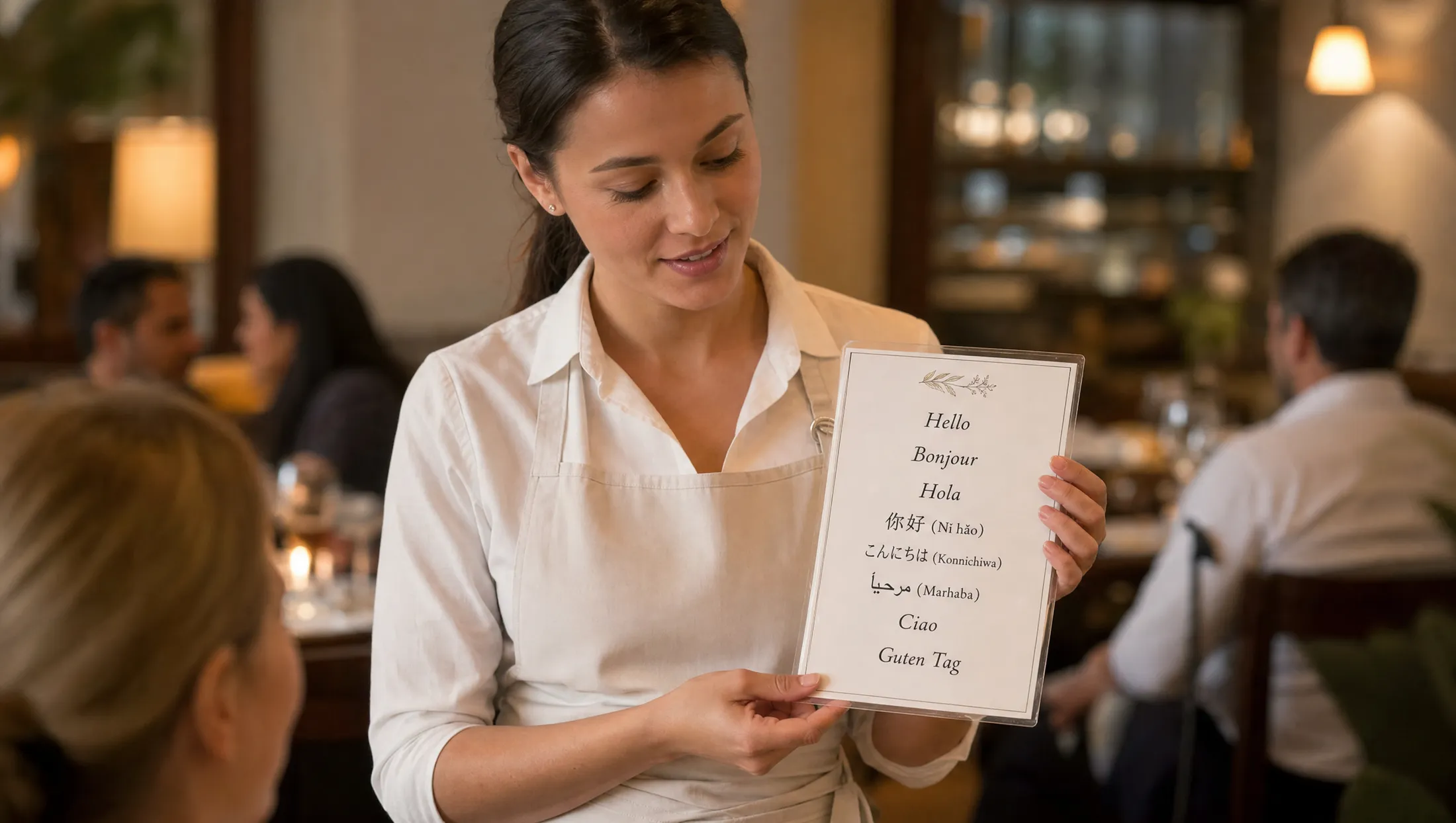
A printable phrase card (or phone-saved version) at the host stand, behind the bar, and on each server's apron is the working tool — not full language training.
Pronunciation matters less than warmth and effort. A heavily-accented "hello" in a guest's language is consistently read as more welcoming than a flawless English greeting.
A multilingual digital menu plus basic phrase training plus a translation backup app on every staff phone is the 2026 production-ready setup.
What 20 phrases should every server know in tourist languages?
Five categories of phrases, each with 4 essential entries.
Category 1 — Greetings (the warmth signal)
"Hello / good evening" — the first 3 seconds of contact set the tone
"Welcome" — slightly more formal, used at the door
"Table for [number]?" — the practical opener
"Thank you / goodbye" — the closing warmth
Category 2 — Language acknowledgment (the patience signal)
"Do you speak [English / French / Spanish]?" — meets the guest where they are
"I'll get someone who does" — a graceful escalation
"I speak a little [language], please be patient with me" — vulnerable but disarming
"I'm sorry, my [language] is not perfect" — shows care for accuracy
Category 3 — Service rhythm (the comfort signal)
"Are you ready to order?" — at the right moment
"Is everything okay so far?" — mid-meal check
"Can I bring you anything else?" — late-meal check
"Would you like the bill?" — closing the table
Category 4 — Allergens & dietary (the safety signal)
"Do you have any allergies?" — the most important phrase a server can know
"Is this for [vegetarian / vegan / gluten-free / halal]?" — confirming dietary needs
"Let me check with the chef" — the right answer when uncertain
"Yes, this dish is [allergen]-free" / "No, this dish contains [allergen]" — the two correct answers
Category 5 — Recommendations (the hospitality signal)
"What do you usually like?" — a great recommendation opener
"I recommend [dish]" — the recommendation itself
"It's [our most popular / a chef's specialty / made fresh today]" — the supporting hook
"Most of our guests really enjoy this" — a low-pressure social proof close
These 20 phrases, in 5–8 languages, cover roughly 80% of in-service language needs. Memorizing them is a half-day of work per language for a server willing to learn.
How do you handle dietary questions when there's a language barrier?
The 2026 escalation protocol, when language is the obstacle:
Step 1 — Confirm visually. Point to the dish on the menu. Tap the allergen icons. Wait for the guest to tap the allergens they need to avoid. Visual communication often closes the gap faster than verbal.
Step 2 — Use the digital menu's filter."Please show me what you can't eat" — gesture at the QR menu's allergen filter. The guest hides the allergens they need to avoid, and the menu hides every dish tagged with them. Dishes with no allergen information move to a separate "Allergen info not provided" group, never into the results. The filter does not certify a dish as safe, so the server still confirms with the kitchen.
Step 3 — Translation app on the staff phone. Every server should have Google Translate (or similar) saved with quick-access. For dietary questions, use the structured phrasing: "Allergic to: [specific allergen]" — single-word translations work better than full sentences for medical specificity.
Step 4 — Bilingual colleague callover. When the dietary need is severe (severe allergy, complex multiple restrictions), don't guess. Get a colleague who speaks the guest's language, even if it means a 90-second wait.
Step 5 — Written confirmation. For severe cases, write the allergen in the kitchen language ("NO PEANUTS — SEVERE ALLERGY") on the order ticket. Don't trust verbal communication alone for life-threatening cases.
The protocol matters because the cost of a single allergen miscommunication is enormous, and language barriers are the highest-frequency cause of allergen miscommunications in tourist-area restaurants.
Should servers learn pronunciations of foreign dish names?
Yes, for the dishes you serve. No, for everything else.
What matters: if your menu has bibimbap, cacio e pepe, kibbeh and bourekas, your servers should pronounce these dishes acceptably in the original language (or at least in a way that won't confuse the kitchen).
What doesn't matter: servers don't need to pronounce every regional variation of every dish in every cuisine they don't serve.
A pronunciation training routine that works:
The day a new dish goes on the menu, the chef demonstrates the pronunciation to the floor team
A pronunciation guide is added to the server training reference (audio clip if possible, phonetic spelling if not)
New servers run through the pronunciation guide as part of onboarding
Quarterly refreshers as the menu evolves
This is a one-hour-per-quarter investment with consistent positive guest feedback. Tourists notice when servers say cacio e pepe correctly — and they notice the wrong way too.
How do you politely confirm orders across languages?
The four-step order confirmation protocol that works across language barriers:
1. Read back the order in the guest's language if you can, slowly."Tagliatelle al ragù, branzino al sale, una bottiglia di Chianti — corretto?" If the guest nods, you're good.
2. If they look uncertain, point at the menu. Tap each ordered item. Let them confirm visually.
3. For complex tables (split orders, modifications), summarize per person."For you — the pasta, no cheese. For you — the fish. For you — the salad. Yes?"
4. Offer the digital order summary on a tablet or phone. Many modern POS systems let the server show the order on a screen for the guest to verify visually. This is bulletproof for cross-language tables.
The principle: visual confirmation is more reliable than verbal across language barriers. Modern menu and POS systems are built around this insight.
What apps can servers keep on their phone for emergencies?
Three categories of apps to have ready:
1. Translation:
Google Translate (with offline language packs downloaded for top tourist languages)
DeepL Translator (better for nuanced translation)
iTranslate Voice (for spoken interactions)
2. Allergen and dietary reference:
Equal Eats (allergen translation cards)
Spokin (allergy-friendly restaurant database)
Local food-safety reference apps where available
3. Hospitality utilities:
The restaurant's own QR menu loaded as a bookmark (instant access for showing guests)
A photo gallery of dishes (for visual confirmation)
Kitchen contact (for fast escalation on dietary questions)
The discipline: every staff member starting their shift opens these apps once to make sure they're working. A 30-second pre-shift check prevents the 5-minute scramble during a peak service moment.
A printable phrase card setup that actually works
Five practical implementation tips:
1. Laminate them. Phrase cards in restaurant kitchens get spilled on, dropped, and ripped. Lamination doubles their useful life.
2. Place them where they're needed. Host stand for greetings. Behind the bar for drink-related phrases. In the kitchen for allergen confirmations. On each server's apron pocket for table-side phrases.
3. Keep them short. A card with 20 phrases is useful. A card with 100 phrases gets ignored.
4. Phonetic spelling matters. Servers won't read IPA notation; they will read phonetic English approximations. "bee-bim-bahp" beats /pibimp͈ap̚/ for a non-linguist server.
5. Update annually. As the menu changes, the phrase card changes. Make this part of your annual training cadence.
Build your own card from the 20-phrase template above: one column per language your guests read, the phrases adapted to your own menu vocabulary, and a phonetic spelling under each line. For the menu itself, a multilingual digital menu does the language work; here is how to make a multilingual menu.
How does multilingual menu training change the staff experience?
Three meaningful operational shifts:
1. Servers spend less time translating, more time being hospitable. When the menu is multilingual and the allergen filter helps with dietary questions, the server's role shifts from "menu translator" to "host." This is more enjoyable work and produces better guest experience.
2. New-hire onboarding gets faster. A server who doesn't have to memorize the menu in 5 languages onboards in days, not weeks. The menu does the language work; the server does the hospitality work.
3. Staff retention improves measurably. Servers in multilingual-menu restaurants report less stress and higher job satisfaction. Reduced language-friction-driven mistakes translate to fewer customer complaints, fewer comps, and a calmer workplace.
The investment in a multilingual menu pays back not just in tourist-cover lift but in operational improvements across the entire service team.
A monthly training calendar (45 minutes/month)
A sustainable training cadence that fits in regular staff meetings:
Month 1 (45 min): Greeting and welcome phrases in top 5 languages. Practice with role-play.
Month 2 (45 min): Allergen and dietary phrases. Confirm digital menu filtering protocol.
Month 3 (45 min): Recommendation phrases. Practice with the current menu.
Month 4 (45 min): Cultural eating-pattern awareness. Review current guest demographic mix.
Month 5 (45 min): Pronunciation refresher for menu dishes. Catch new menu additions.
Month 6 (45 min): Order confirmation across languages. Run scenarios.
Repeat the cycle every 6 months. This is not in addition to existing training — it integrates into the regular staff meeting cadence at no incremental time cost.
Frequently Asked Questions
What 20 phrases should every server know in tourist languages? Five categories of 4 phrases each: greetings, language acknowledgment, service rhythm, allergens/dietary, recommendations. The full list is above.
How do you handle dietary questions when there's a language barrier? Five-step protocol: visual menu confirmation → QR menu allergen filter → translation app → bilingual colleague callover → written confirmation in the kitchen language for severe cases.
Should servers learn pronunciations of foreign dish names? Yes for the dishes you serve. Pronunciation training takes ~1 hour per quarter and produces consistent positive guest feedback.
How do you politely confirm orders across languages? Four-step protocol: read back in the guest's language slowly → point at the menu if uncertain → summarize per person for complex tables → offer digital order summary on a screen.
What apps can servers keep on their phone for emergencies? Translation (Google Translate, DeepL), allergen reference (Equal Eats, Spokin), and the restaurant's own QR menu loaded as a bookmark.
Print Service Phrase Cards in Your Guests' Languages
The 20-phrase card in every language your guests read is a small project and too useful to skip. Build it from the template above, one language per column, and laminate it. For the menu itself, let a multilingual digital menu do the language work: here is how to make a multilingual menu.
If you've been planning to "do the staff training thing" for months, the cards are the simplest 30-minute version of that plan →