
Halal Kosher Restaurant Hosting: Best Practices Explained
Halal observance varies in strictness, but most halal-observant guests look for these signals, in descending order of trust:
TL;DR — Key Takeaways
Religious dietary observance is rarely a "preference" — it's a deeply held commitment. Treating it with the same care as a severe allergy is the right hospitality posture.
The four most-encountered religious dietary categories in 2026 international hospitality: halal (Islam), kosher (Judaism), Hindu vegetarian (no beef + often no onion/garlic), and Jain (no root vegetables).
"Halal-friendly" (no pork, no alcohol, but no certification) and "halal-certified" (formal certification) are different categories and should be tagged separately on a menu.
Religious dietary tagging should be structured data on every dish, never translated prose. The compliance and trust benefits compound across multilingual menus.
The single highest-leverage move for tourist-area restaurants serving religious-diet guests is a multilingual digital menu with structured religious-dietary tags and guest-side filtering.
What do guests look for to know food is halal?
Halal observance varies in strictness, but most halal-observant guests look for these signals, in descending order of trust:
1. Halal certification displayed. A formal halal certification from a recognized certifying body (HFCE, IFANCA, JAKIM, etc.) is the strongest signal. Display the certificate visibly.
2. Verified halal supplier chain. Even without formal certification, restaurants can demonstrate halal sourcing — meat from halal-certified suppliers, no pork on the premises, no alcohol in cooking. Document this.
3. "Halal-friendly" disclosure. A restaurant that doesn't claim certification but commits to halal-aligned practices (no pork, no alcohol) should label this clearly and honestly.
4. Staff knowledge. A server who can answer specific questions ("Is the chicken halal-slaughtered? Is there alcohol in this sauce?") reassures observant guests.
5. Ambient signals. A restaurant in a Muslim neighborhood, with halal-aware decor and signage, communicates competence even before any explicit declaration.
The honest framework: most observant Muslim travelers in 2026 default to halal-certified when available, trusted halal-friendly as a backup, and avoid venues with no clear stance. Operators who clearly communicate their stance — whether certified, friendly, or neither — fare better than operators who try to imply more than they offer.
Do I need certification or is "halal-friendly" enough?
It depends on your customer mix and your operational reality.
Halal certification is worth pursuing when:
A meaningful share of your guests are observant Muslims who require certification
You're located in or near a Muslim-majority neighborhood or tourist hub
You're willing to commit to the operational requirements (sourcing, storage, separation, ongoing audits)
You can absorb the certification cost (typically $1,000–$5,000 annually)
Halal-friendly without certification works when:
You serve a mixed clientele where halal is one of several dietary preferences
You commit to no pork, no alcohol-as-ingredient, and halal-supplier sourcing
You honestly label dishes "halal-friendly" rather than implying certification
You train staff to answer specific questions truthfully
Avoid the middle ground:
Don't claim "halal options available" without a clear, defensible standard
Don't display halal symbols you don't have certification for
Don't use halal in marketing if your kitchen handles pork or alcohol — be honest about the realities
The least-defensible posture is the implicit-halal-friendly claim that doesn't hold up under specific questions. Either commit to certification, commit to clearly-labeled halal-friendly with documented standards, or be clearly non-halal.
How do I label kosher items without offending non-kosher diners?
Use structured dietary tags, displayed neutrally, alongside other dietary markers.
The right approach:
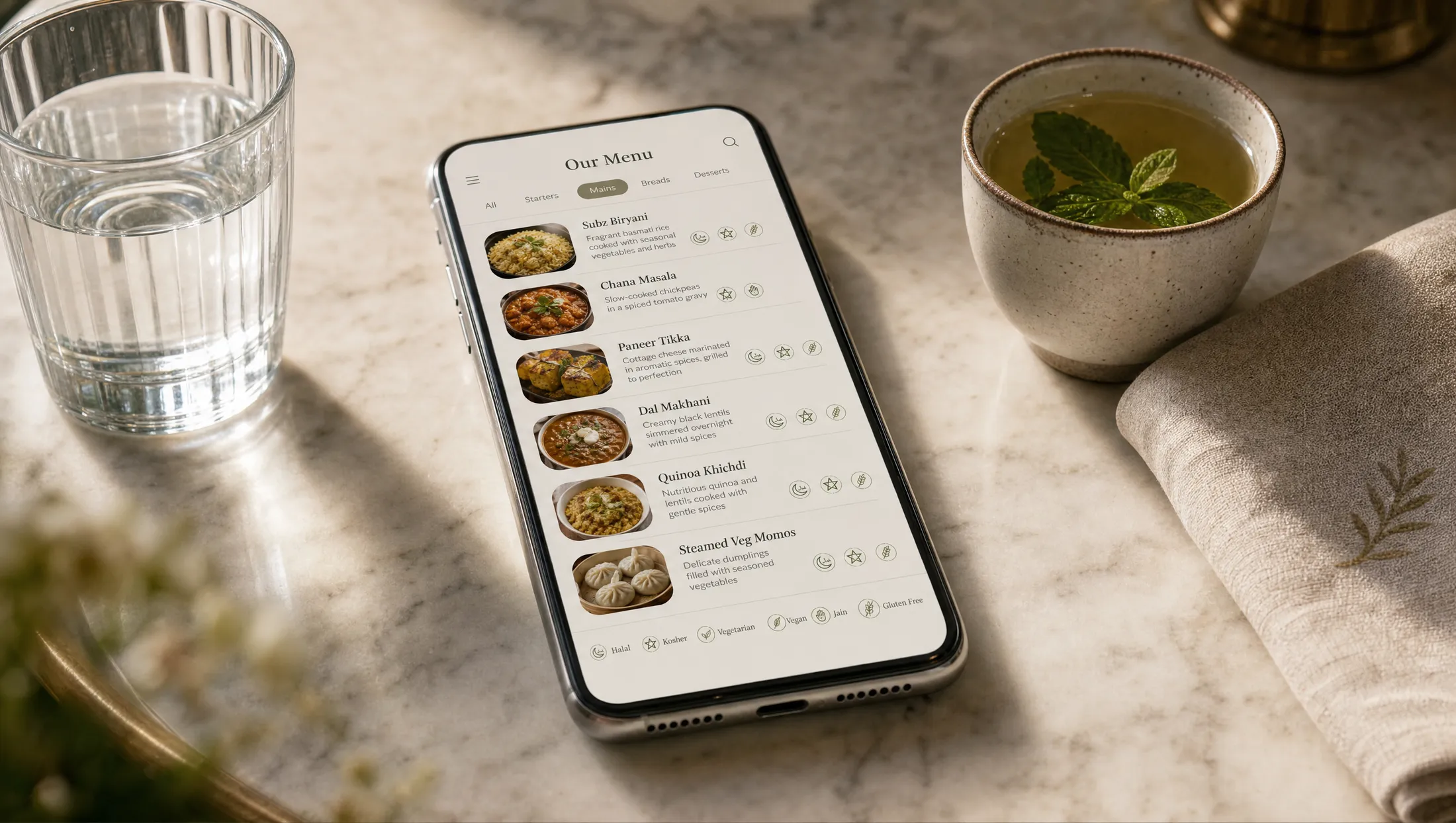
Tag each dish with the relevant dietary status (kosher, halal, vegetarian, vegan, gluten-free, etc.) as structured data
Display the tags as small icons or short labels alongside the dish name
Let guests filter by their preferred dietary marker on the digital menu
The wrong approach:
Long prose explanations of kosher status inline with the dish description
Visual segregation of kosher items into a separate menu section that feels exclusionary
Religious symbology dominating the menu design
The principle: kosher (and halal, and other religious-dietary) markers are practical information for guests who care, and visually invisible for guests who don't. Structured tags + filter-by-need is the cleanest solution.
For genuinely kosher restaurants (full certification, separate kitchens, mashgiach supervision), the kosher status should be prominently displayed because it's the entire identity of the restaurant. For mixed restaurants with kosher options, the structured-tag approach is right.
What's the right way to mark Hindu vegetarian dishes?
Hindu vegetarianism is a category that often gets conflated with general vegetarianism, but the practical kitchen requirements are different.
Three subcategories to handle distinctly:
1. Lacto vegetarian— most common Hindu vegetarian standard. No meat, fish, or eggs. Dairy is fine. Onion and garlic acceptable.
2. Strict Hindu vegetarian— no meat, fish, eggs, onion, or garlic. Common among devout Hindus, particularly Brahmins. The no-onion-no-garlic distinction is more important than many Western kitchens realize.
3. Sattvic— Ayurvedic dietary tradition. No meat, fish, eggs, onion, garlic, mushroom, or any "tamasic" foods. More restrictive than strict Hindu vegetarian.
Tagging approach:
Tag dishes with the most restrictive applicable label
A dish with no onion/garlic is automatically suitable for both lacto vegetarian and strict Hindu vegetarian guests
A dish with onion is fine for lacto vegetarian but not strict Hindu vegetarian — tag it with the lacto vegetarian marker, not "Hindu vegetarian" generically
Common mistakes:
Marking everything "vegetarian" without distinguishing — disappoints strict Hindu vegetarian guests who expected no-onion preparation
Adding "no onion/garlic" as a custom modifier rather than a structured dietary marker — translation drift can lose the distinction
Intermenu tags vegetarian and vegan dishes that guests can filter by; distinctions like lacto vegetarian, strict Hindu vegetarian, Jain and sattvic go into the dish description, which is translated with the menu and can be found through menu search.
What's Jain dietary observance and how do I accommodate it?
Jain dietary observance is among the strictest religious dietary traditions, and Jain travelers often struggle to find suitable restaurants outside India.
Jain dietary requirements:
No meat, fish, eggs (vegetarian baseline)
No root vegetables (onion, garlic, potato, ginger, carrot, radish, beetroot)
No mushrooms (considered non-sattvic)
Often no honey
Often no fermented foods
Strict observance excludes night-time eating (after sunset) — though this is usually a personal commitment, not a restaurant requirement
Practical accommodation:
A restaurant that serves Indian food and wants to accommodate Jain guests typically:
Maintains a small "Jain menu" subset with no root vegetables
Trains kitchen staff on the requirements (no automatic onion/garlic in any "Jain" dish, even as "background flavor")
Tags dishes accurately as "Jain-suitable" only when the kitchen can guarantee compliance
Communicates clearly when Jain accommodation is or isn't available ("we do not have a Jain menu, but our [specific dish] can be prepared without root vegetables on request")
A common mistake: Marking a dish "Jain-friendly" because it lacks meat, but with onion still in the preparation. This is a meaningful violation for Jain guests and damages trust significantly.
How can a non-religious restaurant respect religious diets without changing the menu?
Five practical accommodations a "non-religious" restaurant (one that serves pork, alcohol, etc.) can make for religious-dietary tourists:
1. Tag every dish accurately. Even a restaurant with no halal commitment can mark its halal-incompatible dishes (pork, alcohol-cooked) so observant guests can filter them out and find acceptable options.
2. Commit to specific guarantees on certain dishes."These five dishes are prepared in completely separate utensils and contain no [pork/alcohol/etc.]" provides a defensible safe-zone for observant guests.
3. Handle modification requests respectfully."Can the dish be prepared without alcohol?" should not be a 5-minute negotiation. Train staff to confirm with the chef and respond clearly.
4. Don't be defensive about your kitchen's nature. A non-halal restaurant in a non-Muslim country isn't doing anything wrong; respectful accommodation of observant guests doesn't require apologizing for the restaurant's broader menu.
5. Direct observant guests confidently when needed. Sometimes the right answer is "we don't have a halal-certified option, but the [restaurant nearby] does." Sending a guest elsewhere when you can't accommodate them well builds long-term goodwill.
The principle: respect doesn't require restructuring. A clearly-tagged menu with honest communication accommodates religious-dietary tourists without changing the restaurant's fundamental nature.
How does a multilingual menu interact with religious dietary needs?
The intersection is where multilingual menu and religious-dietary handling become inseparable in 2026.
The compounding challenge:
A halal-observant Saudi tourist reading a French restaurant's menu in Arabic
A kosher-observant American Jewish guest reading a Berlin restaurant's menu in English
A Jain Indian businessman reading a London restaurant's menu
Each of these guests needs the menu in their language and needs the religious-dietary tags to render accurately and needs to find the dishes that fit their commitment — then confirm with staff.
The structured solution:
Religious-dietary status as a structured field on each dish (halal, kosher, vegetarian, vegan, Hindu-vegetarian, Jain, sattvic, etc.)
Tags render in every language version of the menu using the standardized local term
Guest-side filter on the QR menu lets observant guests find acceptable dishes immediately
The wrong solution:
Religious-dietary status as text inside the dish description ("This dish is halal-friendly, no pork or alcohol used")
Translation in each language renders the disclosure inconsistently
Trust drift across language versions
This is one of the strongest arguments for structured religious-dietary tagging in modern menu platforms. The trust impact for observant tourists, who are deciding whether they can dine at a restaurant they've never been to before, is enormous.
Frequently Asked Questions
What do guests look for to know food is halal? Halal certification (strongest signal), verified halal supplier chain, "halal-friendly" disclosure with documented standards, knowledgeable staff, ambient context. Most observant Muslim travelers default to certified when available.
Do I need certification or is "halal-friendly" enough? Depends on customer mix. Certification ($1,000–$5,000 annually) makes sense for restaurants with significant observant Muslim clientele. Halal-friendly with documented standards works for mixed restaurants. Avoid implicit/unclear claims.
How do I label kosher items without offending non-kosher diners? Structured dietary tags + filter-by-need on the digital menu. Visible to guests who care, invisible to guests who don't. Avoid prose explanations or visual segregation.
What's the right way to mark Hindu vegetarian dishes? Distinguish three subcategories: lacto vegetarian, strict Hindu vegetarian (no onion/garlic), sattvic. Tag with the most-restrictive applicable label. Don't conflate.
How can a non-religious restaurant respect religious diets without changing the menu? Tag dishes accurately, commit to specific guarantees on selected dishes, handle modification requests respectfully, don't apologize for the broader menu, direct elsewhere when honestly necessary.
Tag Religious-Friendly Dishes Automatically
Religious-dietary observance deserves the same care as severe allergies — and the technical solution is the same: structured tagging on every dish, rendered consistently in every language, with guest-side filtering.
Intermenu tags vegetarian and vegan dishes and lets guests hide allergens such as cereals containing gluten; halal, kosher, lacto vegetarian, strict Hindu vegetarian, Jain and sattvic status is written into the dish description, which is translated with the menu — so observant guests can search for it in their own language before they talk to a server.
If your current religious-dietary disclosure relies on translated prose, see what structured tagging looks like →