
Navigating Restaurant Allergen Compliance: 2026 Insights
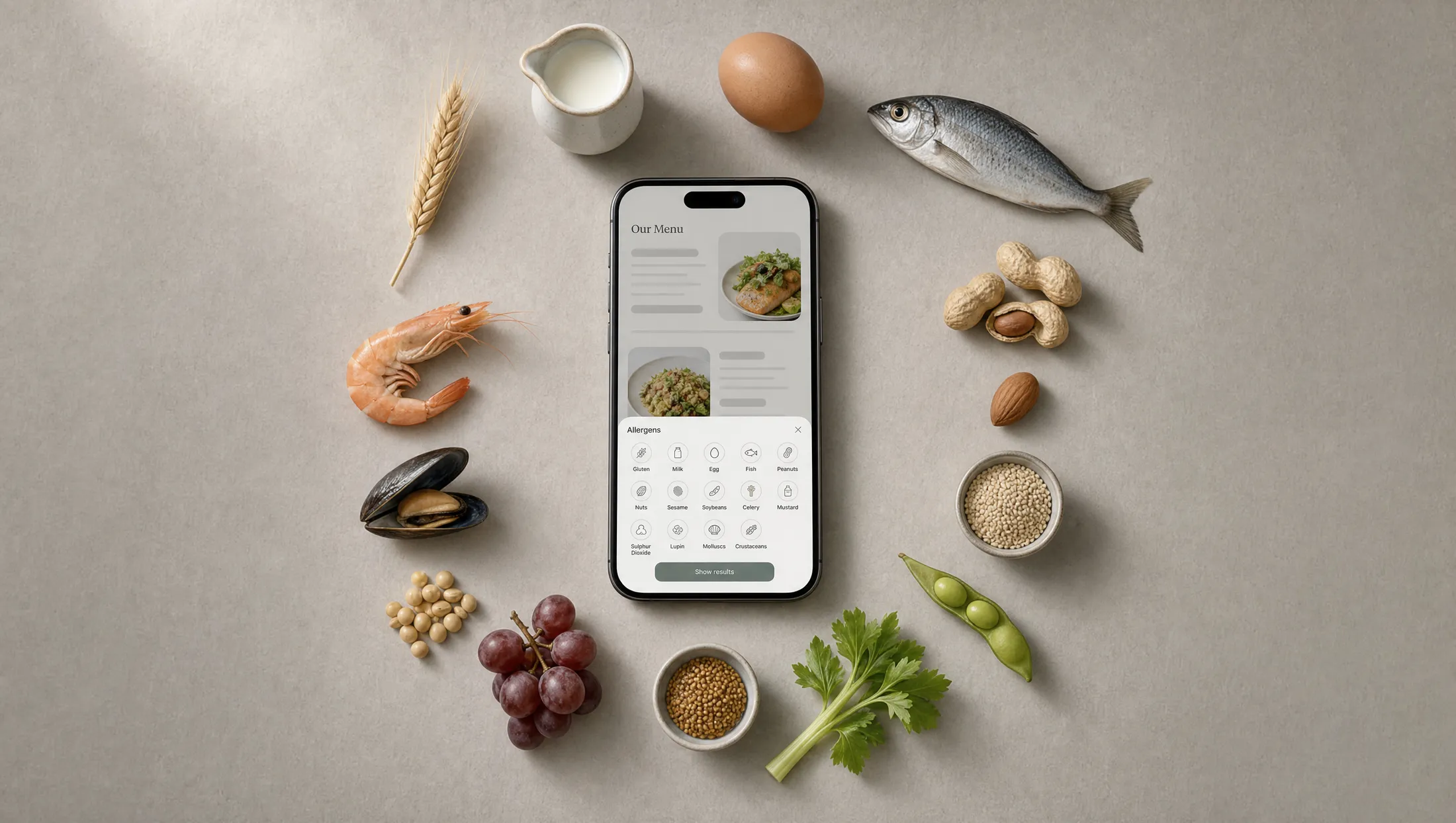
The required allergens vary by jurisdiction. The four most relevant frameworks for international tourist-area restaurants:
TL;DR — Key Takeaways
The EU mandates declaration of14 allergens under Regulation 1169/2011; the US mandates the top 9(sesame added in 2023); other markets vary.
Allergen information must be available to the guest before they order, in a form they can understand. This is the practical compliance bar in EU/UK markets.
Allergens must be tagged as structured data on every dish — not as translatable prose — to ensure consistent disclosure across multilingual menus.
Digital and QR menus are subject to the same allergen-disclosure requirements as printed menus. The "it's just a digital menu" framing is not a compliance defense.
The fastest path to compliance for tourist-area restaurants: a structured digital menu with allergen tagging on every dish, allergen filtering for guests, and per-language disclosure that auto-renders correctly.
What allergens must be declared on a restaurant menu in 2026?
The required allergens vary by jurisdiction. The four most relevant frameworks for international tourist-area restaurants:
European Union — 14 mandatory allergens (EU Regulation 1169/2011)
Cereals containing gluten (wheat, rye, barley, oats, spelt, kamut)
Crustaceans (prawns, lobsters, crabs)
Eggs
Fish
Peanuts
Soybeans
Milk (including lactose)
Nuts (tree nuts: almonds, hazelnuts, walnuts, cashews, pecans, brazil nuts, pistachios, macadamia)
Celery
Mustard
Sesame seeds
Sulphur dioxide and sulphites (>10 mg/kg or 10 mg/litre)
Lupin
Molluscs
United States — Top 9 allergens (FALCPA + 2023 sesame update)
Milk
Eggs
Fish
Crustacean shellfish
Tree nuts
Peanuts
Wheat
Soybeans
Sesame (added 2023 via FASTER Act)
United Kingdom — 14 allergens (UK FSA, mirroring EU)
Same as EU. Post-Brexit, the UK retained the 14-allergen framework via the Food Information Regulations 2014, with additional requirements (Natasha's Law, 2021) for prepackaged-for-direct-sale items.
Other major markets (summary)
Australia and New Zealand: 10 mandatory allergens under FSANZ Standard 1.2.3, including a stricter approach to gluten declaration.
Canada: 11 priority allergens under Food and Drug Regulations.
Japan: 7 mandatory and 21 recommended allergens, with stricter labeling on prepackaged items than restaurant menus.
Brazil: 17 allergens under Anvisa Resolution RDC 26/2015.
For international tourist-area restaurants, the practical answer is: comply with your most stringent applicable jurisdiction, plus declare anything obviously relevant to your guest mix.
What are the EU's 14 mandatory allergens (deeper detail)?
The EU 14 are the global gold standard for restaurant menu allergen disclosure. Even restaurants outside the EU often adopt the 14-allergen framework because it's the most comprehensive baseline.
The legal basis: Regulation (EU) No 1169/2011, on the provision of food information to consumers, often called "FIC." Article 9 establishes the mandatory disclosure of these 14 allergens. Article 44 specifically addresses non-prepackaged foods (which includes restaurant meals). FIC is not the only piece of EU food law reaching your menu — it is worth understanding what the EU Deforestation Regulation means for your supply chain alongside your allergen obligations.
Under FIC, restaurants must:
Disclose all 14 allergens that are present in their dishes, where present.
Make the disclosure available to the consumer before the food is provided— meaning, before the order is placed.
Provide the information in writing or verbally, with member states having the option to require written disclosure (most have).
Cover non-prepackaged dishes (the meals served at the table) as well as any prepacked items sold by the restaurant.
The "before the order is placed" requirement is the operationally important piece. A guest cannot be told allergen information after they've ordered. The disclosure has to be available during decision-making.
For digital menus specifically, this means the allergen information must be visible on the dish itself, not buried in a separate document.
What are the US's top 9 allergens (and the 2023 sesame update)?
The US framework is set by the Food Allergen Labeling and Consumer Protection Act (FALCPA, 2004), with the 9th allergen (sesame) added by the FASTER Act (2021), which took full effect on January 1, 2023.
The US requirements are slightly different from EU requirements in three important ways:
1. The US framework primarily targets prepackaged foods. Restaurant menus are governed largely by state-level regulations (with some federal exceptions for chain restaurants under the ACA's menu labeling provisions).
2. The 9 allergens are slightly narrower than the EU 14. The US doesn't include celery, mustard, sulphites, lupin or molluscs at the federal level — though some states have additional requirements.
3. Disclosure mechanisms vary by state. Some states require written disclosure on menus; others permit verbal disclosure on request; others require staff training but no specific menu format.
The practical 2026 baseline for US restaurants: declare the top 9 on the menu where present, train staff on cross-contamination, and follow your state's specific menu requirements (which may exceed federal).
Do allergen rules apply to QR menus and digital menus?
Yes — and this is one of the most important compliance questions in 2026.
The legal framing in EU/UK: a "menu" includes any format in which the dish information is presented to the guest before ordering. QR menus, tablet menus, websites used as menus, in-room hotel ordering systems and order-pay platforms all qualify. The format doesn't change the disclosure obligation.
What this means operationally:
Your QR menu must show allergen information on every dish, in a form the guest can understand, before they order.
"We have allergen info available — ask the server" doesn't satisfy the EU requirement that information be available during decision-making. Some member states accept this as a fallback if an audit trail of staff training exists; others don't.
Multilingual digital menus must show allergen information in each language version.
The information must be structured so that it remains accurate across language switches, not free-form prose that may translate inconsistently.
The compliance-driven argument for structured allergen tagging in digital menus is overwhelming: it's the only practical way to ensure consistent disclosure across multilingual menus, across menu updates, and across multi-property hotel chains.
Intermenu handles this by treating allergens as a structured field on every dish — the disclosure renders identically in every language version, automatically, with no risk of translation drift losing a critical "may contain" or "contains."
What's the legal liability if my menu doesn't list allergens correctly?
The legal exposure varies by jurisdiction but is meaningful in every developed market.
EU/UK exposure:
Fines under the Food Safety Act (UK) and equivalent member-state laws — typically £5,000–£20,000 per offense.
In severe cases (manslaughter via gross negligence after a fatal allergic reaction), criminal prosecution. Notable case: Pret a Manger after the death of Natasha Ednan-Laperouse, leading to Natasha's Law in 2021.
Civil liability for damages, often substantial.
Reputational impact, often more damaging than the fine.
US exposure:
Federal and state-level penalties under FALCPA and state food-safety laws.
Civil litigation — successful allergic-reaction lawsuits against US restaurants typically settle for $50K–$500K, occasionally higher in fatal cases.
FDA enforcement action where applicable.
Local health department citations.
Practical risk for an independent restaurant:
The single largest risk isn't the fine — it's the civil liability following a serious allergic reaction. A restaurant whose digital menu translation lost the "contains nuts" disclosure for a German guest who suffered anaphylaxis is exposed in a way that compounds: medical bills, civil suit, reputational damage, possible regulatory action.
This is why structured allergen tagging matters. It's the technical guarantee that the disclosure travels with the dish, in every language, on every surface, every time.
How are allergen rules different in Japan, Australia, Canada, Brazil?
Japan has a 7-allergen mandatory framework (eggs, milk, wheat, buckwheat, peanuts, shrimp, crab) plus 21 recommended allergens (including walnut, almond, cashew, sesame, soybean, beef, chicken, pork, fish, sesame, gelatin, kiwifruit, banana, orange, peach, apple, mackerel, salmon, salmon roe, abalone, squid, yam). The mandatory framework targets prepackaged foods more strictly than restaurant menus.
Australia and New Zealand use FSANZ Standard 1.2.3, which mandates declaration of 10 allergens including a stricter approach to gluten (any gluten-containing cereal must be declared, not just wheat). Additional 2024 updates added stricter labeling for sesame and soy.
Canada mandates 11 priority allergens (the EU 14 minus celery, mustard, lupin) plus mustard and sulphites. The Canadian framework is slightly closer to EU than US.
Brazil mandates 17 allergens under Anvisa Resolution RDC 26/2015 — one of the most comprehensive frameworks globally. Includes all the EU 14 plus oat, barley, rye, and natural latex.
Middle East (UAE, Saudi Arabia, Qatar)— no harmonized regional framework. UAE follows GSO standard largely aligned with EU 14. Saudi Arabia uses SFDA labeling rules. Most operators in the Gulf comply with EU 14 as a working baseline.
The pattern: most major markets have adopted some version of the EU 14, sometimes expanded, occasionally narrowed. Compliance with the EU 14 is the practical baseline that satisfies most jurisdictions.
Can I use icons or do I need words?
Both are typically required for clarity, but the legal default in EU/UK is words.
EU/UK requirement: allergens must be declared in writing, in the language of the host country, in a way the consumer can understand. Icons can supplement the words but cannot replace them.
US requirement: generally, words are required for the major allergens; icons can supplement.
Practical 2026 setup:
Tag allergens as structured data on each dish.
Render the structured data as both the standardized icon (for fast visual scanning) and the word (for legal compliance).
Ensure both render in every language version of the menu.
This is one of the strongest arguments for structured allergen data over free-text disclosure: structured data renders in the right format (icon + word) in every language automatically. Free-text disclosure requires a translator to remember the icon convention, which they often don't.
What's the difference between "may contain" and "contains"?
This is one of the most important distinctions in allergen disclosure, and one of the easiest to lose in translation.
"Contains [allergen]"= the allergen is intentionally an ingredient in the dish.
"May contain traces of [allergen]"= the allergen is not an intentional ingredient, but cross-contamination is possible (because of shared kitchen equipment, shared fryers, or proximity in food preparation).
The two phrases have different legal weight, different consumer-decision implications, and require different staff handling.
Why this matters for digital menus: a "may contain" disclosure that gets translated as "contains" (a common AI translation error in 2024 that has largely been fixed in 2026 by hospitality-trained engines) means severely allergic guests avoid dishes they could have safely eaten. The reverse error — "contains" translated as "may contain" — is potentially fatal.
The fix: tag the allergen presence at the dish level with a structured "contains" / "may contain" / "free from" attribute, never as free-text inside the dish description. Modern hospitality platforms render this consistently in every language.
How do I roll out allergen compliance across a multilingual menu?
Six-step rollout, takes 1–2 weeks for a typical 50-item menu.
Step 1 — Audit your kitchen. For every dish on the menu, document:
Intentional ingredients and their allergens
Potential cross-contamination sources (shared fryer, shared knife, shared prep surface)
Modifications that change allergen status (gluten-free version, dairy-free version)
Step 2 — Tag every dish with structured allergen data. In your menu platform, mark each dish with the allergens it contains and may contain. Use the EU 14 framework as the comprehensive baseline.
Step 3 — Verify multilingual rendering. Ensure the allergen tags render correctly in every language. The icon should be the standardized version; the word should be the locally accepted term. Spot-check 10 dishes per language.
Step 4 — Train staff. Front-of-house staff need to know:
That every dish has documented allergen information
How to access the documentation if a guest asks
The protocol for guests who declare allergies (typically: confirm with kitchen, no on-the-fly substitutions without verification)
The boundary between "we can accommodate this" and "we cannot guarantee freedom from cross-contamination"
Step 5 — Add the allergen filter to the QR menu. Guests should be able to filter the menu to show only dishes safe for their declared allergies. This is both a compliance enhancement and a customer-experience win.
Step 6 — Document and audit annually. Keep a record of when allergen data was last reviewed, by whom, and against which sources. An annual audit catches drift before it becomes a liability.
What about cross-contamination?
Cross-contamination is the harder operational problem. Even a perfectly tagged menu doesn't prevent cross-contamination in the kitchen.
Required staff awareness:
Shared fryers transfer allergens (a gluten-free dish fried in the same fryer as breaded chicken is not gluten-free).
Shared prep surfaces transfer allergens (cutting bread on the same board as a "dairy-free" dish is not dairy-free).
Shared utensils transfer allergens.
Shared cooking water transfers allergens (boiling pasta in the same water as a previous gluten-containing pasta).
Documentation:"may contain" disclosures should reflect actual kitchen risk. A dish prepared in a kitchen that handles peanuts realistically "may contain peanut traces" — even if the dish itself has no peanuts.
Communication: for guests with severe allergies, the honest answer is sometimes "we cannot guarantee zero cross-contamination given our kitchen setup." This is better than a false guarantee.
The legal protection for restaurants comes from honest disclosure plus documented training. A restaurant that says "we cannot guarantee" and trains staff accordingly has a defensible position. A restaurant that promises "100% nut-free" and then sends out a dish with peanut traces is exposed.
How does allergen disclosure interact with multilingual menus?
This is the central operational challenge for tourist-area restaurants in 2026.
The problem: an allergen disclosure written in your local language ("contiene noci") needs to render correctly for a German tourist with a severe nut allergy ("enthält Nüsse") and a Japanese tourist with a peanut allergy (落花生を含む) and an English-speaking traveler ("contains nuts"). The disclosure has to be accurate and unambiguous in every language, every time.
The wrong solution: translate the disclosure prose ("contains nuts") through generic AI translation. This produces inconsistent results — sometimes accurate, occasionally translating "may contain" as "contains" or losing the modifier entirely.
The right solution: tag allergens as structured data on each dish. Every language version then renders the disclosure using the standardized local term — not by translating the English prose.
Intermenu is built around this principle. Allergens are first-class structured fields on every dish. The disclosure renders as the standardized term in every supported language, with no translation step in between. This is the technical foundation of allergen safety in multilingual menus.
A worked example: how compliance failures happen
A real-world failure pattern, anonymized and slightly composited from documented cases.
Setting: a tourist-area Italian restaurant in southern Spain. Bilingual paper menu (Spanish, English). German tourist with a documented peanut allergy.
The failure:
The dish Tagliatelle al pesto genovese contains pine nuts, traditionally not classified as "nuts" under common usage but flagged in EU 1169/2011 as a tree nut — pinoli specifically falls under "nuts."
The Spanish menu lists ingredients but doesn't structurally tag the tree-nut allergen.
The English translation ("Tagliatelle with Genoese pesto") loses the ingredient list entirely.
The German tourist, scanning the English menu, doesn't see a tree-nut warning.
The waiter, when asked about peanut allergy, says "no peanuts in pesto" — which is true. The tourist orders.
Allergic reaction at the table.
The compliance failure points:
Pine nuts not declared as a tree-nut allergen in either language.
Translation lost the ingredient detail.
Front-of-house staff weren't trained on the cross-allergen risk (peanut-allergic guests sometimes also react to tree nuts).
What structured allergen tagging would have prevented:
The dish would have been tagged with "tree nuts: pine nuts" as structured data.
The English version would have rendered the same allergen tag in the standardized form.
The QR menu's allergen filter would have hidden the dish from the guest's filtered view.
The waiter's screen would have shown the allergen on the order ticket.
Each step of the structured approach closes a hole that prose-based disclosure leaves open.
Frequently Asked Questions
What allergens must be declared on a restaurant menu in 2026? EU: 14 (Regulation 1169/2011). US: 9 (top 9 including sesame as of 2023). Other markets vary. Comply with your most stringent applicable jurisdiction.
Do allergen rules apply to QR menus and digital menus? Yes. The legal definition of "menu" includes any pre-order presentation of dishes, regardless of format. QR, tablet, website and in-room ordering systems all qualify.
What's the legal liability if my menu doesn't list allergens correctly? Fines (£5,000–£20,000 per offense in UK; comparable in EU member states), civil litigation in the event of an allergic reaction (typical settlements $50K–$500K in US, comparable in EU), and reputational damage. Severe cases can include criminal prosecution.
Can I use icons or do I need words? EU/UK: words required, icons can supplement. US: generally words required for major allergens. Best practice: render structured allergen tags as both icons (for visual scanning) and words (for legal compliance) in every language.
What's the difference between "may contain" and "contains"?"Contains" = intentional ingredient. "May contain" = possible cross-contamination but not intentional. Distinct legal weight; never substitute one for the other.
How do I tag allergens on a multilingual menu without losing accuracy? Tag allergens as structured data on each dish, never as free-form prose. Every language version then renders the standardized term automatically, eliminating translation drift.
What's Natasha's Law and where does it apply? UK law from 2021 requiring full ingredient and allergen labeling on prepackaged-for-direct-sale items. Named after Natasha Ednan-Laperouse, who died of an allergic reaction to a Pret a Manger sandwich whose label didn't disclose sesame. Applies to UK; influences allergen-labeling expectations globally.
Are kitchens with severe-allergy guests legally required to refuse service? No. Restaurants are required to disclose accurately and accommodate where possible. They are not required to guarantee zero cross-contamination. Honest disclosure ("we cannot guarantee zero cross-contamination") is a defensible position.
Get Automated Allergen Compliance for 15 Languages
Allergen compliance in 2026 is too important to run on translated prose. Tools like Intermenu tag allergens as structured data once per dish, then render the disclosure correctly in every supported language — with built-in guest filtering for safe dish discovery.
If your current setup leaves any gap between the kitchen's knowledge and the guest's reading, see what structured allergen tagging looks like →