
Restaurant Google Maps SEO: Boost Visibility for Tourists
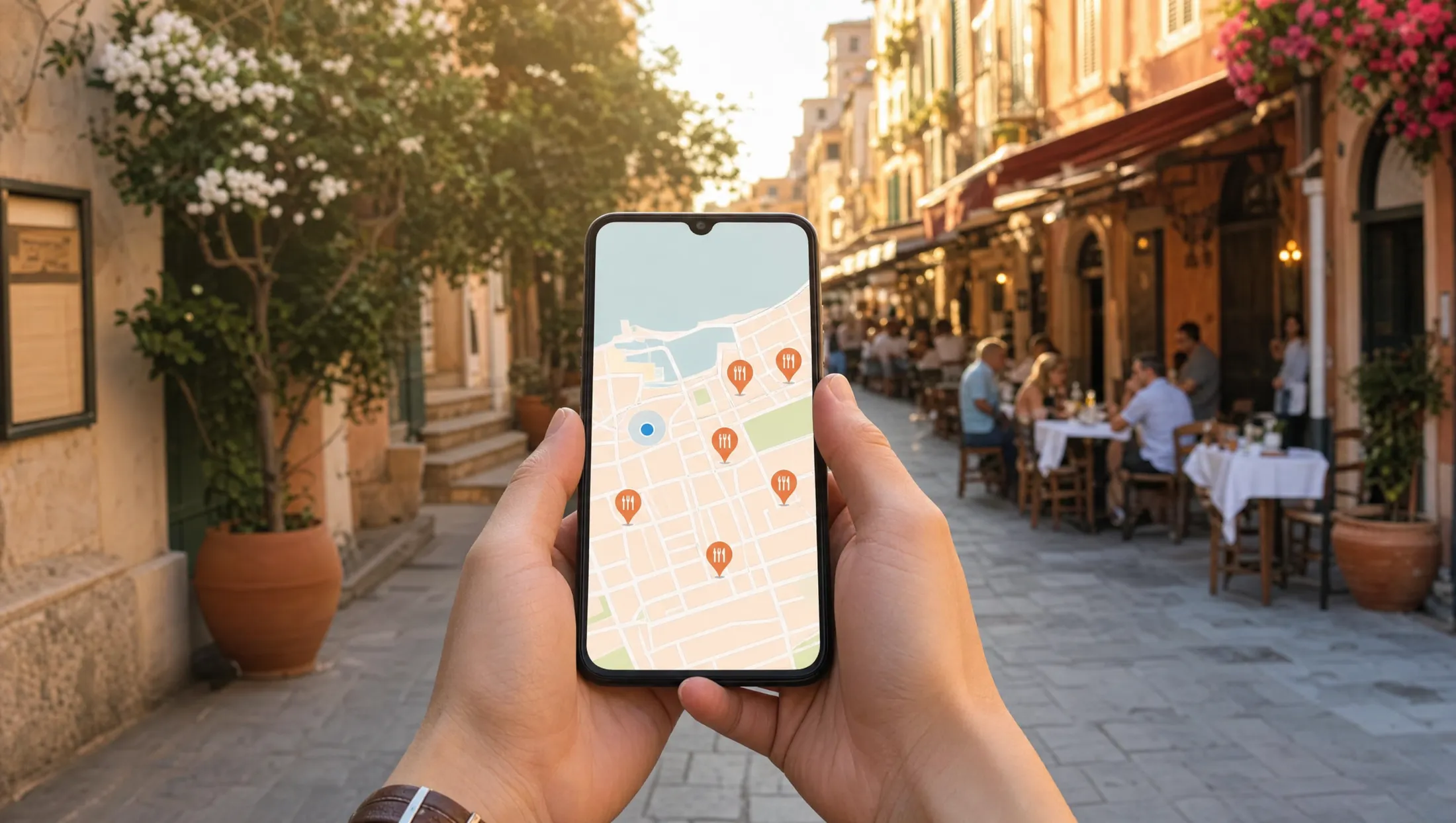
How does Google decide which restaurants to show tourists?
TL;DR — Key Takeaways
Google Maps drives roughly 40% of tourist restaurant decisions in 2026 — the single most important channel for any tourist-area restaurant.
Your Google listing is half the battle — pair these Maps tactics with a fully optimized Google Business Profile for restaurants to lock in your Map Pack spot.
The Google Business Profile (GBP) is the entry point. Eight components matter most: name accuracy, hours, photos, reviews + responses, menu link, attributes, booking link, and category selection.
Photos updated weekly (50+ in total) carry significant weight. AI-generated dish photography makes this trivial: a fresh photo for every dish, every week, at near-zero cost.
Responding to every review within 48 hours is one of the highest-ROI actions in local SEO. It signals active engagement and meaningfully improves ranking.
Tourist reviews count more than locals' reviews in Google's algorithm for tourist-area searches — recent foreign-traveler reviews are a key ranking signal.
How does Google decide which restaurants to show tourists?
Google's local search algorithm in 2026 weighs three primary factors for tourist-area searches:
1. Relevance— does the restaurant match the search terms? "Best ramen in Tokyo" matches restaurants tagged as ramen, mentioned for ramen in reviews, and described as serving ramen.
2. Distance— how close is the restaurant to the search location? Google Maps gives strong preference to nearby results, but for tourist searches the distance weight is slightly relaxed.
3. Prominence— how well-established and well-reviewed is the restaurant? Driven by review volume, review recency, photo activity, link signals, and ambient mentions across the web.
For tourist searches specifically, Google adds:
Recency of reviews from non-locals— reviews from accounts outside the local market
Multilingual signals— restaurants advertising multilingual capability (in description, attributes, photos showing multilingual menus) get a boost on tourist-relevant searches
Specific dish mentions— restaurants whose dish names appear in reviews and the GBP description
Photo freshness— recent photos signal an active operation
Booking integrations— restaurants linked to OpenTable, Resy, etc. signal trustworthiness
The 2026 ranking is more multi-signal than ever. A single optimization (lots of reviews, or great photos, or strong GBP description) won't move you to the top. The cumulative effect of all signals together is what wins.
What's the right way to write a restaurant GBP description in 2026?
A high-performing GBP description has five components, in order:
1. Lead with cuisine and signature dishes."Authentic Sicilian trattoria specializing in fresh pasta, salt-baked branzino, and house-made arancini."
2. Mention multilingual capability if applicable."Menu available in your language with allergen filtering."
3. Add geographic anchor."In the heart of [neighborhood/landmark]."
4. Note any recognition or accolades."Featured in [publication]" or "Top-rated [cuisine] in [area]" — only if true.
5. Close with practical information."Outdoor seating available. Reservations recommended."
The description should be750 characters or less for optimal display, dense with relevant search terms, and honest (puffery hurts long-term ranking by inviting negative reviews when reality doesn't match the claim).
A common mistake: poetic descriptions that emphasize ambience without mentioning cuisine specifics. "Where every meal is an experience" doesn't help Google match search intent. "Where every Roman pasta is hand-cut, including our cacio e pepe and amatriciana" does.
How many photos does my Google Business Profile need?
Minimum50 photos for any tourist-area restaurant in 2026.100+ is meaningfully better.
Photo categories that matter:
Dishes (40-50% of total photos)— every dish on the menu should appear, with multiple angles for top sellers
Interior (10-15%) — atmosphere, table settings, key décor elements
Exterior (5-10%) — front entrance, signage, street view
Staff/team (5-10%) — chef, key servers, the team in action
Atmosphere (10-20%) — diners enjoying themselves (with permission), busy service moments
Menu and signage (5-10%) — actual menu pages, the QR menu in use, language switcher visible
Photo refresh cadence:
5–10 new photos per week is the goal for a competitive operation
AI dish photography makes this trivially easy in 2026
Fresh seasonal photos (summer terrace, winter fireplace, holiday décor) drive seasonal visibility lift
Restaurants that hit 100+ photos with weekly fresh additions consistently rank higher in tourist searches than restaurants with 20 stale photos. The signal is interpreted as "this is an active, well-run business."
Do reviews from tourists count more than locals?
For tourist-area searches, yes — Google appears to weight non-local reviews more heavily for tourist-relevant queries.
The mechanism:
Google's algorithm identifies tourist-relevant searches ("best [cuisine] in [city]," "where to eat near [landmark]")
Reviews from accounts outside the local market signal that the restaurant successfully serves visitors
Recent international reviews are the strongest signal
Practical implication:
Encourage international guests to leave reviews
Make leaving a review easy (QR code on the receipt with a direct link)
Respond to international reviews in their language when possible (signals attentive hospitality)
The wrong approach:
Asking for reviews is fine; offering incentives for reviews is against Google's policy and can result in penalties
Don't dispute negative reviews; respond constructively
A cultural note: Different nationalities review at very different rates. American tourists review ~2x more often than European tourists; Asian tourists review at lower rates but the reviews carry significant weight in their home markets. Adjust expectations accordingly.
Should I respond to reviews in their original language?
Yes, when possible. This is one of the highest-leverage signals available.
The signal interpretation:
A French tourist leaves a review in French
The restaurant responds in French (even briefly)
This signals to Google that the restaurant serves French speakers; signals to the next French-speaking searcher that the restaurant accommodates them
The compounding effect lifts visibility for French-speaker queries
Practical implementation:
Use a translation tool to draft responses; have a multilingual staff member or freelancer review weekly
Keep responses brief and warm
Always thank the reviewer specifically; address any concerns honestly
Don't auto-translate — the friction shows. A few minutes of human review per response per week is enough
The compounding ROI:
Foreign-language responses signal hospitality to foreign-language searchers
Foreign-language responses sometimes get reposted by reviewers in their own social networks
The cumulative SEO + brand effect is meaningful over months
This practice is among the most effective and most underused in tourist-area restaurant marketing in 2026.
How do I get my multilingual menu visible on my GBP?
Three concrete actions:
1. Add the multilingual menu link to your GBP "Menu" attribute. Make sure the link goes to the modern multilingual menu (with the language switcher), not to a PDF or static page.
2. Add "Menu in your language" to your GBP description. Search algorithms and AI assistants both pick up on this phrase.
3. Upload a photo of the multilingual menu in use. A phone showing the menu's language switcher with multiple language flags visible communicates the capability instantly.
The compounding effect: tourists searching "menu in [language]" or "[cuisine] [city] [language]-friendly" find your restaurant. Tourists comparing multiple options use multilingual capability as a tiebreaker.
Intermenu-powered restaurants typically include the language flag panel and the QR menu graphic prominently in their GBP photos — making the multilingual capability discoverable from the search results page itself.
What attributes should I set on my GBP?
Eight high-impact attributes to fill in for any tourist-area restaurant:
1. Cuisine type— primary cuisine (Italian, Japanese, etc.) plus sub-style (Sicilian, Hakata-style ramen, etc.)
2. Price range— Google's $/$$/$$$/$$$$ system
3. Service options— dine-in, takeout, delivery, reservations
4. Highlights— fast service, outdoor seating, live music, family-friendly
5. Offerings— has bar, wine list, specific dietary options (vegetarian, vegan, gluten-free, halal-friendly, kosher)
6. Dining options— breakfast, lunch, dinner, brunch, happy hour
7. Amenities— wi-fi, accessible entrance, restrooms
8. Crowd— tourist-friendly, group-friendly, romantic, family-friendly
Filling all of these is a 30-minute task and significantly improves match accuracy on relevant searches.
How does a 7-day GBP optimization sprint look?
A practical week-long plan to bring an underperforming GBP up to standard:
Day 1 (1 hour): Audit current GBP. Note every empty field, every outdated entry, every missing attribute. Build the working list.
Day 2 (2 hours): Rewrite the description using the 5-component template. Update name accuracy. Verify hours including holiday hours.
Day 3 (2 hours): Photo cleanup and addition. Remove low-quality or outdated photos. Add 20–30 new photos (mix of dish, interior, atmosphere). Use AI generation to fill dish photo gaps.
Day 4 (1 hour): Fill all attributes — cuisine, price range, service options, highlights, offerings, dining options, amenities, crowd.
Day 5 (2 hours): Review response sprint. Go back through the last 90 days of reviews; respond to every one that doesn't have a response. Set up a 48-hour response cadence going forward.
Day 6 (1 hour): Booking and menu links. Verify booking link works on mobile. Verify menu link goes to a real multilingual digital menu (not a PDF). Add structured data to your website.
Day 7 (1 hour): Documentation. Save the GBP login, the response template language, and the photo backlog. Schedule weekly maintenance time.
Total time investment: ~10 hours over a week, repeating monthly maintenance of ~2 hours/month thereafter. The ranking and visibility lift from this single sprint is typically meaningful within 30 days.
Frequently Asked Questions
How does Google decide which restaurants to show tourists? Three factors: relevance (does the restaurant match the search?), distance (proximity), and prominence (review volume, photo activity, link signals). Tourist searches add weight on non-local reviews, multilingual signals, photo freshness, and dish-name matches.
What's the right way to write a restaurant GBP description in 2026? Lead with cuisine and signature dishes, mention multilingual capability, add geographic anchor, note recognition if applicable, close with practical info. 750 characters or less, dense with search terms, honest.
How many photos does my Google Business Profile need? Minimum 50, ideally 100+, refreshed at 5–10 new photos per week. AI dish photography makes this trivially achievable.
Do reviews from tourists count more than locals? Yes, for tourist-relevant searches Google weights non-local reviews more heavily. Recent international reviews are particularly valuable.
Should I respond to reviews in their original language? Yes when possible. Signals to both Google and to other foreign-language searchers that you accommodate international guests. Drafted via translation, reviewed by a multilingual person weekly.
Get Optimized Food Photos for Your Google Business Profile
Maintaining a high-volume photo cadence on your GBP is one of the highest-leverage local SEO investments in 2026. With AI dish photography, the bottleneck shifts from "can we afford the photographer?" to "can we generate the right images quickly?"
Intermenu's AI dish photos are generated right from the dish editor, drawing on your plan's monthly image allowance. Refresh your GBP with 5–10 fresh dish photos every week without ever booking a shoot.
If your GBP photo count is below 50, the fastest path to fixing it runs through the modern visual stack →