
Guide to World Cuisines: 50 Dishes to Savor Locally
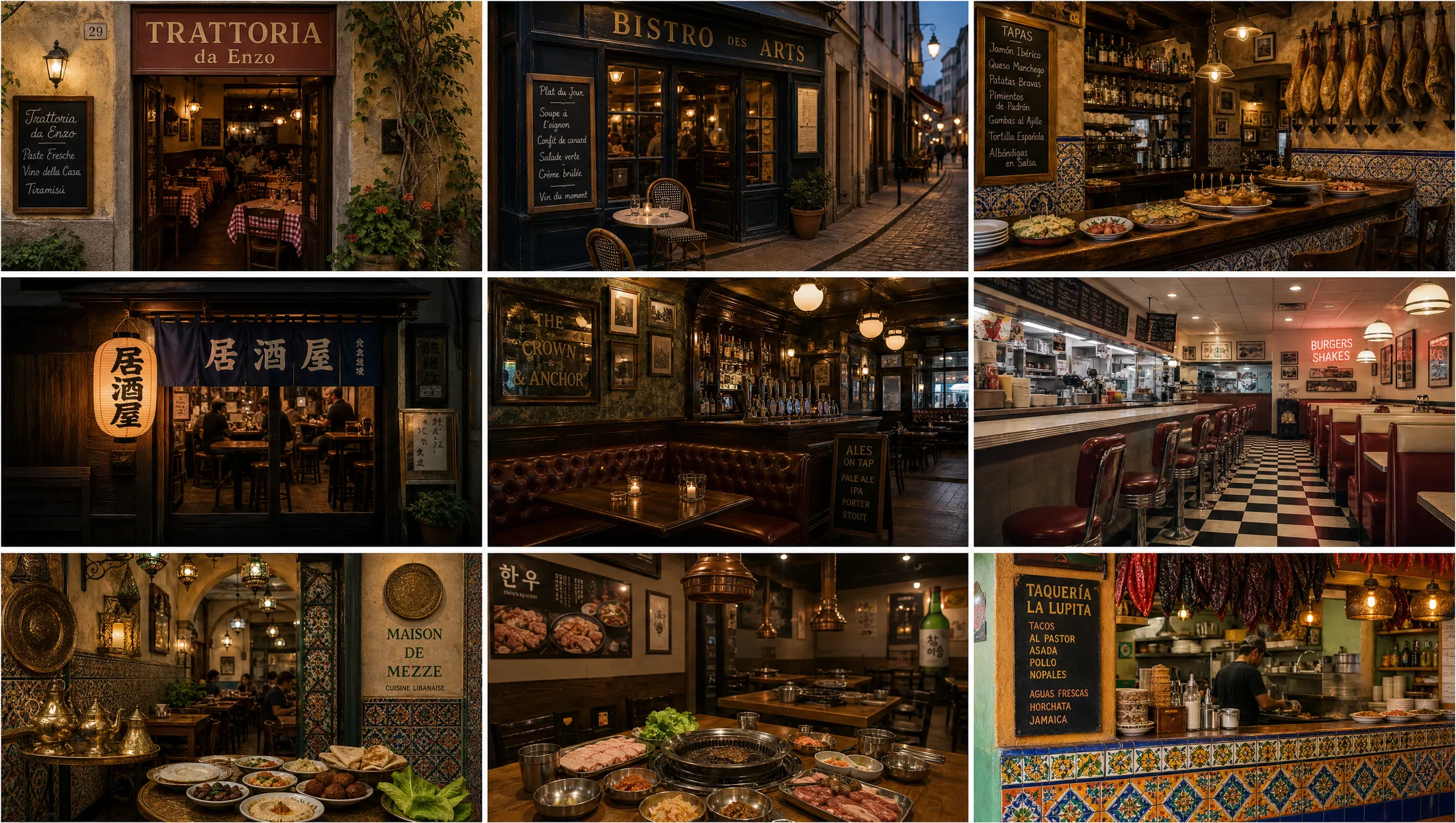
The cuisines are organized by region for ease of reference. Within each region, listings are roughly alphabetical.
TL;DR — Key Takeaways
Food is increasingly the primary driver of travel decisions — 84% of international travelers in 2026 say local cuisine influences their destination choice.
This guide covers 50 cuisines, organized by region, with the signature dish, the cultural context, what to order on a first visit, and the etiquette point most tourists miss.
Every cuisine has a "first dish" — the one a curious traveler should order to taste the culture's character. We name it for each.
Restaurants in tourist-area cities benefit from positioning their cuisine within this broader cultural map; tools like multilingual menus with cultural context fields make this approachable for international guests.
The single biggest travel-and-food insight of 2026: tourists no longer just visit famous cuisine countries — they actively seek lesser-known cuisines (Georgian, Filipino, Eritrean) as part of their food-tourism agenda.
How to use this guide
Each cuisine entry includes:
Region of origin— where the cuisine developed
Signature dish— the one dish that defines the cuisine for first-timers
Cultural context— why this cuisine matters historically or socially
What to order— a curated 3-dish first-visit progression
Etiquette note— one thing tourists frequently get wrong
The cuisines are organized by region for ease of reference. Within each region, listings are roughly alphabetical.
Mediterranean & Southern European cuisines
1. Italian (Italy)
Italian cuisine is regional, not national. Italy doesn't really have one cuisine — it has 20.
Signature dish: depends entirely on the region. Cacio e pepe (Roman), risotto allo zafferano (Lombard), trofie al pesto (Ligurian), pizza margherita (Neapolitan).
First-visit progression: antipasto → fresh pasta → seasonal main → simple dolce. Avoid the touristic "Italian sampler menu."
Etiquette note: don't ask for parmesan on seafood pasta. The flavors clash and the request signals foreignness.
2. Sicilian (Italy, distinct enough to merit its own entry)
A blend of Italian, Arab, Greek, and Spanish culinary traditions. Arancini, caponata, pasta alla Norma, cannoli.
First-visit progression: street food (arancini, panelle), seasonal pasta, fresh seafood, cannoli or cassata for dessert.
3. Greek (Greece)
Ancient cuisine; modern face. Olive oil, oregano, lemon, lamb, fresh fish, simple vegetables.
First-visit progression: mezze platter, moussaka or grilled fish, baklava or fresh fruit.
Etiquette note: eating slowly is part of the culture. A "quick lunch" doesn't really exist in traditional Greek dining.
4. Spanish (Spain)
Tapas culture is the signature. Multiple small dishes shared across a long meal.
First-visit progression: pan con tomate, jamón ibérico, gambas al ajillo, tortilla española, dessert sherry.
Etiquette note: lunch is at 2-3pm, dinner at 9-10pm. Showing up at 7pm for dinner marks you as foreign.
5. Portuguese (Portugal)
Atlantic-facing cuisine with strong colonial influences. Bacalhau, pastéis de nata, fresh sardines, pão.
First-visit progression: pastéis de bacalhau (cod fritters), grilled sardines, bifana (pork sandwich), pastel de nata.
6. Catalan (Catalonia, Spain — distinct cuisine)
Catalan cuisine has its own identity. Pa amb tomàquet, escudella i carn d'olla, crema catalana, fideuà.
7. Maltese (Malta)
Underrated. Fusion of Italian, Sicilian, Arab and British influences. Pastizzi, fenkata (rabbit stew), ftira.
Western European cuisines
8. French (France)
Foundational to Western cuisine. Regional variation is enormous.
First-visit progression: escargot or œufs en meurette, coq au vin or bouillabaisse, crème brûlée or cheese course.
Etiquette note: bread is for the meal, not the appetizer. Don't ask for it before food arrives unless requested.
9. Belgian (Belgium)
Distinct from French. Beer, mussels, fries, chocolate, waffles. Foundational cuisine for several modern food categories.
First-visit progression: moules-frites, Belgian beer, waffle— in that order.
10. Dutch (Netherlands)
Often overlooked. Cheese, herring, bitterballen, stroopwafels.
First-visit progression: raw herring (with onions), bitterballen, Gouda or Edam tasting.
11. German (Germany)
Regional variation underestimated. Bavarian, Berlin, Northern German, Swabian — different cuisines.
First-visit progression: bratwurst with kraut, Schnitzel (Wiener-style or Jäger), Apfelstrudel.
12. Austrian (Austria)
Distinct from German. Wiener Schnitzel, Sachertorte, Tafelspitz, Kaiserschmarrn.
13. Swiss (Switzerland)
Mountain cuisine with French, German, Italian influences. Fondue, raclette, rösti, zürcher geschnetzeltes.
14. British (UK)
Genuinely modern. Sunday roast, fish and chips, full English breakfast, afternoon tea, but also a strong Indian, Chinese, and global fusion influence.
First-visit progression: Sunday roast lunch, fish and chips by the sea, afternoon tea (high tea is different).
15. Irish (Ireland)
Irish stew, colcannon, Guinness, soda bread, modern Atlantic seafood.
16. Scandinavian (Denmark, Sweden, Norway, Finland — closely related)
Smørrebrød (Denmark), gravlax, köttbullar (Swedish), lutfisk, cinnamon buns. New Nordic cuisine has redefined this category globally.
First-visit progression: seasonal smørrebrød, gravlax, classic dessert (kanelbullar in Sweden, æbleskiver in Denmark).
Eastern European & Balkan cuisines
17. Polish (Poland)
Pierogi, bigos, żurek, kielbasa, makowiec.
First-visit progression: żurek soup, mixed pierogi platter, makowiec poppy-seed cake.
18. Czech (Czech Republic)
Svíčková, guláš, knedlíky, Pilsner Urquell. Heavy in winter, lighter in summer.
19. Hungarian (Hungary)
Goulash (the real one — a soup, not a stew), paprikash, langos, Tokaji sweet wine.
20. Russian (Russia)
Borscht, pelmeni, blini with caviar, kvass, medovik honey cake.
21. Georgian (Georgia, eastern Europe — increasingly popular globally)
Khachapuri, khinkali, pkhali, churchkhela. One of the world's oldest wine cultures.
First-visit progression: adjarian khachapuri, khinkali dumplings (eat with hands, leave the doughy top), Georgian wine.
22. Turkish (Turkey, technically Eurasian)
Massive cuisine, vastly underrated globally. Kebab, meze, baklava, Turkish coffee, pide.
First-visit progression: mixed meze, mixed grill (kebab varieties), baklava, Turkish coffee.
Etiquette note: Turkish coffee is sipped slowly and never shaken. The grounds settle at the bottom; don't drink them.
Middle Eastern cuisines
23. Lebanese (Lebanon)
Foundational to broader Middle Eastern cuisine. Hummus, tabbouleh, fattoush, kibbeh, shawarma.
First-visit progression: mixed mezze, kibbeh nayyeh (raw lamb), grilled meat platter, baklava.
24. Israeli (Israel)
Modern Israeli cuisine is a fusion of Mediterranean, Middle Eastern, North African, and Eastern European traditions.
First-visit progression: sabich, falafel, hummus with toppings, malabi.
25. Persian / Iranian (Iran)
One of the world's oldest cuisines. Polo (rice), kabab, fesenjan, ghormeh sabzi, saffron desserts.
First-visit progression: kuku sabzi (herb omelet), chelo kabab, saffron rice with pistachios.
26. Egyptian (Egypt)
Koshari, molokhia, ful medames, fattah. Strong Mediterranean influence in coastal areas.
27. Moroccan (Morocco)
Tagine, couscous, pastilla, harira, mint tea.
First-visit progression: harira soup, lamb tagine with prunes, mint tea served sweet.
28. Tunisian (Tunisia)
Distinct from Moroccan despite proximity. Brik, couscous, harissa-heavy stews, fresh fish.
29. Saudi / Gulf (Saudi Arabia, UAE, Qatar)
Kabsa, machboos, mandi, luqaimat, gahwa (cardamom coffee).
30. Yemeni (Yemen)
Often overlooked. Mandi, salta, bint al-sahn, sahawiq.
South Asian cuisines
31. Indian — North (Punjab, Delhi, Uttar Pradesh)
Butter chicken, naan, biryani, dal makhani, tandoor.
First-visit progression: start with one curry, one dal, naan, raita. Build up.
32. Indian — South (Tamil Nadu, Kerala, Karnataka, Andhra)
Distinct from North Indian. Dosa, sambar, idli, thali, coconut-based curries, fish curry.
33. Hyderabadi (a city's cuisine that became globally recognized)
Hyderabadi biryani, haleem, pathar ka gosht. Persian-Indian fusion.
34. Bengali (Bengal — both India and Bangladesh)
Macher jhol, cholar dal, mishti doi, rosogolla. Fish-forward, sweet-leaning.
35. Sri Lankan (Sri Lanka)
Hoppers, kottu roti, fish curry with coconut, string hoppers.
36. Pakistani (Pakistan)
Biryani, nihari, kebabs, chai, halwa.
37. Nepalese (Nepal)
Dal bhat, momos, sel roti. Influenced by Indian and Tibetan cuisines.
38. Afghan (Afghanistan)
Kabuli pulao, mantu, aushak, kebabs.
East & Southeast Asian cuisines
39. Japanese (Japan)
Multiple distinct cuisines within Japan. Sushi, ramen, kaiseki, donburi, teppanyaki.
First-visit progression: good ramen first, then go further (sushi omakase, casual izakaya, eventually kaiseki).
40. Korean (South Korea)
Bibimbap, bulgogi, kimchi, Korean BBQ, banchan.
First-visit progression: Korean BBQ for the social experience, bibimbap, japchae, patbingsu.
41. Chinese — Cantonese (Hong Kong, Guangdong)
Dim sum, char siu, fresh seafood, wonton noodles, soft preparations.
42. Chinese — Sichuan
Mapo tofu, kung pao chicken, dan dan noodles, Sichuan hotpot. Ma-la (numbing-spicy) flavor profile.
43. Chinese — Shanghainese / Jiangsu
Xiaolongbao (soup dumplings), braised pork belly, drunken chicken. Sweet-savory balance.
44. Thai (Thailand)
Pad Thai, tom yum, green curry, som tam, mango sticky rice.
First-visit progression: tom yum, pad Thai, green curry, mango sticky rice.
45. Vietnamese (Vietnam)
Pho, bun cha, banh mi, banh xeo, summer rolls.
46. Indonesian (Indonesia)
Nasi goreng, rendang, sate, gado-gado, Padang cuisine.
47. Filipino (Philippines)
Increasingly globally popular. Adobo, sinigang, lechon, halo-halo, kare-kare.
48. Malaysian (Malaysia)
Fusion of Chinese, Indian, Malay influences. Nasi lemak, char kway teow, laksa, roti canai.
African & Latin American cuisines
49. Ethiopian / Eritrean (Ethiopia, Eritrea)
Injera, doro wat, tibs, kitfo. Communal eating from a shared platter.
First-visit progression: mixed platter for two with injera, traditional honey wine.
50. Mexican (Mexico — multiple regional cuisines)
Tacos al pastor (CDMX), mole poblano (Puebla), cochinita pibil (Yucatán), aguachile (Sinaloa), tlayudas (Oaxaca).
First-visit progression: street tacos, mole, fresh ceviche, mezcal.
How fusion cuisine is changing the global food map
The 2026 reality is that pure regional cuisines are now joined by serious fusion traditions:
Nikkei— Japanese-Peruvian fusion that originated in Lima and is now globally significant
Chifa— Chinese-Peruvian fusion
Tex-Mex— distinct from Mexican cuisine; its own tradition
Cubano sandwiches— Cuban-American
British curry— distinct from Indian cuisine despite shared origins
Italo-American— distinct from Italian cuisine; the cuisine of the Italian-American diaspora
California cuisine— fusion of European technique with Mexican, Asian, and American ingredients
These fusion cuisines are no longer "second-tier" — they're cultural achievements in their own right and worth seeking out as travel experiences.
Why this map matters for restaurants
Restaurants serving any of the cuisines above benefit from clearly positioning their cuisine within the broader map.
For tourist-area restaurants:
Anchor your cuisine clearly in the menu description — "Sicilian, not Italian-American" or "Hyderabadi-style biryani, distinct from Punjabi"
Use the menu's translation engine to render dish names with cultural context —kibbeh nayyeh with a one-line "Lebanese-style raw lamb tartare" explanation reaches a tourist who's never heard of the dish
Tag dishes with the regional anchor as structured data so the menu's filter can show "Sicilian only" or "Hakata-style only"
Train staff to communicate the cultural specifics confidently when asked
Intermenu's menu keeps that regional and cultural context in each dish description, which is translated with the menu, so the broader map of world cuisines becomes navigable to tourists in any language the menu is offered in — supporting the platform mission of making food culture accessible across language lines.
Frequently Asked Questions
What cuisines should every food traveler know? The 50 above cover the major regional traditions. The first-visit list for new food travelers: Italian (regional), French, Japanese, Indian (start with one regional cuisine), Mexican, Thai, and Lebanese.
Which cuisines are most beginner-friendly for travelers? Italian, Japanese ramen and sushi, Greek, Spanish tapas, Mexican tacos, Thai (mild dishes). These have well-defined "starter" dishes that don't intimidate.
What dish should I order on my first trip to [country]? The progression for each cuisine in the listings above. The general rule: start with the soup or appetizer, then a signature main, then the iconic dessert.
How is fusion cuisine changing the global food map? Fusion cuisines (Nikkei, Chifa, modern Israeli, British curry, etc.) are now established traditions in their own right, not "second-tier" hybrids. They're worth seeking out as travel experiences.
Find Restaurants Serving Authentic [Cuisine] in Your Language
Food culture is the most underrated reason to travel. The richer the food map a tourist carries with them, the better their meals.
Intermenu restaurants list up to five cuisine types in their profile and write the region and tradition into each dish description, which is translated with the menu — so a tourist looking for "authentic Sicilian" or "Hakata-style ramen" can find it without language friction. The platform's mission is to bridge food and language together.
If you operate a restaurant with a specific regional identity, see what positioning your cuisine within the broader map can do for your discovery →