
How to Order Coffee Abroad: Tips for 8 Cultures
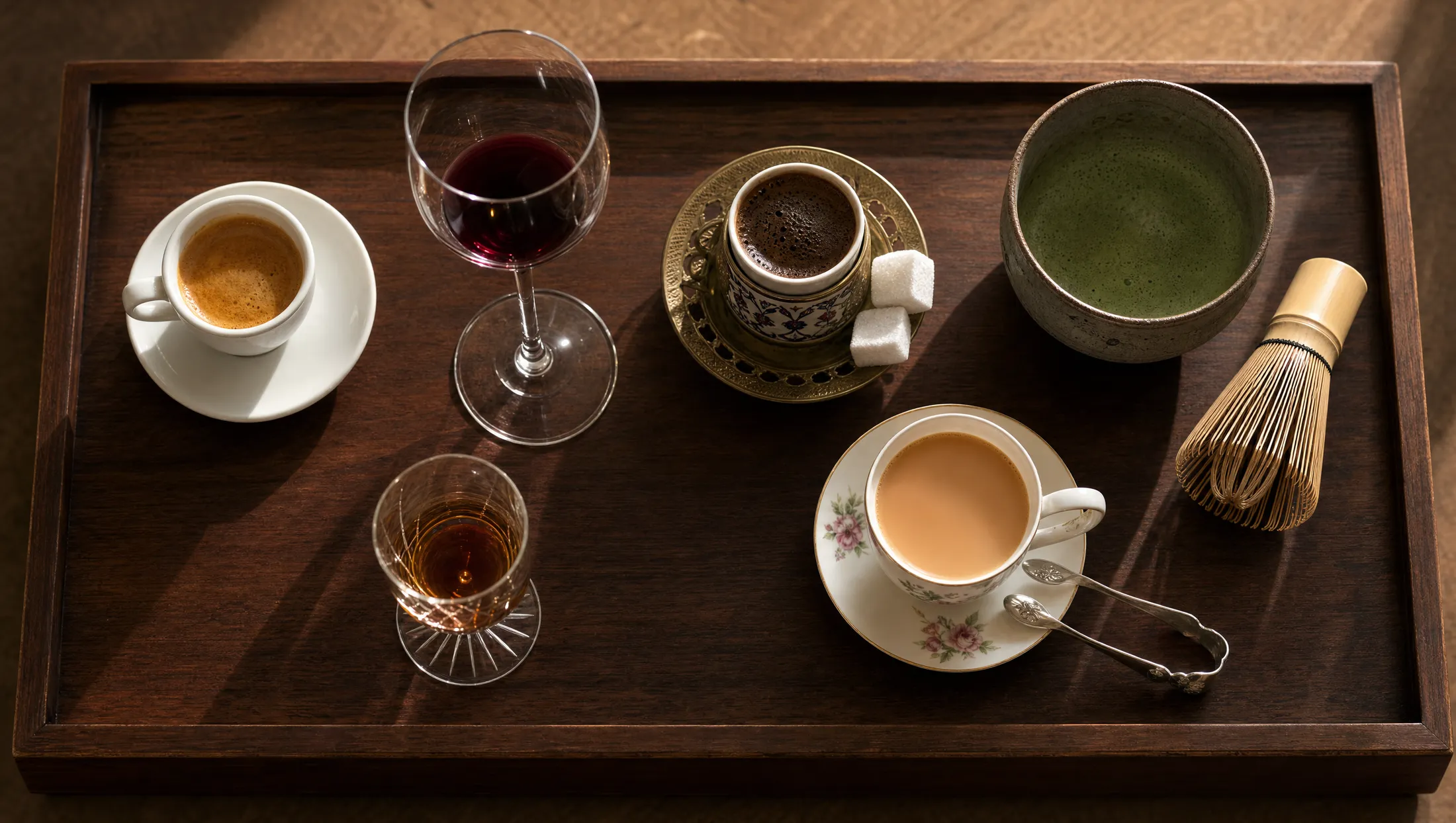
Food etiquette gets discussed often. Beverage etiquette is more specialized and easier to get wrong, partly because beverages are often the first thing a tourist orders — coffee in the morning, wine at lunch, tea in the afternoon. Get the beverage order right and the meal starts well.
TL;DR — Key Takeaways
"Latte" doesn't mean coffee in Italy — it means milk. Asking for "a latte" in Rome gets you a glass of warm milk; ask for caffè latte if you want what English speakers mean.
France has strict, sometimes unspoken wine-pairing conventions; ordering a Bordeaux red with sole meunière marks you as foreign.
Turkish coffee is sipped slowly, the grounds are not stirred, and the cup is sometimes overturned for fortune-reading. Etiquette matters.
Japanese tea ceremony has formal versions (chanoyu) and informal versions (everyday tea service); both follow specific patterns of host-guest interaction.
The eight cultures decoded below — Italy, France, Turkey, Japan, China, Spain, England, and Levant — represent the most common beverage-ordering challenges international tourists encounter.
Why beverage etiquette is its own category
Food etiquette gets discussed often. Beverage etiquette is more specialized and easier to get wrong, partly because beverages are often the first thing a tourist orders — coffee in the morning, wine at lunch, tea in the afternoon. Get the beverage order right and the meal starts well.
This guide decodes the most common beverage etiquette differences across eight cultures, with practical ordering phrases and the cultural context behind each.
1. Italy — Coffee, wine, and the cappuccino-after-11 rule
Coffee
Italian coffee culture is built around the caffè— what English speakers call espresso. The default order:
Caffè / espresso— single shot of espresso. The default. Drunk standing at the bar in seconds.
Caffè doppio— double shot.
Caffè macchiato— espresso with a small amount of foamed milk.
Cappuccino— espresso with steamed milk and foam. Only ordered before 11am. After 11, this marks you as a tourist.
Caffè latte— espresso with hot milk. Ordered at breakfast only.
Caffè americano— espresso with hot water added. The closest to American "coffee."
Caffè corretto— espresso with a splash of grappa or sambuca. Common after dinner.
The "latte" trap: asking for "a latte" in Italy gets you a glass of warm milk. Always say "caffè latte" if you want what English speakers mean.
Where to order: stand at the bar (cheaper, faster, more authentic) or sit at a table (more expensive but acceptable for relaxed moments).
Wine
Italian wine ordering is regional. The default is to drink local wine with local food.
Vino della casa— the house wine. Inexpensive, almost always good. Order a quartino (250ml) or a half-liter.
Vino al calice— by the glass.
Vino della regione— wine of the region.
Pairing logic: Italian wine is regional. In Tuscany, drink Chianti or Brunello. In Piedmont, drink Barolo or Barbera. In Sicily, drink Nero d'Avola or Etna Rosso. Asking for a Bordeaux in a Tuscan trattoria is foreign.
The water question: in Italy, asking for tap water (acqua del rubinetto) is unusual. Italians order bottled —acqua minerale, either frizzante (sparkling) or naturale (still).
2. France — Wine, coffee, and the lunchtime ritual
Wine
France is where wine-with-food is most ritualized. The basics:
Wine by the glass—un verre de vin. Specify red, white, or rosé.
House wine—vin de la maison, often a regional choice.
A bottle for the table— the default at lunch and dinner.
Pairing convention— fish/seafood with white, red meat with red, foie gras with sweet white wine, cheese with red wine (mostly).
The unspoken rules:
Don't add ice to wine.
Don't ask for wine recommendations to "go with your mood" — pair with the food.
White wines are served chilled; reds at room temperature.
A second bottle is normal at a leisurely meal.
Coffee
French coffee is simpler than Italian:
Café / express— single espresso. The default after a meal.
Café crème— espresso with steamed milk. The morning drink.
Café au lait— coffee with hot milk, usually served in a bowl. A breakfast drink.
Noisette— espresso with a touch of milk (smaller than a macchiato).
Important note: unlike Italy, French diners regularly drink coffee with milk all day. The "no cappuccino after 11" rule doesn't apply.
Water
In France, carafe d'eau (tap water) is free at any restaurant. You can ask for it without judgment — it's a French law that water must be available free.
3. Turkey — Coffee culture as social ritual
Turkish coffee is one of the world's oldest coffee traditions, and the etiquette is specific.
How it's served:
Finely ground coffee, sugar, and water are simmered in a small pot (cezve).
The coffee is poured grounds-and-all into a small cup (fincan).
The grounds settle at the bottom; the top is drinkable.
A glass of water is served alongside.
How to drink it:
Sip slowly. Do not gulp.
The bottom third is grounds; do not drink them.
Some traditions overturn the cup at the end for fortune-reading from the patterns.
Sweetness levels:
Sade— no sugar
Az şekerli— slightly sweet
Orta şekerli— medium sweet
Çok şekerli— very sweet
The order is asked at preparation, not added at the table. Specify when you order.
Tea (çay): Turkish tea is also significant. Black tea, served in tulip-shaped glasses, with sugar cubes on the side. Drink it throughout the day; a refusal is sometimes seen as unfriendly.
4. Japan — Tea ceremony and everyday tea
Formal tea ceremony (chanoyu)
The traditional Japanese tea ceremony is highly formal — a multi-hour ritual involving a small group, a specific order of preparation, specific ceramics, and meditative silence.
If you participate (rare for tourists, available at some traditional venues):
Bow upon entering the tea room
Watch the host's preparations attentively
Receive the tea bowl with both hands
Rotate the bowl twice clockwise before drinking
Drink in 3-4 sips
Wipe the rim where you drank
Compliment the host on the preparation
Everyday tea
In everyday Japanese restaurants:
Green tea (ocha) is often free with the meal
Don't pour your own tea if you're with others — pour for them, let them pour for you
Tea is sipped slowly, not gulped
Coffee
Modern Japanese coffee culture is sophisticated. Kissaten (old-style coffee shops) serve siphon-brewed coffee in elaborate ceramics. Western-style cafés are common.
Drip coffee— common, often elaborate
Siphon coffee— slow vacuum brewing, theatrical
Espresso-based drinks— common in modern cafés
Milky drinks— common; "milk coffee" or "coffee with milk" is accepted
The Japanese coffee scene is increasingly recognized as world-class.
5. China — Tea-tapping and the formality of pouring
Chinese tea culture is enormous and varies by region. Common rules:
Tea-tapping: when someone pours tea for you, tap the table twice with two fingers to thank them. (Custom traceable to imperial-era stories of an emperor in disguise.)
Pouring: in formal settings, the most senior person pours; in casual settings, the host pours; in informal groups, anyone pours.
Refilling: keep the teapot lid slightly tilted to signal "more tea, please" to the server. (In some restaurants.)
Types worth knowing:
Green tea (lùchá)— the most common. Subtle, vegetal.
Oolong (wūlóng)— partly oxidized. Complex.
Pu'erh— fermented dark tea. Earthy. Common in Cantonese dim sum.
Jasmine tea— green tea scented with jasmine. Common in tourist contexts.
Coffee: modern Chinese coffee culture is rapidly developing, especially in major cities. Western-style cafés are common.
6. Spain — Wine, sherry, and the casual rhythm
Spanish wine is regional and excellent. The basics:
Vino tinto / blanco / rosado— red, white, or rosé
Vino de la casa— house wine, often very good
Crianza, Reserva, Gran Reserva— wine aging categories (longer = more aged)
Sherry (jerez): an underrated category for tourists. Drier sherries (fino, manzanilla) are served chilled with seafood and tapas. Sweeter sherries (oloroso, PX) are dessert wines.
Spanish lunch and dinner timing:
Lunch: 2-3pm
Dinner: 9-10pm
Showing up at 7pm for dinner marks you as foreign. Restaurants often don't open until 8 or 8:30.
Coffee:
Café solo— espresso
Café cortado— espresso with a small amount of milk
Café con leche— coffee with hot milk
Café americano— espresso with water
7. England — Tea ritual and pub culture
Tea
English tea culture is more important than tourists realize.
Black tea with milk (commonly Builders' tea or strong English breakfast tea) is the default. Served:
Hot
With milk added (in the cup or after pouring tea — the "milk first" debate)
Sometimes with sugar
Afternoon tea is a formal ritual:
Loose-leaf tea
Small finger sandwiches
Scones with jam and clotted cream
Small pastries
Often served in elegant settings — hotels, formal teahouses
Don't confuse afternoon tea with "high tea" (which historically referred to a working-class evening meal, not a fancy afternoon ritual).
Pub culture
English pubs serve drinks first, food second:
Pint— a full glass of beer
Half— half-pint
Bitter, lager, ale, stout— different beer styles
Order at the bar, not at the table — this is the key cultural rule
Coffee
English coffee culture has improved enormously. Specialty coffee is now standard in most cities. Cafés operate similarly to other Western coffee cultures.
8. Levant (Lebanon, Syria, Jordan) — Coffee, tea, and hospitality
Levantine beverage culture centers on hospitality. The patterns:
Arabic coffee (qahwa): very small cups, cardamom-flavored, served with dates. A symbol of hospitality. Decline politely if you don't want it; refusing entirely can be insulting in a hosted context.
Mint tea: very common. Sweet, fragrant, served throughout the day.
Coffee in cafés: Western-style espresso drinks are common in modern Levantine cities. Traditional Arabic coffee remains the cultural reference point.
Hospitality note: in homes and hosted contexts, refusing offered drinks can be culturally awkward. Accept at least a small portion. Hospitality is a deep cultural value.
How beverage knowledge improves your travel experience
Five practical takeaways for tourists:
1. Order coffee correctly. The latte/cappuccino confusion in Italy and the "café au lait" timing in France are the two most common tourist beverage mistakes globally.
2. Pair wine with the cuisine's region. In Italy, drink local. In France, pair traditionally. In Spain, try sherry. The local pairing is almost always the best pairing.
3. Learn the local cup ritual. Tea-tapping in China, the slow sipping of Turkish coffee, the milk-first/milk-second nuance of English tea — small details that signal you respect the culture.
4. Refusing food/drink in hospitality contexts. In some cultures (Levant, parts of South Asia, parts of East Asia), refusing offered hospitality can signal rejection. When in doubt, accept a small portion.
5. Ask if uncertain."What do you recommend with this dish?" is universally appreciated. The chef or server will be happy to help.
How restaurants help international tourists with beverage questions
A practical pattern: restaurants in tourist areas can structure their wine and beverage lists to gracefully bridge cultural gaps.
On the menu:
Wine list with regional and pairing notes
Beverage section organized by category (coffee, tea, wine, spirits)
Cultural context where useful —"Cappuccino traditionally served before 11am"or"Turkish coffee best ordered with sweetness level: sade (none), az şekerli (mild), orta şekerli (medium), çok şekerli (sweet)"
On the digital menu specifically:
Same notes translate alongside the dish in each language
Pairing recommendations rendered consistently
Allergen info on coffee and tea additives (lactose for milky drinks, sulphites for wine)
Intermenu gives drinks descriptions just like dishes, so a cultural note written into a drink's description is translated into every language your guests read — so the wine list at an Italian trattoria reads with appropriate regional context for German, Mandarin, or Arabic guests, not as untranslated culinary jargon.
Frequently Asked Questions
Why doesn't "latte" mean coffee in Italy? Latte in Italian means milk. Asking for a latte gets you a glass of warm milk. Use caffè latte if you want espresso with steamed milk.
How do you order wine in France without seeming rude? Pair regionally. Don't ask for ice. Don't request whites that don't match the food. Trust the server's recommendation.
What's the etiquette for Turkish coffee? Order sweetness level when you order, not at the table. Sip slowly. Don't drink the grounds at the bottom. The accompanying water is to refresh the palate before drinking.
Why is Japanese tea served in specific orders? In tea ceremony (chanoyu), each step is ritualized. In everyday tea, the host pours for guests. The pouring rhythm is part of the social hospitality.
What drinks should I never ask for at a fine French restaurant? Don't ask for ice in wine. Don't request unusual cocktails not on the menu. Don't pair red wine with delicate fish (or sweet wine with savory food in unusual orders).
See Beverage Lists in Your Language
Wine and coffee culture is one of the deepest cross-cultural areas in dining — and one where translation drift causes the most confusion.
Intermenu lets you write that context into each drink's description, and it is translated into every language your guests read. So a Japanese tourist reading an Italian wine list sees the regional context of Chianti vs Barolo in Japanese — and orders confidently.
If your beverage list deserves the same attention as your food menu, see what cross-language wine and coffee context looks like →