
The 50 Most Mistranslated Menu Items (What They Should be)
Mistranslated menus are funny because they're surreal. They're surreal because the words are real, the grammar is correct, and the meaning is catastrophically wrong. "The chicken not having sex" is a real menu translation that a real diner once read in a real Chinese restaurant — the kitchen had translated 童子鸡 (literally "young chicken" but the term carries a cultural connotation closer to "spring chicken") through a tool that took the first character pair too literally.
TL;DR — Key Takeaways
The funniest menu translation mistakes almost all come from one error: running culturally specific dish names through generic word-by-word translation tools instead of hospitality-trained AI.
Restaurants should never literally translate dish names like carpaccio, bibimbap, kibbeh or arancini— keep the original name and add a clear, localized description.
Three categories of error account for nearly every viral menu fail: literal-translation errors (rooster wine), homophone collisions (the infamous "fried child"), and untranslated structured data (allergen warnings rendered as nonsense).
The fix is the same in every case: tag dish names, ingredients and allergens as structured data; use a translation engine that knows hospitality vocabulary; have a native speaker review the top 20 dishes.
Cultural localization, not literal translation, is the marker of a menu that respects both its kitchen and its guests.
Why mistranslated menus matter (and why they're so funny)
Mistranslated menus are funny because they're surreal. They're surreal because the words are real, the grammar is correct, and the meaning is catastrophically wrong. "The chicken not having sex" is a real menu translation that a real diner once read in a real Chinese restaurant — the kitchen had translated童子鸡(literally "young chicken" but the term carries a cultural connotation closer to "spring chicken") through a tool that took the first character pair too literally.
These translations are funny once. They are not funny when the diner is yours, the photo ends up on TripAdvisor, and the search-engine result for your restaurant's name is a screenshot of your menu calling a dish "fried child" for the next eight years.
This list catalogs the 50 most-seen mistranslation patterns from public restaurant menus around the world, organized by the underlying error. For each one, we show what it should actually say, and the rule that prevents it next time.
If you want a faster route to the takeaway: the meta-rule is that dish names should almost never be translated literally. The dish name is a cultural reference. Translate the description, leave the name alone.
Category 1: Literal translation of culturally specific dishes
These are the classics. The dish name is famous, the literal translation is absurd, and the original name should have been kept.
1. "Husband and wife lung slices"(Sichuan:夫妻肺片) — A famous cold beef-and-tripe dish from Chengdu. The actual dish has nothing to do with lungs (the original used offal cuts no longer on the modern menu) and obviously has nothing to do with married couples. Should be:"Husband and Wife (Fuqi Feipian) — sliced beef and tripe in chili oil and Sichuan peppercorn."
2. "Ants climbing a tree"(Sichuan:蚂蚁上树) — Glass noodles with minced pork. Looks like ants on a branch when plated. The literal translation alarms every diner. Should be:"Mayi Shang Shu — glass noodles with seasoned minced pork, Sichuan style."
3. "Buddha jumps over the wall"(Fujian:佛跳墙) — A luxury seafood soup. The legend is that a monk would break his vegetarian vow at the smell. Should be:"Fo Tiao Qiang — slow-braised abalone, sea cucumber and ginseng broth (the famous Fujianese 'Buddha Jumps Over The Wall' soup)."
4. "Strange-flavor chicken"(Sichuan:怪味鸡) — A perfectly normal cold chicken dish; "strange" here means "complex, multi-flavored."Should be:"Guai Wei Ji — cold chicken in a complex Sichuan sauce of chili, sesame, garlic and vinegar."
5. "Rooster in wine"(French: coq au vin) — Translated literally, this becomes accurate but unappealing. Should be:"Coq au vin — chicken slow-braised in red Burgundy with bacon, mushrooms and pearl onions."
6. "Sea bass in salt"(Italian: branzino al sale) — The literal translation suggests the fish is buried in salt, which it is, but doesn't communicate the technique. Should be:"Branzino al sale — whole sea bass salt-baked in a crust, cracked tableside."
7. "Rotting tofu"(Chinese:臭豆腐) — Stinky tofu, fermented. The "rotting" translation is accurate but terrifying. Should be:"Chou Doufu — fermented tofu, deep-fried, served with chili sauce."
8. "Stir-fried Wikipedia"— A real Chinese menu translated干爆芸豆by feeding the dish name through a translation tool that helpfully autocorrected to "Wikipedia." The dish is dry-fried green beans. Should be:"Gan Bao Yun Dou — dry-fried Sichuan green beans with garlic and chili."
9. "Sweat from the head"(Korean:돼지머리국밥) — Pork-head soup, a Korean breakfast staple. The literal translation is gruesome. Should be:"Dwaeji Gukbap — Korean pork bone-broth soup with rice."
10. "Drunk shrimp"(Chinese:醉虾) — Live shrimp in liquor. The literal name is correct but startles diners who don't know the dish. Should be:"Zui Xia — fresh shrimp marinated in Shaoxing rice wine (served chilled)."
Category 2: Homophone and character-set collisions
Asian languages produce some of the most surreal menu mistakes when single characters get translated out of context. A homophone or alternate meaning takes over and the whole dish becomes nonsense.
11. "The chicken not having sex"— The infamous童子鸡mistranslation. A "young/virgin chicken" rendered through a homophone collision. Should be:"Tongzi Ji — tender young chicken, classically poached and served with ginger oil."
12. "Fried child"—炸子鸡misread by a translation engine that took子(which can mean child but here is a particle) literally. The dish is a fried young chicken. Should be:"Crispy Cantonese fried chicken (Zha Zi Ji)."
13. "The benevolent god of cookery"— A real menu attempting to describe a Buddhist vegetarian platter. The original uses a phrase that translates poetically but only in context. Should be:"Vegetarian Buddha's Delight — mixed seasonal vegetables in light soy."
14. "Sixi roasted husband"—四喜烤夫is "four-joys roasted gluten" — a vegetarian dish. The character夫(gluten / wheat seitan) is also the character for "husband."Should be:"Sixi Kao Fu — braised wheat gluten with peanuts, mushrooms and lily flowers."
15. "Government-abuse chicken"—宫保鸡丁(Kung Pao chicken) misread when宫保(the Qing-dynasty official the dish honours) gets translated piece-by-piece. Should be:"Kung Pao chicken — diced chicken stir-fried with peanuts, dried chili and Sichuan peppercorn."
16. "Whatever"— A real menu had this listed as the name of a dish. The Chinese was随便(suíbiàn) — meaning "as you wish" / chef's choice. Should be:"Chef's choice — daily specials, please ask your server."
17. "Slip the meat into the women"— A direct mistranslation of肉女郎(a regional dish name). Should never be translated literally. Should be: The dish should be removed and re-described from scratch with its actual ingredients.
Category 3: French dish names lost in literal translation
French menu translations often suffer not from absurdity but from flatness — a beautiful dish name becomes a clinical ingredient list.
18."Œufs en meurette"→ "Eggs in red wine"— Technically correct, but the dish is a Burgundy classic that deserves more. Should be:"Œufs en meurette — Burgundian poached eggs in red wine and bacon sauce."
19."Pot-au-feu"→ "Pot on fire"— Literal translation sounds dangerous. Should be:"Pot-au-feu — slow-simmered French beef and root vegetable broth."
20."Cassoulet"→ "Big-pot bean stew"— Reduces a regional masterpiece to a description that no French diner would recognise. Should be:"Cassoulet — Toulouse-style white bean cassoulet with duck confit and Toulouse sausage."
21."Andouillette"→ "Tripe sausage"— The translation is technically correct and will lose 80% of orders. Should be:"Andouillette — traditional French pork sausage from Troyes (intensely flavored, served with mustard)."
22."Rillettes"→ "Pork paste"— Same pattern. Should be:"Rillettes — slow-cooked pork shoulder spread, served with toasted baguette."
23."Tarte Tatin"→ "Upside-down apple pie"— Loses the heritage. Should be:"Tarte Tatin — caramelized upside-down apple tart, classic Loire Valley dessert."
Category 4: Italian dish names where translation removes the soul
Italian menus suffer the most when generic AI tools translate dish names that should never be translated.
24."Cacio e pepe"→ "Cheese and pepper"— Technically correct. Sells a third as well as the original name. Should be:"Cacio e pepe — Roman pasta with Pecorino Romano and freshly cracked black pepper."
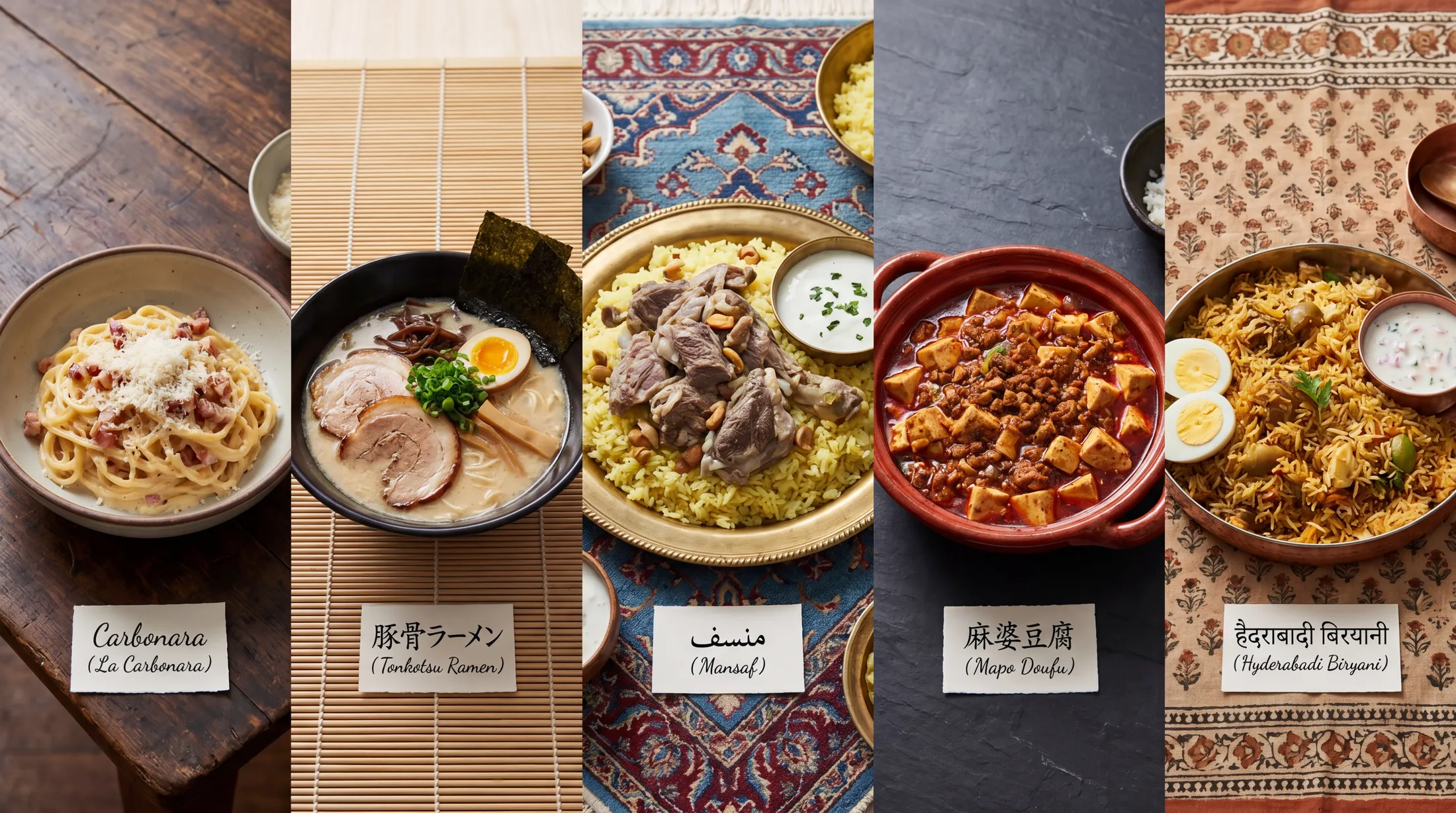
25."Carbonara"→ "Coal-miner pasta"— A real translation seen in tourist-area menus. Should be:"Carbonara — Roman pasta with guanciale, egg yolk, Pecorino Romano and black pepper."
26."Saltimbocca"→ "Jump in mouth"— The literal translation is accurate but the dish gets lost. Should be:"Saltimbocca alla Romana — veal scallopine with prosciutto and sage in white wine butter."
27."Vitello tonnato"→ "Tuna veal"— Confuses the dish entirely. Should be:"Vitello tonnato — chilled poached veal in a creamy tuna and caper sauce, Piedmontese classic."
28."Ossobuco"→ "Bone with a hole"— Literal and unhelpful. Should be:"Ossobuco alla Milanese — slow-braised veal shank with gremolata and saffron risotto."
29."Bagna cauda"→ "Hot bath"— The Piedmontese dish loses all character. Should be:"Bagna cauda — warm Piedmontese garlic-and-anchovy dip, served with raw vegetables."
30."Arancini"→ "Little oranges"— The dish has nothing to do with oranges, only the visual resemblance. Should be:"Arancini — Sicilian risotto balls stuffed with ragù, breaded and fried."
Category 5: Spanish and Portuguese mistranslations
31."Pulpo a la gallega"→ "Octopus to the Galician"— A direct word-by-word translation that doesn't make sense in English. Should be:"Pulpo a la gallega — Galician-style octopus with paprika, olive oil and sea salt."
32."Cochinillo"→ "Little pig"— Loses dignity. Should be:"Cochinillo — traditional Castilian roast suckling pig, slow-cooked in a wood oven."
33."Bacalhau à brás"→ "Cod in the arms"— Bizarre literal output. Should be:"Bacalhau à brás — Portuguese salt cod scrambled with potatoes, eggs and onions."
34."Caldo verde"→ "Green broth"— Technically correct, sounds unappetizing. Should be:"Caldo verde — Portuguese kale and potato soup with chouriço sausage."
35."Pão de queijo"→ "Bread of cheese"— Correct but flat. Should be:"Pão de queijo — traditional Brazilian cheese bread, served warm."
Category 6: Japanese dish names where romaji should be preserved
36."Omakase"→ "Chef's mercy"— A real translation. Omakase literally means "I leave it to you," but the cultural meaning is "chef's tasting menu."Should be:"Omakase — multi-course chef's tasting menu (chef chooses based on the day's freshest ingredients)."
37."Donburi"→ "Bowl"— Loses everything. Should be:"Donburi — Japanese rice bowl topped with seasoned protein and vegetables."
38."Wagyu"→ "Japanese cow"— Technically accurate, commercially catastrophic. Should be:"A5 Wagyu — premium Japanese-bred beef, prized for marbling and tenderness."
39."Tempura"→ "Deep-fried things"— A real menu translation, kept generic. Should be:"Tempura — light, crisp Japanese batter; served with seasonal vegetables and prawns."
40."Kaiseki"→ "Pocket stones"— A homophone-driven mistranslation. Should be:"Kaiseki — multi-course traditional Japanese tasting menu, balancing seasonal ingredients."
Category 7: Middle Eastern and South Asian mistranslations
41."Kibbeh nayyeh"→ "Raw lamb mush"— Technically accurate, devastating commercially. Should be:"Kibbeh nayyeh — Lebanese-style raw lamb tartare with bulgur, fresh mint and olive oil."
42."Mansaf"→ "Big plate"— Mansaf is the national dish of Jordan. The literal translation flattens it. Should be:"Mansaf — traditional Jordanian lamb cooked in fermented yogurt sauce, served over rice with toasted almonds."
43."Shawarma"→ "Turning meat"— Loses the dish entirely. Should be:"Shawarma — Levantine spit-roasted lamb (or chicken), shaved and served in flatbread with tahini and pickles."
44."Tagine"→ "Clay pot"— Refers to the vessel only. Should be:"Tagine — Moroccan slow-cooked stew (lamb, prunes, almonds) named after the conical clay vessel it's cooked in."
45."Bibimbap"→ "Mixed rice"— Reductive. Should be:"Bibimbap — Korean rice bowl with seasoned vegetables, beef and gochujang chili paste, mixed at the table."
46."Pho"→ "Noodle soup"— Insulting to the dish. Should be:"Pho — traditional Vietnamese rice noodle soup with slow-simmered beef bone broth, herbs and lime."
47."Biryani"→ "Mixed rice"— Same reductive error. Should be:"Hyderabadi biryani — fragrant basmati rice slow-cooked with marinated lamb, saffron and whole spices."
Category 8: Allergen disclosures rendered as nonsense
This is the dangerous category. Allergen text in prose translates badly. The rule: tag allergens as data, never as text.
48."Contains tree nuts"→ translated literally into Mandarin— produces a string that names a specific tree species rather than a culinary nut category. The diner with a nut allergy may not recognize the warning. Fix: tag the dish with the structured allergen: tree nuts attribute, which then renders in every language as the standard culinary term.
49."May contain traces of gluten"→ German "Spuren von Gluten möglich"— usually fine, but generic AI sometimes loses the conditional ("may"), turning it into "contains gluten." Severe consequences for celiac diners. Fix: use a hospitality-specific translation engine that handles allergen modal verbs correctly.
50."Suitable for vegetarians"→ in some languages becomes "for the vegetable-eating people"— losing the "vegetarian" dietary marker entirely, which a vegetarian guest cannot reliably search by. Fix: tag the dish with a structured vegetarian: true attribute that renders as the standard term in every language.
The four rules that prevent every mistake on this list
After 50 examples, the pattern is clear. Four rules eliminate almost every viral menu mistake:
1. Keep the dish name in its original language. Add the explanation in the target language, but never translate the name itself. Carpaccio is Carpaccio in every language — what changes is the description, not the name.
2. Use hospitality-trained AI, not generic translation tools. Generic tools introduce homophone collisions and lose dish identities. Hospitality-trained engines preserve them.
3. Tag allergens on the dish, never as prose. Allergen disclosures should travel with the dish as tags, not as a translatable sentence. (On Intermenu, for example, you tag each dish once, and the allergen names appear in every menu language you switch on.)
4. Have a native speaker review the top 20 dishes per language. AI is excellent. But the dishes that drive 80% of orders deserve 20 minutes of native-speaker eyes.
These four rules are the difference between a multilingual menu that respects both your kitchen and your guests, and one that ends up as a screenshot in someone's TripAdvisor review.
Frequently Asked Questions
What's the funniest menu translation mistake ever?"The chicken not having sex" remains the most-shared single example, but "strange-flavor chicken" and "ants climbing a tree" are equally famous in their own contexts. The funniest mistakes almost always come from translating a dish name literally instead of culturally.
Why does literal translation fail for food? Because dish names are cultural references first and recipes second. Carbonara is not "coal-miner pasta," even though the etymology is correct. The dish name is a brand. Translating the brand destroys the brand.
How do you translate cultural dishes without a direct equivalent? Keep the original name, then write a one-line localized description that anchors to a familiar reference point in the target language. Bibimbap doesn't need an English translation; it needs an English explanation: "Korean rice bowl, mixed at the table."
What's the difference between translation and localization for menus? Translation converts the words. Localization adapts the meaning to the reader's culinary memory. The right approach for menus is: translate the description, localize the explanation, never translate the dish name.
How can I check my menu translation is accurate? Have one native speaker per target language read the top 20 dishes and tell you what they think is arriving on the plate. If their description matches the actual dish, the translation works. If not, you have your edit list.
Stay Off the Mistranslation Hall of Fame
If your menu runs through a tool that doesn't know carbonara from "coal-miner pasta," one of your dishes will eventually end up on a list like this — and once it's a screenshot on TripAdvisor, it stays there.
Hospitality-trained platforms like Intermenu preserve dish names by default and add localized descriptions underneath, so a Sicilian arancino never accidentally becomes "little orange." If you're curious how your current menu would look run through one, the preview takes about a minute.