
Static vs Dynamic QR Code Menu: Which Fits Your Restaurant?
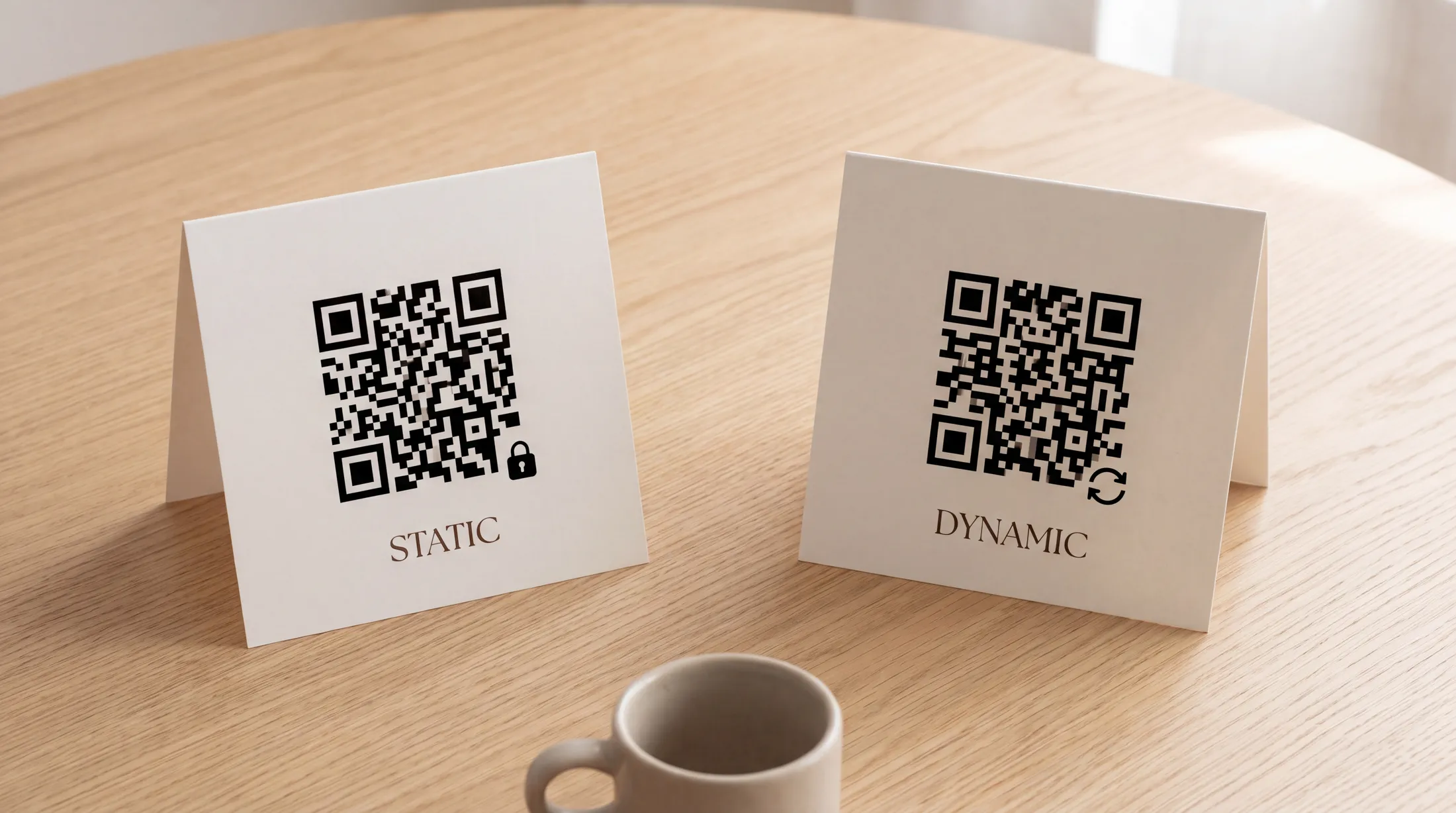
If you ever plan to change your menu, your branding or your seasonal offerings, point your code at a live menu you control, not at a PDF. The printed code never needs replacing, and you don't need a "dynamic QR" subscription to get that.
TL;DR — Key Takeaways
A static QR code encodes your menu URL directly. To change anything (URL, menu version, language) you have to reprint every QR code.
A dynamic QR code uses a redirect — you change what the code points to without touching the printed materials. A code that points at a live menu page you edit gets the same benefit without a redirect: the menu behind the address changes, not the code.
What matters is not the code type but what it points at. A code that points at a live menu you control never needs reprinting, and you don't need a separate "dynamic QR" subscription to get that.
Scan tracking belongs to the menu, not the code: Intermenu's menu records menu views, dish opens and where guests came from, a QR scan among them.
The trap is a code from a generator that expires or charges monthly: when the subscription lapses, every printed code can stop working. Intermenu's QR code points at your live menu, so printed codes never need replacing.
The decision in one sentence
If you ever plan to change your menu, your branding or your seasonal offerings, point your code at a live menu you control, not at a PDF. Then the printed code never needs replacing, and you don't need a "dynamic QR" subscription to get that. A code that points at a fixed file is a false economy.
The longer answer is below, with the technical and practical differences laid out so you can make the call with confidence.
What is a static QR code?
A static QR code is a QR pattern with the destination URL encoded directly into the pixels of the code itself. The QR is the URL. Scanning it sends the phone to a fixed address. Changing the URL means changing the pixels — meaning you have to generate a new QR code and reprint everything that uses it.
Static QR codes are:
Free to generate. Any free online QR generator produces them.
Permanent. They will work forever, as long as the URL they point to is alive.
Untrackable. The QR generator has no idea who scans them, when, or where.
Inflexible. You cannot redirect them, A/B test them, pause them, or update them without reprinting.
Static codes are appropriate for things that genuinely never change — a restaurant business card, a permanent address card, a fixed historical landmark plaque. A static code that points at a fixed file is usually wrong for a restaurant menu. A static code that points at a live menu page is a different thing: the code never changes, but the menu behind it does.
What is a dynamic QR code?
A dynamic QR code uses an intermediate redirect. The QR pattern points to a short URL hosted by the QR platform. When a guest scans, the redirect server looks up where to send them and forwards their phone to the actual menu URL.
Because the redirect is a server-side lookup, you can change the destination at any time — without changing the QR code on your printed materials. The same printed table tent that pointed to your winter menu yesterday can point to your summer menu today, with no operational change.
Dynamic QR codes are:
Subscription-priced. Most platforms include them in their menu plan; standalone dynamic QR services start around $5–$10/month.
Updatable. Change the destination anytime.
Trackable. Every scan is logged with time, location (approximate), device, and language.
Flexible. A/B test two destinations, pause them temporarily, redirect to a holiday landing page.
For restaurants, the operational difference is what matters: you need to change the menu without reprinting. A dynamic code gives you that through a redirect you rent. A code that points at your own live menu page gives you the same thing without the rental: edit the menu, and the next guest to scan sees the change.
Five reasons your code should point at a live menu
1. Your menu changes more than you think. Even restaurants that consider their menu "fixed" change pricing, descriptions, daily specials, seasonal items, allergen info, photography, and language coverage over the course of a year. Each change requires reprinting if your code points at a fixed file.
2. You want to know who is reading. A live menu records its own views: Intermenu's counts menu views, dish opens and where guests came from, a QR scan among them. This is the foundation of menu engineering. Without it, you're flying blind.
3. Your branding will eventually change. Restaurants rebrand. Restaurants move locations. Restaurants change ownership. Restaurants pivot. A code that points at a fixed file locks you into a single moment in your business's history. A code that points at a live menu follows you.
4. You may need to change what guests see at short notice. Menus change during closures and short seasons too (renovations, holidays, a shorter winter card). A code that points at a fixed file keeps showing whatever was printed. On a live menu you hide a section or mark dishes sold out from the app, and the next guest to scan sees it.
5. You want to compare channels. A live menu shows where guests came from: a QR scan, a direct link, another website or a tagged campaign link. A code that points at a PDF tells you none of that.
When is a static QR code acceptable?
A static code that points at a live menu page is always fine. A static code that points at a fixed file is almost never right for a menu, but here are the rare cases:
A truly tiny operator (a single-stand street vendor with three permanent items) with no interest in any analytics.
A pop-up restaurant with a known end date and no plans to operate beyond that date.
A heritage / landmark establishment whose menu literally has not changed in decades and where any analytics layer would feel inappropriate.
For everyone else, a code that points at a live menu.
Can dynamic QR codes track who scans them?
Yes — within privacy boundaries. Modern dynamic QR codes track:
Time of scan. The data point most useful for operational planning.
Approximate location (city-level, from IP). Tells you whether you're getting tourist traffic.
Device type and OS. Tells you about your guest demographic.
Phone language setting. Tells you the language mix of your scanners — invaluable for multilingual menu prioritization.
Referrer (rarely populated for QR scans, but occasionally informative).
What dynamic QR codes do not track without explicit guest consent:
Personal identity (name, email, phone number).
Precise GPS location (only city-level from IP).
Other apps the guest is using.
The privacy boundary is set by the analytics platform and by relevant privacy law (GDPR in the EU, CCPA in California, similar elsewhere). A reputable hospitality menu platform will be compliant by default.
Are static QR codes more secure?
Slightly, in one specific way: a static QR code cannot be "redirected" by a malicious actor who gained access to your QR account, because there's no redirect to redirect.
In practice, this risk is negligible. Reputable QR platforms have account security, audit logs and (often) two-factor authentication. The probability that someone hijacks your dynamic QR redirect is much lower than the probability that you lose business because you can't update your menu.
The static-is-more-secure argument is sometimes made by free QR generators trying to justify their lack of dynamic features. Treat it skeptically.
Cost comparison: static vs dynamic over a year
For a typical 50-cover restaurant making 4 menu changes per year:
Static QR code:
Code generation: $0
Reprinting per change: ~$80 (table tents × 25 tables, plus window decal and front-door card)
Annual cost: 4 × $80 = $320 per year
Plus: zero analytics, no flexibility
Dynamic QR code (within a hospitality platform):
Subscription: typically $15–$60/month, including QR + menu hosting + translation + allergen filter + analytics + AI photography
Reprinting: $0 (QR doesn't change)
Annual cost: $180–$720/year (but the QR is one feature among many in this number)
Plus: full analytics, flexibility, integrated with the menu
If you only count the QR functionality, a paid platform seems more expensive. If you count the entire restaurant tech stack the platform provides, a platform is dramatically cheaper than running static QR codes plus a separate menu builder plus separate translation plus separate analytics.
Intermenu bundles all of these — a QR code that points at your live menu, translation into as many languages as your menu needs, allergen filtering, calorie data, AI dish photography, ad templates — into one plan, and the QR code needs no separate subscription. The QR layer is one piece of the larger product, not an isolated cost.
How to move from a PDF code to a live menu without losing your existing QRs
For operators whose current code points at a PDF and who want to move to a live menu, here's the painless migration path:
Step 1. Set up your menu on a platform whose QR code points at the live menu.
Step 2. Configure your new live-menu QR code, but don't print it yet.
Step 3. Replace your static menu URL with a redirect to your new live menu address. (If your static QR currently points to a website you control, this is just a 301 redirect on your web server.)
Step 4. Verify scans flow through the redirect chain correctly.
Step 5. Reprint table tents on your next normal print cycle (e.g., when you'd normally update them anyway). The old static codes continue to work via the redirect; the new tents have the live-menu code directly.
This avoids any service interruption and lets you switch printers on your normal schedule rather than as a panicked migration.
Frequently Asked Questions
Can I update a static QR code? No. The URL is encoded into the pixels. Changing the URL means generating a new QR code, which means reprinting every printed material that uses it.
Are static QR codes really free? Yes — any free QR generator produces them. But "free" excludes the cost of reprinting every time you want to change anything, and the cost of having no analytics on what's actually happening.
Do dynamic QR codes need a subscription? Standalone dynamic codes almost always do: the redirect server has to be hosted somewhere. That subscription is the trap, because if it lapses, the printed codes can stop working. A menu doesn't need one: a code that points at your own live menu page gets the same benefit, because the menu behind the address changes, not the code.
Do dynamic QR codes work offline? The QR scan itself works offline (it's just a barcode), but the redirect requires internet to look up where to send the phone. For most situations this is fine; for connectivity-poor venues, look for offline-mode support.
Which is right for a small café with a fixed menu? Even small cafés benefit from a code that points at a live menu — for the analytics if nothing else. The cost difference between a free static generator and a $15/month hospitality menu platform is small, and the platform brings translation, allergen filtering and update flexibility on top.
See a Live-Menu QR Code in Action
If you're still on a free static QR generator, the lift from a real platform shows up immediately — in your menu views, your translation coverage, and the time you save on the next menu update. Intermenu includes a QR code that points at your live menu in every plan, alongside the multilingual menu, allergen filter and AI dish photography, so the printed code never needs replacing.
Try a live menu for two weeks and see what data your old QR was hiding from you →