
How to Add Allergens & Dietary Tags to a Menu
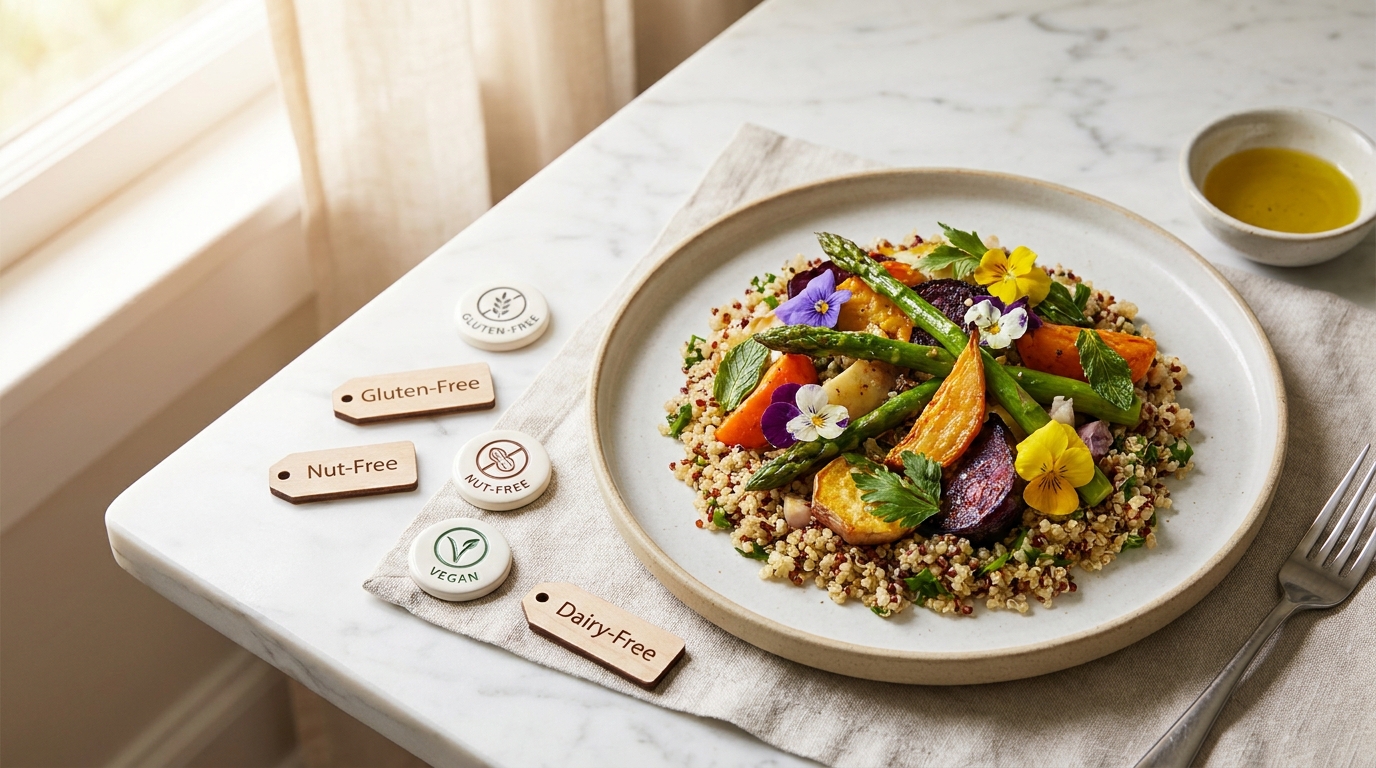
Allergen and dietary information is the one area of your menu where a mistake carries real risk — and the one where digital genuinely beats paper. Tagged as structured data instead of a footnote, guests can filter the menu to what is safe for them, your staff field fewer mid-service questions, and your disclosure stays correct even after the menu is translated. Here is how to do it right.
TL;DR — Key Takeaways
Tag, don't footnote. Structured per-dish allergen and diet data lets guests filter the menu; a block of asterisks at the bottom does not.
Know your list. The EU mandates declaring 14 allergens; the US requires 9 (sesame was added in 2023). Tag against the list that applies to you.
Diet labels are different from allergens. Vegan, vegetarian, halal, and keto describe suitability; allergens describe what a dish contains. Use both.
Translation must not break disclosure. Tags carried as data stay correct in every language; tags buried in prose can get lost in translation.
Tag only what's true. Mark allergens a dish actually contains and diets it genuinely fits — accuracy is the whole point.
Why structured allergen data matters
A paper menu handles allergens with a footnote: a row of tiny symbols, or "please ask your server." It puts the burden on the guest and the floor staff, it is easy to get out of date, and it does nothing once the menu is translated. For the one area of your menu with genuine liability, that is the weakest possible tool.
Structured tagging flips it. When each dish carries its allergens and diet suitability as data, the menu itself can answer "what can I eat here?" A guest with a nut allergy filters the menu to safe dishes in one tap; a vegan sees only what fits. Disclosure becomes a feature guests trust rather than fine print they squint at — and it stays accurate as you update and translate the menu.
Step 1 — Know which allergens you must declare
Tag against the framework that applies to your market:
European Union — 14 allergens: cereals containing gluten, crustaceans, eggs, fish, peanuts, soybeans, milk, tree nuts, celery, mustard, sesame, sulphur dioxide/sulphites, lupin, and molluscs.
United States — 9 major allergens: milk, eggs, fish, crustacean shellfish, tree nuts, peanuts, wheat, soybeans, and sesame (added as the 9th in 2023).
Most digital menus give you the full list as checkboxes so you simply tick what each dish contains. If you operate across regions, tag comprehensively — covering the EU-14 also covers the US-9. For the deeper compliance picture by country, see our restaurant allergen compliance guide.
Step 2 — Add dietary labels (they're not the same thing)
Allergens say what a dish contains; dietary labels say who a dish is for. Both are useful, and they answer different guest questions. Common labels worth using:
Vegan— no animal products at all.
Vegetarian— no meat or fish.
Halal— prepared per halal requirements.
Keto / low-carb— where it genuinely applies.
Tag these honestly. A dish is not vegan because it "can be made vegan" — label what it is as served, and let modifiers handle "hold the cheese." Diet labels also power filtering, so a guest can see your vegetarian options as a set instead of hunting for the leaf symbol. If catering to specific diets is core to your concept, our special diet menus guide goes deeper.
Step 3 — Tag each dish as you build it
In practice this is a quick, per-item job. On the item's form you will find the allergen checkboxes and the diet labels together — tick the allergens the dish contains and the diets it fits, and save. The fastest workflow is to do it as you create or import each dish, so tagging is never a separate, dreaded project. If you imported a menu, set aside one pass to tag the items, starting with anything containing the common, high-risk allergens (nuts, gluten, shellfish, milk).
A few habits keep it accurate: tag from the actual recipe, not memory; re-check when a recipe changes; and when in doubt about a shared fryer or trace contamination, reflect your real kitchen practice rather than guessing optimistically.
Step 4 — Let guests filter, and keep it correct across languages
The payoff of structured tags is the guest experience: on the live menu, a diner can filter to "vegetarian" or hide dishes with a given allergen and instantly see what works for them — no flagging down a server, no scanning footnotes. That is a better experience and a safer one.
Crucially, because the tags are data rather than prose, they survive translation. When your menu is shown in another language, "contains milk, gluten" and the vegan label come through correctly, not garbled into a sentence that loses meaning. If you serve international guests, this is where allergen safety and multilingual menus reinforce each other — the guest reads the dish in their language and sees accurate disclosure.
A worked example
Heirloom Tomato Burrata—Vegetarian · Contains: Milk, Gluten
Falafel Plate—Vegan, Vegetarian · Contains: Sesame, Gluten
Grilled Sea Bass— Contains: Fish
Lamb Kofta—Halal · Contains: (none of the 14)
Each dish carries its true diet suitability and the allergens it contains. A guest filtering for vegan sees the falafel; one avoiding gluten skips the burrata and falafel; a halal diner spots the kofta immediately. That is structured disclosure doing the work the footnote never could.
Allergens, intolerances, and "free-from" claims
It helps to keep three things distinct, because guests and the law treat them differently:
Declared allergens are the regulated list (the EU-14 / US-9). You are disclosing what a dish contains— this is the part with legal weight, so it must be accurate.
Intolerances and preferences (lactose, FODMAP, low-carb) are not on the mandated list but matter to guests. Diet labels and good descriptions cover most of these.
"Free-from" claims ("gluten-free," "nut-free") are a stronger promise than "doesn't contain." Only make them if your kitchen can actually stand behind them, because a guest with a serious allergy will trust that label completely.
Tagging gives you a clean way to handle all three: declare the allergens precisely, label the diets honestly, and reserve "free-from" language for dishes you can genuinely guarantee.
Handling cross-contamination honestly
Structured tags describe ingredients, but a shared fryer or a busy prep line is a real-world risk they do not automatically capture. Decide your kitchen's honest position and reflect it: if you cannot guarantee a dish is safe for a severe allergy because of shared equipment, do not imply that you can. A short, standing note that guests with severe allergies should speak to staff — combined with accurate per-dish tags — is more honest and more useful than a blanket "gluten-free" badge the kitchen cannot back up. Accurate beats optimistic every time; this is the one area of the menu where a wrong tag can genuinely hurt someone.
Why structured allergen data protects your business
Allergen information is the one place on a menu where an error is not just a lost sale — it is a safety and liability problem. Structured, per-dish tagging is your strongest protection on both fronts. It makes disclosure consistent: every dish carries the same checked list, so nothing slips through because a description happened to forget an ingredient. It keeps that disclosure correct across languages, because the tags are data rather than prose that can be mistranslated — which matters enormously for guests who cannot read your base language and are trusting the labels completely.
It also creates a clear, reviewable record of what each dish contains, exactly what you want to be able to show if a guest ever asks how you handle their allergy. Compare that with the paper approach — a footnote of symbols and "please ask your server" — which pushes the burden onto a busy floor team and goes stale the moment a recipe changes. Structured data turns allergen handling from a recurring risk into a managed, dependable part of the menu.
Make tagging a habit, not a project
The reason allergen tags get skipped is that they feel like a separate, daunting task bolted onto an already-built menu. The fix is to fold tagging into the moment you create or import each dish, so it is never a project in its own right — you tick the allergens and diets as you go, and the menu is born compliant. If you have imported an existing menu, do one focused pass and start with the high-risk, common allergens: nuts, gluten, shellfish, milk.
Re-check tags whenever a recipe or a supplier changes, because that is when accurate data quietly goes wrong — a swapped oil, a new bun, a different stock. A few minutes of discipline here is the cheapest insurance on the whole menu, and it compounds: a kitchen that tags as a habit never faces a daunting catch-up later. Tagging sits alongside a good description and a fair price as part of building each dish well — see the complete guide to creating a digital menu.
Common allergen-tagging mistakes
Footnotes instead of tags."Ask your server" is not disclosure and cannot be filtered.
Confusing diets with allergens."Vegetarian" is not an allergen, and "milk" is not a diet — tag both, separately.
Optimistic tagging. Marking a dish vegan or nut-free when the kitchen can't guarantee it is the one mistake with real consequences.
Tagging the base recipe but ignoring modifiers. If an add-on introduces an allergen, account for it.
Letting tags drift. When a recipe or supplier changes, update the tags the same day.
Tag allergens and diets free with Intermenu
Intermenu builds allergen and dietary tagging into every dish: tick the EU-14 / US-9 allergens and labels like vegan, vegetarian, and halal, and guests can filter your live menu to exactly what's safe for them — with disclosure that stays correct in all 15 languages your menu supports.
Build your digital menu free with Intermenu →
Frequently Asked Questions
How do I add allergens to my menu?
On each dish, tick the allergens it contains from the standard list (the EU-14 or US-9), and save. Stored as structured data per item, those tags then power guest filtering and stay correct when the menu is translated.
What allergens are restaurants required to declare?
In the EU, 14: gluten, crustaceans, eggs, fish, peanuts, soybeans, milk, tree nuts, celery, mustard, sesame, sulphites, lupin, and molluscs. In the US, 9: milk, eggs, fish, crustacean shellfish, tree nuts, peanuts, wheat, soybeans, and sesame.
What's the difference between an allergen tag and a dietary tag?
An allergen tag says what a dish contains (e.g. milk, nuts). A dietary tag says who it suits (e.g. vegan, halal). Use both: they answer different questions and both let guests filter.
Can guests filter a menu by allergen or diet?
On a structured digital menu, yes — guests can hide dishes with a given allergen or show only items matching a diet, instantly, without asking staff. That is the main advantage of tagging over a printed footnote.
Do allergen tags stay correct when the menu is translated?
When they are stored as data rather than written into a description, yes — the labels and allergen lists carry across languages accurately, which is essential for safe disclosure to international guests.