How to Make a Multilingual Menu (Auto-Translate)
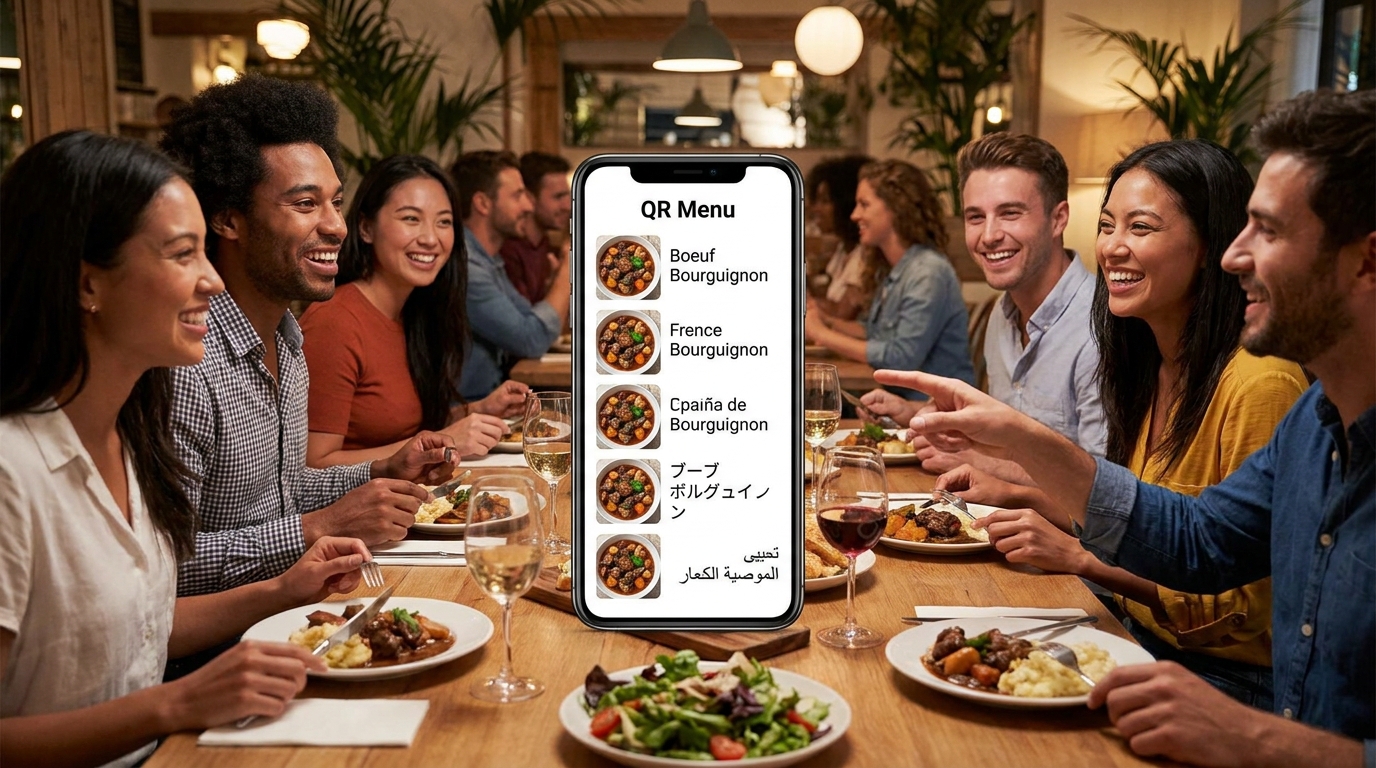
If tourists, students, or international residents walk through your door, a menu in their language is the difference between a confident order and a hesitant one — or no order at all. The good news: you no longer translate menus by hand or pay per page. Here is how to make a multilingual menu with automatic translation, keep your dish names intact, and make sure allergen labels stay correct in every language.
TL;DR — Key Takeaways
Auto-translation does the heavy lifting. Pick your target languages and translate the whole menu in one pass, instead of paying per page.
Keep dish names; localize descriptions. A guest should still order "Shish Tavuk" — the description is what gets translated.
You stay in control. Review the output, fix any wording, and mark it approved. The machine drafts; you sign off.
Allergen labels must stay correct. Structured tags carry across languages accurately — a safety point, not just convenience.
One menu, every language, one update. Change a price once and it updates across all languages — no separate translated PDFs to maintain.
Why a multilingual menu is worth it
A guest who can't read your menu does one of two things: orders the one thing they recognize, or asks a stressed server to translate mid-rush. Both shrink the check and the experience. In a tourist area, near a university, or in any city with international residents, a menu in the guest's language removes that friction entirely — people order more freely and more adventurously when they understand what they're reading.
It also signals welcome. A visitor who opens your menu and finds it in their own language feels looked after before the food arrives. That's a competitive edge over the place next door still handing out a single English page. For the broader playbook on winning international guests, see attract international tourists with the right tactics and our complete guide to multilingual restaurant menus.
How automatic menu translation works
Modern menu translation is built for hospitality, not generic word-for-word substitution. Two principles matter:
Dish names stay put."Shish Tavuk," "Baba Ghanoush," or "Bistecca alla Fiorentina" are part of your identity and how guests order — a good translator leaves them intact rather than turning them into a clumsy literal phrase.
Descriptions and labels get localized. The supporting copy — "charcoal-grilled chicken marinated in garlic and lemon" — and the allergen and diet labels are what actually get translated, so a guest understands the dish without losing the name.
Because it's machine-assisted, translating a whole menu into several languages takes minutes, not the days-and-invoices of manual translation. But "minutes" doesn't mean "unchecked" — which is the next step.
Step 1 — Choose your target languages
Pick the languages your actual guests speak, not every language available. Look at who walks in: a German base language with English, Arabic, and Turkish targets suits one neighborhood; English with Spanish and French suits another. Start with the two or three that cover most of your international guests; you can add more later. (Your plan sets how many languages you can run — most restaurants need only a handful.)
Step 2 — Translate the menu in one pass
With your base menu written and your target languages chosen, run the translation. The platform works through your items and categories and produces the translated versions as a batch — a job you can kick off and let run rather than translating dish by dish. This is exactly why writing tight, concrete descriptions first pays off: clean source copy translates cleanly.
Step 3 — Review and approve
This is the step that separates a menu that reads like a local wrote it from one that reads like a machine did. Automatic translation gets you 90% of the way instantly; your review handles the last 10% — a dish name that should have stayed in the original, a regional term, a description that's technically correct but slightly off in tone. A good translation workflow shows you, per language, what's translated, what's been reviewed, and what still needs attention, so you can work through it methodically rather than guessing.
You don't need to be fluent in every language to do this well — focus your attention on your highest-traffic languages, get a native-speaking staff member or friend to glance at the rest, and approve as you go. The point is that you remain the editor; the machine is the drafter.
Step 4 — Keep allergen labels correct across languages
This is where multilingual menus and safety meet. Because allergen and dietary tags are stored as structured data rather than written into prose, they carry across every language accurately — "contains milk, gluten" and the vegan label show up correctly whether the guest is reading German, Arabic, or French. That's not a nicety; it's how you keep disclosure honest for guests who don't read your base language. Set your tags up properly once (see how to add allergens and dietary tags) and translation preserves them.
Step 5 — Maintain one menu, not five
The quiet win of doing this inside your digital menu — instead of maintaining a stack of translated PDFs — is that there's one source of truth. Change a price, 86 a dish, or add a special, and every language reflects it. When you add a brand-new item, you translate just that item rather than re-doing whole documents. The guest always switches to their language with a tap and sees the current menu, never last season's translated print-out. Translation is one stage of the complete guide to creating a digital menu, and doing the earlier stages well makes it far smoother.
Which languages to add first
Let your guests, not a wish list, choose your languages. Three quick ways to decide:
Watch the room. Which languages do you already hear at tables and at the counter? Start there.
Check your analytics. Your menu analytics show which languages guests are actually reading the menu in — the clearest possible signal of where the next translation pays off.
Read your location. A tourist district, a port, a university quarter, or a neighborhood with a large immigrant community each points to specific languages.
Start with the two or three that cover most of your international guests, get them genuinely polished, and add more only as the need shows up. Two excellent languages beat six rushed ones.
What to double-check after translating
Even a strong translation deserves a quick human pass on a few specifics:
Dish names stayed in the original where they should ("Shish Tavuk," not a literal rendering).
Allergen and diet labels carried across correctly — re-confirm on a couple of dishes, since this is the safety-critical part.
Numbers and units (prices, portion sizes, spice levels) read naturally in the target language.
Tone fits — a description that is technically correct can still feel stiff; nudge it toward how a local would say it.
You do not need to be fluent in every language to catch the big issues; for the rest, a native-speaking staff member or friend glancing over your top languages is enough to ship with confidence.
Why machine translation is finally good enough for menus
For years the advice was to never trust automatic translation on something as customer-facing as a menu, and for years that was right — generic translation mangled dish names and produced stilted, sometimes embarrassing copy. That has changed, and it is worth understanding why, because it is what makes the workflow in this guide practical. Modern translation tuned for hospitality treats a menu as a menu, not a block of generic text: it knows to leave dish names intact, to localize descriptions naturally, and to keep the structured allergen and diet labels accurate as data.
The result is copy that reads as though a bilingual staff member wrote it, produced in minutes rather than over days of back-and-forth with an agency. The catch — and it is an important one — is that "good enough to start from" is not "good enough to publish unread." The technology gets you a strong draft instantly; your quick human review is what makes it trustworthy. That division of labor — the machine drafts, you approve — is the whole reason a small restaurant can now offer a genuinely good menu in six languages without a translation budget.
The business case for a translated menu
The return on a translated menu is concrete. International guests order more freely and more adventurously when they can actually read what is on offer, which lifts both the size and the confidence of the order. It removes a real bottleneck during service, where a server otherwise spends time translating dishes table by table. And it is a visible signal of welcome that sets you apart from the place next door still handing out a single English page — a guest who finds their own language feels looked after before the food even arrives. In a tourist area, near a university, or anywhere with international residents, that is not a nice-to-have; it is the difference between capturing those guests and losing them to a competitor who made ordering easy.
Common multilingual menu mistakes
Translating dish names literally. Guests order by the name they see on signage and online — keep "Shish Tavuk," don't turn it into "grilled chicken skewer."
Publishing the raw machine output unread. It's a strong draft, not a final — skim it, especially your top languages.
Idioms and hype in the source copy."A flavor explosion" doesn't survive translation; concrete copy does.
Maintaining separate translated PDFs. They drift out of sync the first time you change a price. Keep one menu, many languages.
Forgetting allergen labels. Make sure your disclosure is tagged as data so it stays correct in every language.
Make a multilingual menu free with Intermenu
Intermenu translates your menu into up to 15 languages with a hospitality-trained engine that keeps your dish names and localizes the rest — then gives you a clear review workflow so you sign off on the wording. Allergen and diet labels stay correct in every language, and one price change updates them all.
Build your multilingual menu free with Intermenu →
Frequently Asked Questions
How do I make my restaurant menu multilingual?
Build your menu in your base language, choose your target languages, and run an automatic translation across all items and categories. Then review the output, fix any wording, and publish — guests switch to their language with a tap.
Will translation change my dish names?
It shouldn't. A hospitality-trained translation keeps dish names intact — guests still see and order "Shish Tavuk" — and translates the descriptions and labels around them. Always review to confirm names stayed put.
Is automatic menu translation accurate?
It's very good as a first pass and built for food specifically, but you should review it, especially in your highest-traffic languages. The workflow is machine-drafts, you-approve, which gets you both speed and a natural read.
How many languages should my menu support?
Start with the two or three your actual guests speak, then add more as needed. Most restaurants only need a handful; choose based on who walks through your door, not on what's available.
Do allergen labels stay correct after translation?
Yes, when they're stored as structured tags rather than written into the description. The labels and allergen lists carry across languages accurately, which is essential for safe disclosure to guests reading in another language.