
Multilingual Hotel Menus — One Menu, 15+ Guest Languages
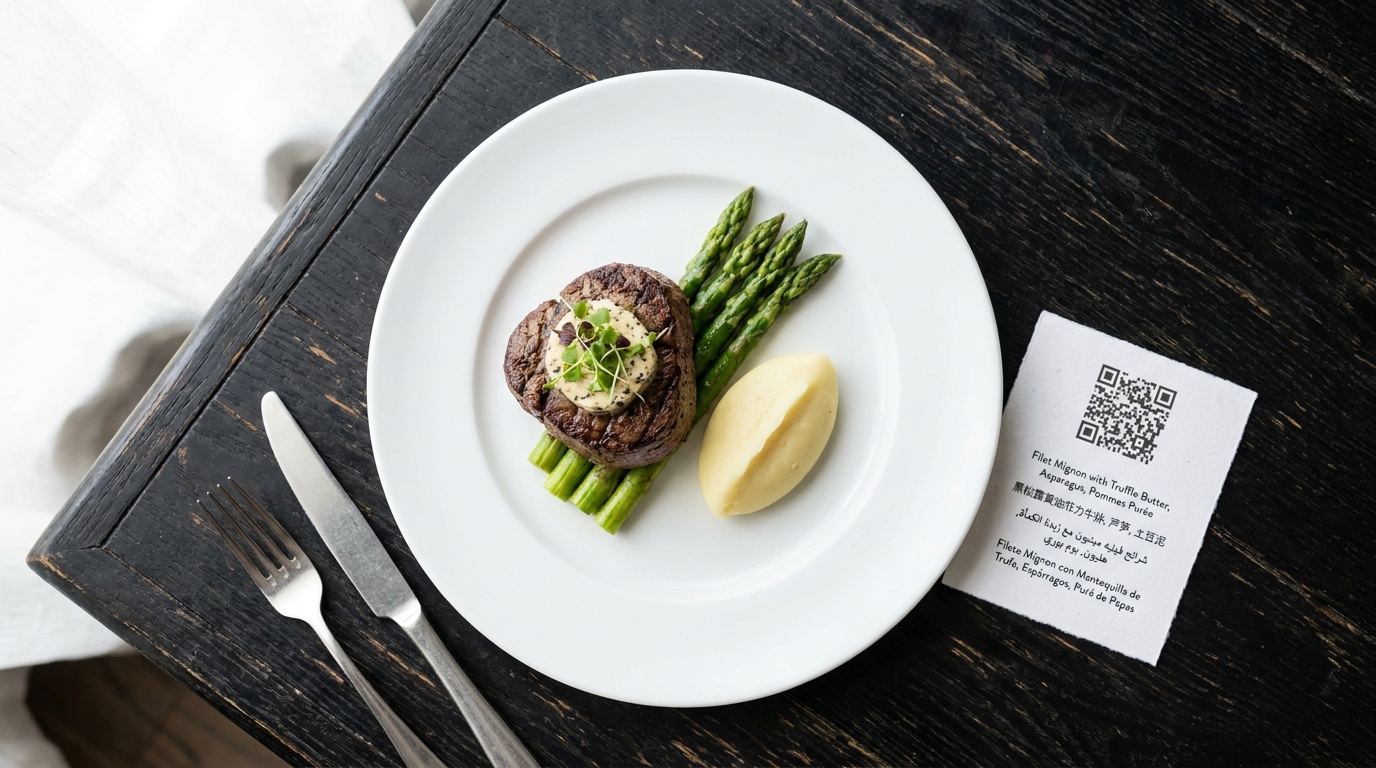
Hotels carry a tougher multilingual menu problem than restaurants. Three outlets, weekly menu changes, 8+ guest languages, and one allergen disclosure that has to stay correct across all of it. Here is the operator playbook for running one F&B menu across every guest's language.
TL;DR — Key Takeaways
Hotels carry a harder multilingual problem than restaurants— three outlets, weekly updates, 8+ guest languages, and one allergen list (per EU 1169/2011and the US FDA major allergens list) that has to stay synchronized.
Pick languages with data, not guesswork. Pull reservation country-of-origin reports, review-platform language stats, and local tourism data. Most hotels need 6–10, not 15.
Dish names need careful handling. Word-for-word translation makes "Beef Wellington" into something unrecognizable in Mandarin. Keep proper names; localize descriptions.
Allergen disclosure across languages is a compliance issue, not a feature. EU 1169 and US FALCPA both apply to non-English-speaking guests.
Printed cards lose at 3+ languages. Reprint cycles cannot keep up with kitchen changes. Digital menus that update once and propagate across every language are the only architecture that survives the operational reality.
Why multilingual menus are existential for hotel F&B
A standalone restaurant translates its menu twice a year and prints. Hotel F&B does not have that luxury. Three structural realities make the multilingual challenge meaningfully harder for hotels:
Multiple outlets sharing one F&B operation. The lobby bar, the restaurant, room service, and the banquet menu often share dishes and ingredients but display them on separate menus, each with its own update cadence.
Weekly menu changes. Hotel F&B teams substitute ingredients, take items off, add specials, and adjust pricing at a frequency that paper translation cannot keep up with.
A wider international guest mix than a restaurant of the same size. International business hotels, resort properties, and airport hotels routinely see 6–10 guest languages on a normal weekend. That mix shifts seasonally — a Spanish coastal hotel runs heavy on German and Dutch in summer, on UK English in autumn, on French in winter.
These realities are why most hotels under-invest in menu translation. The operational cost looks unbounded. It does not have to be — but the printed-card architecture genuinely cannot solve it.
The opportunity is real. The hotel guest who sees the menu in their language orders more confidently, asks fewer questions of staff, and rates the F&B experience meaningfully higher. The hotel guest who sees only English skips the items they can't read, defaults to safe choices, and tips less. The cost difference between the two outcomes runs into hundreds of euros per international guest stay.
The languages a hotel actually needs
Stop guessing. Pull data.
Three sources tell you, with confidence, which languages your property needs:
Your reservation system's country-of-origin report. Top 10 countries; their primary language is your language. (Watch for English as a second language — a Dutch guest reads Dutch faster, not English.)
Your review-platform language data. Booking.com, TripAdvisor, and Google all surface review language stats per property. The mix there mirrors the mix of guests who actually engage with you.
Local tourism data. Most national tourism boards — and the UN World Tourism Organization at the global level — publish per-city visitor-origin reports. They confirm or correct the property-level data.
For most properties the answer is6–10 languages, not 15. A common pattern:
European 4-star city hotel: English, German, French, Spanish, Italian, Dutch, Portuguese
Mediterranean resort: English, German, French, Dutch, Russian, Polish, Hungarian
Middle East luxury: English, Arabic, French, Russian, Mandarin, Hindi
Asia-Pacific business: English, Mandarin, Japanese, Korean, Bahasa Indonesia, Thai
Adding languages costs operational complexity. Picking the right 8 outperforms running 15 mediocre translations.
For the broader picture of how restaurants approach this, the complete guide to multilingual restaurant menus covers the language-selection methodology in depth. The hotel-specific application here is the same playbook with reservation data layered in.
The 3-outlet problem — keeping room service, lobby bar, and restaurant in sync
The single biggest operational difference between a hotel and a restaurant is the multi-outlet shared menu. The same kitchen feeds the lobby bar at 6pm, the restaurant at 8pm, the room service at midnight, and the breakfast buffet at 6am the next morning — and many of the dishes overlap across outlets.
When the kitchen substitutes an ingredient — switching from feta to halloumi because of a supply gap — that substitution has to propagate to:
The lobby bar menu (in 8 languages)
The restaurant menu (in 8 languages)
The room service menu (in 8 languages)
The buffet card (in 8 languages)
The allergen disclosure for that dish (in 8 languages)
That is 40 menu touches for a single ingredient change. On printed cards this is impossible. On a hosted menu where each outlet maintains its own version, this is the source of compliance drift — week three, the lobby bar still says "feta" while the restaurant says "halloumi". A guest with a dairy allergy ordering at the lobby bar sees the wrong allergen tag.
The architecture that survives is one dish database, multiple menus. Dishes are tagged, allergens are tagged, translations are tagged — once. Each outlet's menu is a filtered view of the same dish database. Change one dish, change every menu, in every language, instantly.
This is also the only architecture that scales to the hotel allergen compliance reality— where the EU 1169 or US FALCPA disclosure has to stay accurate in every language across every outlet, every minute.
Translation quality — why Google Translate ruins your menu
Word-for-word translation is the single biggest reason hotels avoid multilingual menus. The output is genuinely embarrassing.
The classic failures:
Proper names translated literally. A "Beef Wellington" becomes "牛威灵顿" in Mandarin — recognizable to nobody.
Cooking methods mistranslated."Smoked" turns into the smell rather than the technique.
Idiomatic dish names lost entirely."Surf and turf" translates to "冲浪和草坪" — surfing and lawn.
Allergen disclosure subtly wrong."Contains gluten" translates fine; "may contain traces of peanuts" loses the conditional in several languages and becomes a flat assertion.
The fix is not human translation everywhere — that does not scale to weekly menu changes. The fix is hospitality-trained translation: a model that knows "Beef Wellington" keeps its name, that "smoked" is a cooking method when applied to fish, that "may contain traces of" needs careful preservation. The50 most mistranslated menu items guide walks through the most expensive errors restaurants make. The same errors compound in hotel F&B because they propagate across multiple outlets.
Dish names that don't translate (and how to handle them)
A handful of dish names should never be translated — they are global proper nouns. Keep them in the original language, add a short description in the target language.
Italian: Pasta Carbonara, Cacio e Pepe, Tiramisu, Pizza Margherita → keep
Japanese: Sushi, Sashimi, Wagyu, Tempura → keep
French: Crème Brûlée, Foie Gras, Bouillabaisse → keep
Spanish: Paella, Gazpacho, Tortilla Española → keep
Mexican: Quesadilla, Guacamole, Tacos al Pastor → keep
Middle Eastern: Hummus, Shawarma, Mezze → keep
Asian: Pho, Pad Thai, Ramen, Bibimbap → keep
The rule of thumb: if a guest at any nationality recognizes the dish by its original name, keep the original name and translate the supporting description. This preserves both the dish's identity and the guest's comfort. The same logic applies in reverse for regional specialties — your hotel's local signature dish should keep its name in every language, with a small description.
The menu translation by cuisine guide covers the dish-by-dish naming conventions for the major cuisines hotels carry.
Allergen disclosure across languages — the EU-14 / US-9 challenge
This is where multilingual menus stop being a convenience feature and start being a compliance obligation.
EU Regulation 1169/2011 mandates disclosure of 14 declared allergens for any food sold in EU member states. The regulation applies regardless of the language the menu is displayed in — a German hotel serving a Saudi guest is still obligated to disclose allergens accurately in the language the guest reads. The US FDA's FALCPA requires disclosure of 9 major allergens (sesame added in 2023) on the same basis.
Bad allergen translation generates two kinds of failure:
Disclosure missing entirely in the target language because the translator didn't render the allergen footer.
Disclosure subtly wrong— "may contain traces of nuts" softening to "with nuts" or "no nuts" in translation.
Either failure exposes the hotel. The mitigation is structured per-dish allergen data, tagged once and rendered automatically into every language, so the disclosure is not "translated" sentence by sentence — it is generated from data. The allergen tagging for multilingual menus guide covers the data model and the rendering pattern in detail.
This is also the topic the hotel allergen compliance guide goes into for the multi-outlet hotel context — the legal and operational risk runs deeper at a hotel than at a single restaurant.
Printed menus vs digital — the cost & speed reality
The cost case is one-sided once you actually compute it.
Printed multilingual menu (8 languages, 4 outlets):
Initial design + translation: $4,000–$8,000
Print run: $1,500–$3,000 per refresh
Refresh cadence: every 6 months (slower than the kitchen would prefer)
Per-year total: $7,000–$14,000 plus the time cost of forced slow updates
Digital multilingual menu (same 8 languages, 4 outlets):
Platform setup: $0–$500
Monthly subscription: $30–$200 typical (independents); $200–$1,500 enterprise multi-property
Refresh cadence: real-time, no incremental cost per update
Per-year total: $360–$2,400 in subscription with no print costs
The printed version is roughly 5–10× more expensive and slower. The argument for printed cards used to be aesthetic — leather-bound menus look like luxury. The argument has weakened as luxury hotels increasingly hybridize: keep the leather card with a curated 6-item selection in English; QR for the working menu in 8 languages.
Live update propagation — change one item, every language updates
The operational point this all comes down to: a kitchen ingredient change at 5:45pm should propagate to every language and every outlet before guests sit down at 6pm.
On printed cards, this is impossible. On hosted multi-outlet menus where each outlet is updated separately, this is the source of inconsistency and compliance drift. On a true single-source platform where the dish data lives once, this is the default behavior — change the ingredient on the dish, the translation regenerates, the allergen tag updates, the lobby bar + restaurant + room service menus all reflect the change at the same time.
This is the architecture every hotel F&B operation needs to be moving toward. The QR code in-room ordering guide covers the room-service application; the same pattern applies across every outlet.
Sample multilingual menu structure (one dish, 4 languages)
WAGYU BURGER—Aged cheddar, caramelized onions, truffle aioli, brioche bun, served with parmesan fries. (V) (G)
WAGYU BURGER—Gereifter Cheddar, karamellisierte Zwiebeln, Trüffelaioli, Brioche-Brötchen, mit Parmesan-Pommes. (V) (G)
和牛汉堡—陈年切达奶酪、焦糖洋葱、松露蛋黄酱、布里欧修面包,配帕玛森芝士薯条。(V) (G)
هامبرغر واغيو—جبن الشيدر المعتق، البصل المكرمل، مايونيز الكمأ، خبز البريوش، مع بطاطس بارميزان. (V) (G)
Notice three things: the dish name "Wagyu" stays the same in every language, the description translates fully, and the allergen tags (V = contains dairy, G = contains gluten) are universal symbols not translated text — they render identically in every language.
Common multilingual hotel menu mistakes
Translating the menu once and never updating. The kitchen substitutes ingredients weekly; the translation goes stale immediately.
Translating proper dish names. Beef Wellington in Mandarin loses its identity.
Allergen disclosure missing in some languages. A compliance failure, not a feature gap.
Running 15 languages mediocrely.8 good translations beat 15 weak ones.
Per-outlet menus that drift out of sync. The lobby bar still says "feta" when the restaurant says "halloumi".
English-only allergen footer on a Spanish menu. Read carefully — most multilingual menus fail here.
Hardcoding the menu in PDFs. Cannot be updated, cannot be analyzed, defeats the purpose.
Build your multilingual hotel menu free with Intermenu
Intermenu is the digital menu platform built for hotel F&B. One dish database, one allergen tagging system, one update — propagated automatically across every outlet (room service, lobby bar, restaurant, banquet, buffet) and every guest language. Translation is hospitality-trained and preserves proper dish names. Allergens render from structured data, so disclosure stays accurate across 15 languages.
Build your multilingual hotel menu free with Intermenu →
Frequently Asked Questions
How many languages should a hotel menu support?
For most properties, 6–10 languages picked from the actual guest mix outperforms running 15 mediocre translations. Pull reservation country-of-origin data and review-platform language stats to identify the right ones.
How do hotels translate their menus?
Most still translate manually in batches every 6 months for printed cards — which goes stale immediately when the kitchen substitutes ingredients. The modern pattern is hospitality-trained digital translation tied to a single dish database, where one update propagates to every language automatically.
Should I keep my hotel menu in English only?
No, not if any meaningful share of your guests speak other languages. The hotel guest who can read the menu orders more confidently, asks fewer questions, and rates F&B higher. The cost of multilingual menus is now low; the cost of English-only is meaningful.
Are translated allergen disclosures legally binding?
Yes. EU Regulation 1169/2011and the US FDA major food allergens regulation both apply regardless of the language the menu is displayed in. A hotel that fails to disclose allergens accurately in the guest's language carries the same legal exposure as a hotel that fails to disclose in English.
Should I use Google Translate for my hotel menu?
No. Word-for-word machine translation generates the predictable failures (proper names translated literally, allergen footers lost, idiomatic dish names mistranslated). Use hospitality-trained translation that preserves dish names and renders allergens from structured data.
How often should a multilingual hotel menu be refreshed?
Every time the kitchen makes a real change — which means weekly or more often at most properties. Printed cards cannot keep up. Digital menus update once and propagate automatically.
Can the same multilingual menu work across room service, restaurant, and bar?
Yes — if the architecture is a single dish database with multiple outlet views. Dishes are tagged once, allergens are tagged once, translations happen once; each outlet's menu is a filtered view. This is the only pattern that scales operationally.
Related guides
Optimizing hotel F&B menu management for 2026 success— the cluster pillar
Hotel allergen compliance — multi-outlet F&B operations— the legal layer
In-room dining menu — how to design one that sells— one of the outlets this multilingual menu serves
The complete guide to multilingual restaurant menus— the broader multilingual playbook
Menu translation by cuisine — Italian, Japanese, Arabic, Chinese, Indian— the dish-name conventions
Allergen tagging on a multilingual menu— the data model behind the allergen layer