
Hotel Allergen Compliance — Multi-Outlet F&B Operations (2026)
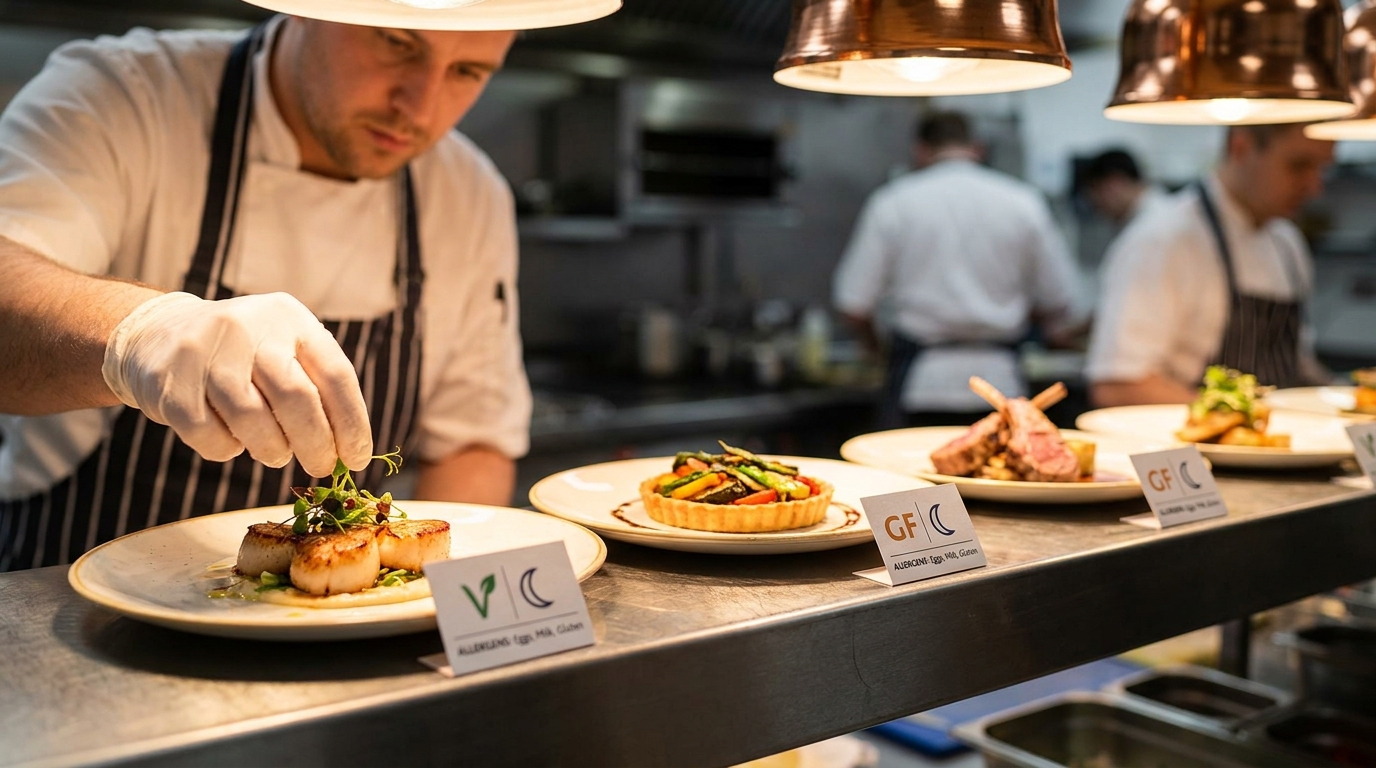
Hotels carry far more allergen risk than restaurants — multiple outlets, multiple cuisines, multiple chefs, multiple shifts, and guests who do not speak the staff's language. One mistake makes headlines and lawsuits. Here is the operator playbook for hotel allergen compliance that actually scales.
TL;DR — Key Takeaways
Hotels carry more allergen risk than restaurants because they run 4+ F&B outlets, multiple cuisines, multiple chef teams, and rotating shifts.
EU 1169/2011 and US FALCPA both mandate allergen disclosure regardless of the language the menu is displayed in. The disclosure has to be accurate in every language a guest reads.
Per-outlet risk is uneven. Room service (no waiter conversation), buffet (self-service cross-contact), bar (chef not on duty), banquet (pre-set, pre-disclosed) — each needs a different protocol.
Staff training is the lawsuit failure point. Failing to document training exposes the hotel even when the procedures are being followed.
The only architecture that scales is structured per-dish allergen tagging tied to translation — one data update propagates to every outlet, every language, every printed and digital surface.
Why hotels face more allergen risk than restaurants
A restaurant has one kitchen, one waiter team, one menu, one shift pattern. A hotel has all of those, four times over, often with different cuisines, sometimes outsourced to different operators, and with a shift pattern that puts a junior cook in charge of breakfast prep at 5am and an executive chef nowhere in sight after 10pm.
The risk vectors compound:
Multiple outlets— restaurant, room service, lobby bar, banquet, buffet, mini-bar, pool/beach. Each has its own menu, its own staff, and its own opportunity to mis-disclose an allergen.
Shared ingredients across outlets but separate menus. A peanut sauce listed correctly in the restaurant menu may not be flagged on the bar's bar food menu using the same sauce.
Multiple cuisines. International business hotels routinely run a Mediterranean restaurant + an Asian outlet + a steakhouse, each with cuisine-specific allergen patterns staff need to learn.
Rotating shifts. The chef who handles the daytime allergen call-out is not on shift at midnight when the late-arrival room service order goes in.
Language barriers. A guest with a celiac diagnosis trying to communicate in their second or third language to a waiter operating in their own second language is the single most common allergen incident pattern.
Hotel-side hospitality lawyers consistently flag allergen disclosure as a top-3 negligence-exposure area for the hospitality industry. Patient advocacy organizations like Food Allergy Research & Education (FARE) document case after case of severe restaurant-and-hotel allergic reactions in their public reporting. A failed disclosure that leads to anaphylaxis generates seven-figure settlements and lasting brand damage. The operating cost of a real compliance program is meaningfully lower than the cost of one such incident.
The legal landscape — EU 1169/2011, US FALCPA, sesame addition
Two regulatory frameworks cover most international hotel operations:
EU Regulation 1169/2011mandates disclosure of 14 allergens in any food sold to the consumer, including in hotels and restaurants. The 14 are: cereals containing gluten, crustaceans, eggs, fish, peanuts, soybeans, milk, nuts, celery, mustard, sesame, sulphites, lupin, molluscs. Disclosure must be at the point of sale — meaning on the menu, on the buffet card, or made available on request before the order. The EU 1169/2011 allergen compliance guide covers the regulation in detail, including the documentation requirements for kitchens.
The US FDA's major food allergens framework (FALCPA, plus the FASTER Act of 2021) requires disclosure of 9 major allergens: milk, eggs, fish, crustacean shellfish, tree nuts, peanuts, wheat, soybeans, and — since the FASTER Act — sesame, which became enforceable in 2023. Federal law does not impose the same per-dish menu disclosure requirements on restaurants as it does on packaged food, but a growing number of US states and localities have added their own menu-disclosure rules. Even where no specific statute applies, serving a dish with an undisclosed allergen after a guest has flagged the allergy creates clear negligence exposure.
Natasha's Law (UK, 2021) requires pre-packed food for direct sale to carry full ingredient labeling with allergens emphasized. The law was named for a teenager who died from a sesame allergy after an unlabeled baguette — the legal and brand consequences are concrete.
Hotel groups operating across multiple jurisdictions need a compliance baseline that satisfies the strictest applicable regulation. In practice, that usually means the EU 14 plus sesame — covering every market.
The 4 outlets and their unique allergen risks
The risk profile is meaningfully different per outlet. A blanket "tell everyone about allergens" policy fails because it treats unequal risks equally.
Room service — closed-door, no staff conversation
The highest-risk outlet. The guest is alone, the order goes through a phone or QR menu, and a runner delivers the tray without ever discussing allergens. There is no waiter conversation, no opportunity to clarify "does this contain peanut oil?". Whatever the menu discloses is the only disclosure the guest gets.
The mitigation: structured per-dish allergen tagging, surfaced on the in-room dining menu in the guest's language, with a guest-filter option ("show me what's safe"). The in-room dining menu guide covers the menu structure that supports this; the QR in-room ordering setup covers the technical implementation.
Breakfast buffet — cross-contact everywhere
Buffets are an allergen nightmare. Guests serve themselves using shared serving spoons. The spoon that scooped the croissant just scooped the gluten-free muffin. The waffle iron that made standard waffles ran a "gluten-free" batter without being cleaned. The orange juice carafe was refilled with juice that had pulp added.
The mitigation:
Allergen card at every chafing dish— a small, clear card listing the allergens present in that dish, in the guest's language.
Dedicated serving utensils for allergen-free items— color-coded, kept separate.
Separate physical zones for high-risk items— gluten-free pastries on their own tier, not mixed with regular bread; vegan items on their own dish, not garnished with cheese.
Visible staff trained in allergen response— a guest with a concern should not have to flag down a runner.
The hotel breakfast buffet menu guide covers the operational layout that makes this possible.
Lobby bar — chefs not on duty
The lobby bar runs late, after the head chef is gone. Bar food orders go to a junior cook on the late shift. Bartenders, who often have only baseline allergen training, are the front-line.
The mitigation:
Bar food menu items are all pre-tagged. No off-menu requests after the chef leaves.
Bartenders trained to never improvise on allergen questions. The answer to "does this have peanuts" is "let me check the menu data with you", not "I don't think so".
Allergen tags on the bar menu in the guest's language.
The hotel lobby bar menu guide covers the menu structure.
Banquet — pre-set menus, pre-disclosed
The lowest-risk outlet, when handled correctly. Banquet menus are agreed with the event planner days or weeks in advance. Allergens are pre-collected via the event RSVP process. The risk is when the kitchen substitutes an ingredient on the day-of and the substitution doesn't propagate to the disclosure.
The mitigation: ingredient substitution at the banquet kitchen requires a manager sign-off and a notification to the event planner before service. The disclosure document gets reprinted with the change. The hotel banquet & catering menus guide covers the workflow.
Allergen documentation — what every kitchen needs in writing
Documentation is the difference between a covered incident and an uncovered one. The kitchen needs four documents, accessible at the line, kept current:
Master dish recipe book with every ingredient listed, including hidden ones (the sesame oil used for the wok, the gelatin in the dessert mousse, the wheat flour dusted on the pan).
Per-dish allergen card generated from the recipe book, posted at the dish's prep station.
Substitute log tracking every ingredient swap with the date, the reason, and the manager who approved.
Allergen training log with every staff member's training date, the trainer, and the renewal date.
Failing to document allergen training is the single most common compliance failure that exposes hotels in litigation. The procedures might be followed correctly; without a documented training record, the hotel cannot prove they were.
Staff training across shifts and languages
Training has to land with every shift, including:
The 5am breakfast prep team
The 11pm room service runner
The 8pm banquet line cook brought in for the event
The bartender on the lobby bar weekend shift
The pool/beach service team at a resort
Training has to land in the staff's working language. A waiter receiving training in English when their working language is Spanish absorbs the procedures imperfectly. The restaurant staff multilingual training playbook covers the script structure for serving international guests; the allergen-specific application is a subset that should be trained separately and refreshed quarterly.
Refresh cadence: full training annually, refresher training quarterly, ingredient-change briefings within 24 hours of any kitchen substitution that adds or removes a major allergen.
Multilingual allergen disclosure — the guest does not speak your language
The single biggest compliance failure in hotel F&B today is allergen disclosure that exists in English on the printed menu and disappears entirely when the guest opens the same menu in their language.
The root cause: most multilingual menus are translated as text. The allergen footer is a sentence in English, gets translated to a sentence in Spanish, gets translated to a sentence in Arabic — sometimes accurately, sometimes not. There is no way to verify the disclosure stays correct across 8 languages every time the kitchen changes an ingredient.
The mitigation is to stop translating allergen disclosure as text and start generating it from structured data. Each dish is tagged with the EU-14 / US-9 allergens it contains. The menu rendering layer reads the tags and generates the disclosure automatically in every language using a fixed translation per allergen. The translation never drifts; the disclosure stays correct.
The allergen tagging for multilingual menus guide covers the data model in detail. The complete guide to multilingual restaurant menus covers the broader translation architecture that this fits into.
The dietary-filter approach — letting guests find safe dishes themselves
The most reliable allergen protection is to let the guest filter the menu themselves to dishes that are safe for their specific allergy profile. A guest with a celiac diagnosis taps "gluten-free" — and only the dishes the kitchen has certified gluten-free appear. A guest with a tree-nut allergy taps "no tree nuts" — and any dish with almonds, pecans, walnuts, hazelnuts disappears from the view.
This solves three problems at once:
The language problem— the filter renders in the guest's language automatically.
The waiter conversation problem— the guest does not need to negotiate with a server in a language neither is comfortable in.
The cross-outlet problem— the same filter works across the restaurant menu, the room service menu, the bar menu, and the buffet card.
Filter UX has to be honest. A dish should appear in the "vegan" filter only if it has been verified vegan in the kitchen — not because the title doesn't mention meat. The kitchen team and the F&B director both sign off on the per-dish tagging.
Liability — what insurance won't cover
Hotel general liability insurance typically covers food-related guest injury claims, but the coverage carries common exclusions:
Punitive damages for gross negligence
Failure to follow documented procedures
Failure to provide documented allergen training
A hotel that disclosed allergens incorrectly because the printed menu was out of date typically loses the "we followed procedure" defense — because the procedure was demonstrably out of date. A hotel that failed to document allergen training loses the same defense even if the training did happen.
The compliance investment that closes these exposure gaps is modest: structured allergen data, multilingual disclosure, documented quarterly training. The cost is in setup; the running cost is low. The cost of an uncovered settlement runs into the millions.
Sample allergen-tagged menu item
PASTA CARBONARA—Slow-cooked guanciale, pecorino romano, egg yolk, fresh tagliatelle, cracked pepper.
Allergens: Gluten · Egg · Milk
Dietary: Contains pork
May contain traces of: Nuts (shared kitchen)
Same disclosure renders in every language the menu supports — generated from data, not translated as text.
The "may contain traces of" disclaimer is itself a structured field, not a free-text note. It reflects shared-kitchen reality honestly without translation drift.
Common hotel allergen mistakes
Printed menu allergen disclosure that goes stale weekly. The kitchen substitutes; the printed menu doesn't.
English-only disclosure on a multilingual menu. A direct compliance failure under EU 1169.
No documented staff training record. Even when training happens, the lack of documentation exposes the hotel.
Per-outlet menus with drift. The lobby bar still shows the old ingredient list when the restaurant has updated.
Buffet without per-dish allergen cards. The single highest-risk allergen exposure pattern.
Bartenders or runners answering allergen questions without referring to data."I don't think it has peanuts" is the answer that ends careers.
Substitute log not kept. When a guest reaction happens, there is no record of what changed and when.
Build your allergen-safe hotel menu free with Intermenu
Intermenu tags every dish with the EU-14 / US-9 allergens plus dietary flags (vegan, halal, kosher, gluten-free). The disclosure renders correctly in 15 guest languages, with guest filtering built in — so a guest with a tree-nut allergy or a celiac diagnosis can find safe dishes themselves in their own language. One ingredient change propagates to every outlet and every language at once.
Build your allergen-safe hotel menu free with Intermenu →
Frequently Asked Questions
What allergens must a hotel disclose?
In the EU, the 14 allergens defined under Regulation 1169/2011. In the US, the 9 major allergens defined under FALCPA (including sesame since 2023). Operators across multiple jurisdictions usually standardize on the EU 14 to cover every market.
Are hotels legally liable for allergic reactions?
Yes, when negligence is established. Failure to disclose allergens accurately, failure to train staff, or failure to document training are all paths to negligence exposure. Hotel general liability insurance usually covers reasonable claims but excludes gross-negligence cases.
How do hotels handle allergens on a buffet?
With per-dish allergen cards at every chafing dish, in the guest's language, plus dedicated serving utensils for allergen-free items and physical separation of high-risk dishes (gluten-free pastries on a separate tier, etc.).
Should staff be trained on allergens in their own language?
Yes. A waiter trained in English when their working language is Spanish absorbs procedures imperfectly. Training has to land in the working language and be documented.
Do allergen translations need to be perfect?
They need to be correct. The reliable way to keep them correct is to render disclosure from structured data using a fixed translation per allergen, not to translate allergen sentences as text.
How often should hotel allergen training be refreshed?
Full training annually, refresher quarterly, ingredient-change briefings within 24 hours of any kitchen substitution involving a major allergen.
What is the highest allergen risk outlet in a hotel?
Room service, because of the absence of waiter conversation, and the buffet, because of cross-contact between dishes. Both are addressable with the right menu architecture and operational discipline.
Related guides
Optimizing hotel F&B menu management for 2026 success— the cluster pillar
Hotel breakfast buffet menu — engineering for profit— the buffet-line allergen risk
In-room dining menu — how to design one that sells— the closed-door outlet
Multilingual hotel menus — one menu, 15+ guest languages— the language layer this depends on
Allergen tagging on a multilingual menu— the data model
EU 1169/2011 restaurant allergen compliance guide— the European regulation in depth
Restaurant allergen liability — protect your business— the litigation reality