
Hotel Breakfast Buffet Menu — Engineering for Profit (2026)
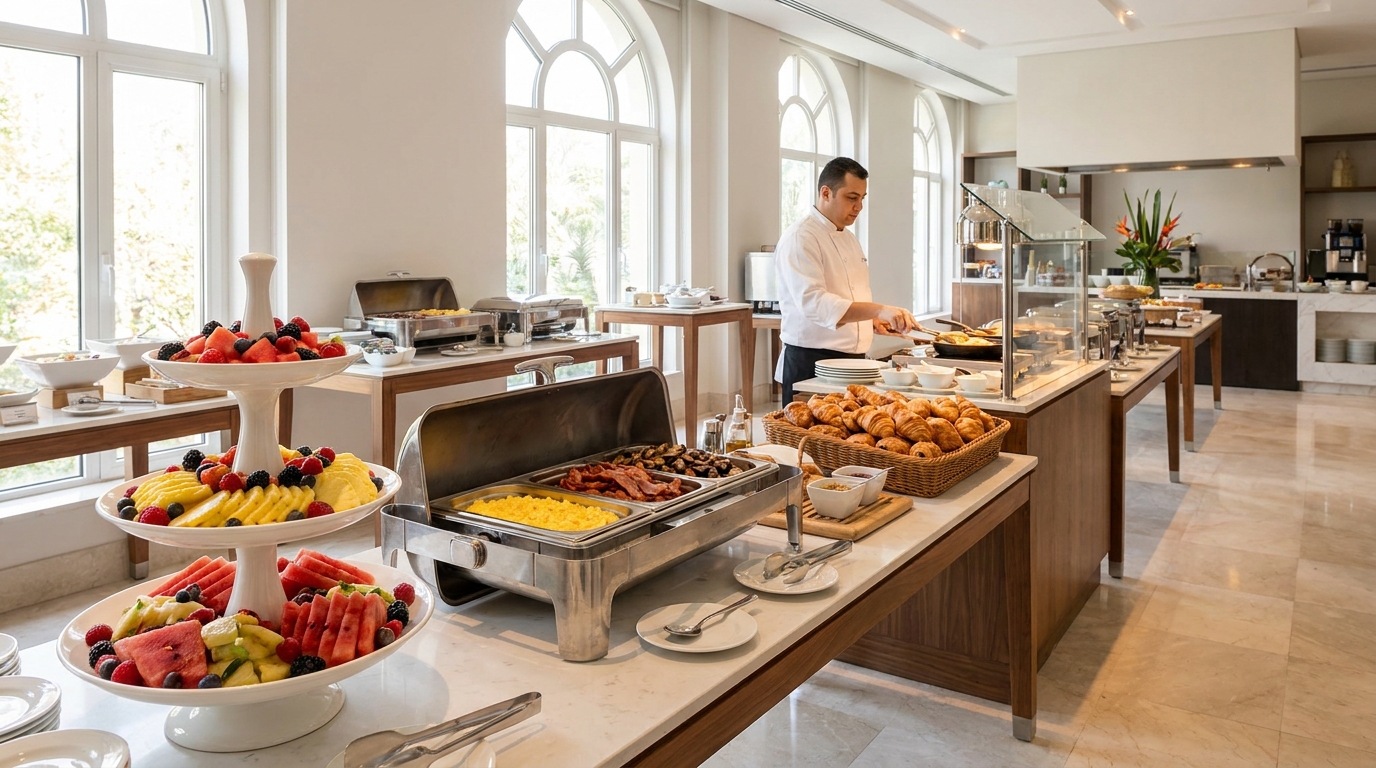
Hotel breakfast is the single most profitable F&B service in most properties — but only when the buffet is engineered. Most buffets are not. Here is the operator playbook: the 7 zones, the food-cost math, the layout that moves traffic, and the digital signage that finally fixes allergen labels.
TL;DR — Key Takeaways
Target 25–35% food cost. Above 40% and breakfast stops being profitable. Below 25% guests start complaining.
Seven zones, not one buffet. Hot proteins, breads & pastries, fresh cuts, cereals/yoghurts, hot grains/world dishes, beverages, and a made-to-order station. Build by zone, not by recipe.
Layout drives both flow and food cost. Light forward, hot in the middle, beverages at both ends. Tiered stands lift visibility. 70–100 cm deep tables. One station max per 120 guests.
Waste is a budget line, not a surprise. Plan 10–20% over-portion at the start; track it daily.
Allergen signage at every chafing dish. Multilingual where the guest mix needs it. The printed card is the bottleneck and the lawsuit risk.
Why hotel breakfast is a profit machine — and why most hotels leave money on the line
Hotel breakfast is the most reliably profitable F&B service a hotel sells. A bundled $18–$25 breakfast spend that costs $4–$6 in food translates to a margin most restaurant operators only dream of. CBRE's hotel benchmarking work on F&B shows the category averaging around 29% profit, and breakfast is the line item that pulls that average up — when it is managed.
The problem is that most hotels do not manage it. The same buffet, the same SKUs, the same Bain Marie layout, year after year. Food cost drifts to 40%+ as guest counts shift, allergen risk multiplies as menus mutate weekly, and the buffet card on the tabletop has not been re-photographed since 2019.
A well-engineered buffet runs 25–35% food cost, generates fewer guest complaints, and uses the layout to move guests through high-margin items first. Industry guidance on this is consistent — and it is not complicated. It is a discipline question, not a chef question. Most hotels handle the dish work fine and the layout, waste, and merchandising work poorly.
What a great hotel breakfast buffet includes — the 7 zones
Stop thinking about a buffet as a list of items. Think about it as 7 zones, each with a job. Build each zone tight, name a chef who owns it, and the buffet engineers itself.
Hot proteins
The anchor zone. Eggs in three forms (scrambled, fried, poached or hard-boiled), bacon, sausage, a vegetarian protein (mushrooms or beans), and a regional hot item (chorizo for Spain, ful medames for North Africa, etc.). Held in Bain Maries above 140°F (60°C) per the FDA Food Code hot-holding standard, restocked every 15 minutes during peak.
Continental breads & pastries
Sourdough, baguette, brown bread, croissants, pain au chocolat, a regional pastry, plus toasters with butter, jam, honey, and at least one fruit preserve. Display in baskets on tiered stands for visibility — lying flat on a table reads "cafeteria".
Fresh cuts
Cold cuts (ham, salami, prosciutto), cheeses (3 — soft, hard, blue), smoked salmon, sliced cucumber and tomato, olives. Held below 40°F. This is where the international business traveler eats — and where allergen disclosure matters most.
Cereals, yoghurts & cold staples
Granola, muesli, two cold cereals, plain and flavored yoghurts, milk and a plant alternative (almond, oat), sliced fruit, dried fruit, nuts. The lowest-margin zone — but the one that anchors the "healthy" perception of the buffet.
Hot grains & world dishes
Porridge or oatmeal with toppings (the highest-margin hot item on the buffet), a noodle or rice dish if your guest mix includes Asian travelers, baked beans, sautéed mushrooms. This zone differentiates your hotel from the airport-hotel template.
Beverages
Coffee (drip + espresso machine if guests demand it), tea selection, fresh juice (one squeezed if budget allows, two from concentrate), water still and sparkling, milk. Place at both ends of the buffet to spread traffic.
Made-to-order station
The one premium feature that moves a buffet from "fine" to "memorable". Omelets and pancakes are the workhorses. Belgian waffles or eggs Benedict on weekends. One chef, in white, working at the front of the room — this is theatre, not just food.
A sample 4-star hotel buffet menu
HOT PROTEINS— Scrambled Eggs · Bacon · Sausage · Sautéed Mushrooms · Hash Browns · Baked Beans
MADE-TO-ORDER STATION— Omelet (choice of fillings) · Belgian Waffle · Pancakes
CONTINENTAL— Sourdough · Baguette · Brown Bread · Croissants · Pain au Chocolat · Danish · Toaster + Spreads
FRESH CUTS— Sliced Ham · Salami · Prosciutto · Smoked Salmon · Brie · Cheddar · Blue · Cucumber · Tomato · Olives
CEREALS & YOGHURT— Granola · Muesli · Cornflakes · Plain Yoghurt · Berry Yoghurt · Plant-Based Milk · Sliced Fruit · Dried Fruit
HOT GRAINS & WORLD— Steel-Cut Oatmeal + Toppings · Congee · Vegetable Stir-Fry
BEVERAGES— Drip Coffee · Espresso · Tea Selection · Fresh OJ · Apple Juice · Still & Sparkling Water · Whole/Skim/Oat Milk
That is 36 SKUs across 7 zones — the sweet spot for a 4-star with 150–300 guests. A boutique runs 20 SKUs; a luxury or all-inclusive runs 60+.
How many items should a hotel breakfast buffet have?
The right answer scales with guest count and rate.
Limited-service / select-service (under 100 breakfasts):15–25 SKUs. The continental + 3 hot items + cereal/yoghurt/fruit. No made-to-order station.
Full-service / 4-star (100–300 breakfasts):30–40 SKUs across the 7 zones. One made-to-order station.
Luxury / resort / all-inclusive (300+):50–80 SKUs. Two or three made-to-order stations. Regional sections that rotate.
Anything beyond ~80 SKUs starts to generate waste faster than incremental satisfaction. The discipline of reducing menu items — the 80/20 menu applies to a buffet line as surely as to a printed restaurant menu: most of your buffet plates are built from 20% of your SKUs.
Buffet layout — the golden-triangle of a buffet line
The first 90 seconds at the buffet decide what a guest takes. Treat the line as a sequence, not a wall.
The single biggest layout fix at most hotels is to put lighter items first— fresh fruit, yoghurt, pastries — then hot proteins, then composed dishes. Guests fill their plate at the front; they do not double-back. This is the same eye-flow logic that drives menu engineering on a printed page, applied to a physical line. Where guests' eyes land first is where you place what you want them to choose first.
Practical layout rules:
Tables 70–100 cm deep. Less and guests bump elbows reaching across.
One station per 120 guests max. Above that, build a second mirrored station.
Beverages at both ends. Splits queue traffic and removes the single bottleneck most hotels create.
Vertical space matters. Tiered stands and risers lift small items into eye-line; flat-on-table reads cafeteria.
Group by color and texture. Vibrant fruit together, neat rows of pastries — the buffet should look composed, not assembled.
For a deeper read on how guests' eyes flow over a layout, see the menu engineering work referenced above. The principles port directly.
Food cost — the 25–35% rule
The single biggest financial metric on a breakfast buffet is food cost percentage. Industry guidance from sources like Hotel Management magazine is consistent: target 25–35%. Below 25% you are probably cheating somewhere — too small a fruit display, no real protein at the omelet station — and guest reviews will catch it. Above 40% and the buffet stops generating profit, even at a $25 list price.
Quick math for a $20 breakfast at 30% food cost: $6 in raw food, $14 in margin to cover labor, overhead, and the property's contribution. Most hotels can get there. Many do not because of three habits — over-portioning the early-restock, refusing to track waste daily, and refilling the chafing dish at minute 89 of a 90-minute service.
The "buffet is profitable at $10–$12" claim turns out to be true at a basic continental — a quality continental can hold 25% food cost at the $10 list. A full hot buffet needs a $16–$22 list to keep the same percentage.
If breakfast is bundled into the room rate, common allocation is12–18% of the room rate to breakfast cost. A $200/night room implies $24–$36 for breakfast — well within the 25–35% food cost band on a $20–$30 retail menu.
Waste — the budget line everyone forgets
Plan10–20% waste into the budget. This is not a sign of mismanagement; it is the cost of buffet service. The fix is not to under-order — under-ordering generates worse guest reviews than over-ordering. The fix is to track waste daily, share the number with the chef, and adjust portion-out cadence the next morning.
Three operational moves cut waste without cutting quality:
Smaller chafing dishes restocked more often beat large pans held all service.
The last 30 minutes runs on smaller portion-outs. Most hotels don't taper.
Untouched protein from the last 30 minutes gets repurposed for staff meals or, where local food safety rules allow, for in-room dining all-day breakfast on the same day.
Allergens & dietary labels at the chafing dish
The single most under-managed compliance risk on a hotel breakfast buffet is allergen disclosure. EU Regulation 1169/2011mandates the 14 declared allergens for any food sold in EU member states; the US FDA's major food allergens list covers 9 since sesame was added in 2023. On a buffet, where a guest serves themselves and no waiter takes an order, the disclosure has to live at the dish — not in a folder behind the host stand.
The minimum acceptable standard is a small allergen card next to every dish, listing the allergens present in that recipe. The card should also work in the guest's language — and this is where most hotels fail, because reprinting allergen cards in 8 languages every time the chef substitutes an ingredient is operationally impossible on paper.
The allergen tagging guide for multilingual menus walks through the working version: tag each dish with structured allergen data, render the cards from that data, update once and have every language update at the same time.
Multilingual signage — when your buffet has 7 guest languages
International business hotels, resort properties, and airport hotels routinely see 7+ guest languages over breakfast. The traditional answer is a multilingual menu card on each table — which goes out of date the moment the kitchen substitutes an ingredient.
The modern answer is a QR card next to each chafing dish. Guests scan once, the dish description and allergen disclosure render in their language, and a kitchen change propagates to every translation in seconds. The complete guide to multilingual restaurant menus covers the language selection, dish-name handling, and translation quality issues that come up; the version that applies to a buffet line is a simplified subset of the same playbook.
Digital buffet menu — when QR replaces the printed card
A printed buffet card has three failure modes: it goes out of date, it cannot be cost-effectively translated, and it cannot warn a guest about an allergen that was added at 6am because the egg supplier short-shipped. A QR card on the buffet line fixes all three.
The investment is modest. The card is printed once. The menu behind it is software. Allergens, languages, and dish updates all happen in seconds. We cover the implementation choices in the QR code in-room ordering guide— most of the same architecture applies on the buffet line.
Common hotel breakfast buffet mistakes
No daily food cost or waste number. You cannot improve what you do not measure.
Refilling at minute 89 of a 90-minute service. Wastes money, frustrates the kitchen.
Allergen cards in English only. Compliance and lawsuit risk.
Heavy items first in the line. Guests pile their plate with $0.80 of bacon before they ever see the fruit zone.
One buffet station for 250 guests. Build a second mirrored line.
Beverages at the start. Creates a single bottleneck at the front of the queue.
Static menu card with no photos and no translations. A QR card costs less to maintain and looks better.
Build your hotel breakfast menu free with Intermenu
Intermenu turns each chafing-dish card into a live, mobile-first menu — translated automatically into 15 guest languages, tagged with the EU-14 / US-9 allergens, with one update propagating across every language and every outlet. The kitchen substitutes an ingredient at 5:45am; the allergen tag updates before guests sit down.
Build your hotel breakfast menu free with Intermenu →
Frequently Asked Questions
What should a hotel breakfast buffet include?
Seven zones: hot proteins, continental breads and pastries, fresh cuts, cereals and yoghurts, hot grains and world dishes, beverages, and a made-to-order station. Scale by guest count.
What is the food cost percentage on a hotel breakfast buffet?
Industry target is 25–35%. Above 40% is no longer profitable; below 25% generally means guests are getting less than they expect and will say so in reviews.
What is the markup on hotel breakfast?
At a 30% food cost, the markup is roughly 3.3× — $6 of raw food sold at $20. When breakfast is included in the room rate, hotels typically budget 12–18% of room rate toward the breakfast spend.
How do hotels calculate buffet portion size per guest?
Standard guidance: 350–500g of food per adult guest across the full buffet, with 10–20% waste planned on top. Hot proteins are budgeted at 80–100g per guest; pastries at 1.5 pieces per guest; fresh fruit at 100g per guest.
Should I charge for breakfast or include it in the room rate?
For business-traveler segments, included usually wins — it removes a friction point at the front desk. For leisure properties, charged builds margin. The deciding factor is your competitive set: if comparable hotels include it, you should too.
How do you handle leftover buffet food?
Where local food-safety rules permit, untouched hot food at the close of service can be repurposed for staff meal or for the in-room dining all-day breakfast menu the same day. Track waste daily and feed the number back to the kitchen for the next morning's portion-out.
Is continental breakfast still relevant in 2026?
Yes, at limited-service and select-service properties. The continental works when it is genuinely a quality continental — fresh pastries, real fruit, decent coffee — and not the bagel-and-burnt-coffee version that hurt the format's reputation.
Related guides
Optimizing hotel F&B menu management for 2026 success— the cluster pillar
In-room dining menu — how to design one that sells— the other big in-hotel meal
Hotel allergen compliance — multi-outlet F&B operations— the buffet-line risk in depth
The 80/20 menu — cut your menu in half— the SKU discipline this article borrows
Menu engineering 2026 — how to design a menu that sells— the eye-flow principles applied to a buffet line
The complete guide to multilingual restaurant menus— the language handling