
Hotel Banquet & Catering Menus — Pricing by Event Type (2026)
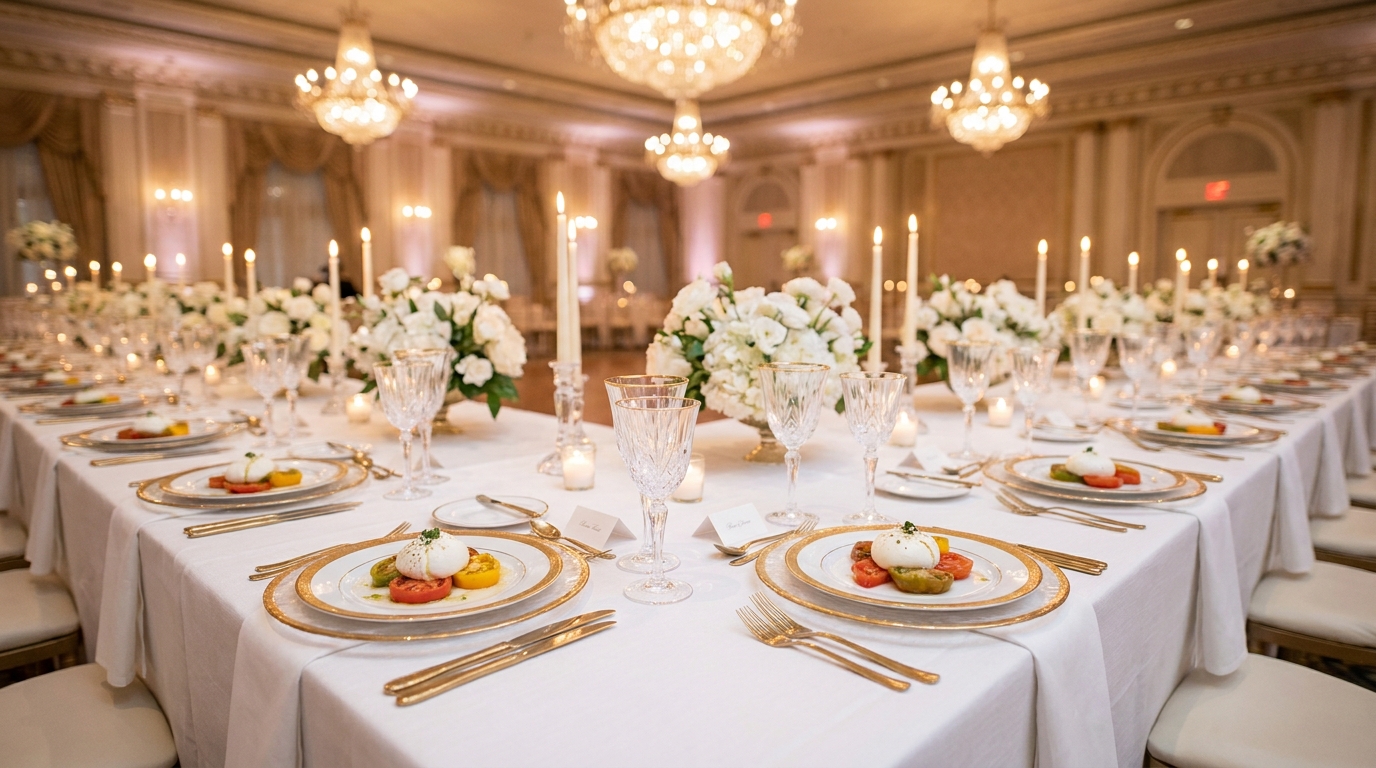
Banquet F&B is the highest-margin revenue stream in most hotels — and the most poorly documented online. Here is the operator playbook: 5 event-type packages, the per-head pricing math, allergen pre-disclosure with the planner, and multilingual banquet cards for international weddings.
TL;DR — Key Takeaways
Banquet F&B is the highest-margin hotel revenue stream— when the menu is built as event-type packages, not as one-off custom orders.
5 packages cover 90% of bookings: conference / corporate, wedding, gala dinner, cocktail reception, family event.
Per-head pricing math matters more than the dishes. Industry pattern is "per person plus-plus" — plus tax, plus service charge (often 18–26%).
Allergen pre-disclosure is the planner's job, not the day-of nightmare. Collect dietary requirements via the RSVP process; bake them into the kitchen's prep.
Multilingual banquet cards are the missing feature for international weddings. A printed card in one language excludes half the wedding party.
Why banquet menus are different from restaurant menus
A restaurant menu is built for a guest who walks in cold, scans, and decides. A banquet menu is built for an event planner working a spreadsheet four months out, who needs to know:
The per-head price
What the package includes (room, AV, ceremony space, dance floor)
The minimum food-and-beverage spend
What the upgrades cost
Whether the bar package is included or hosted
What dietary accommodations are possible
These are not menu questions. They are commercial questions packaged as menu questions. Hotel banquet menus that succeed treat the menu as a sales tool first and a kitchen brief second.
The economic case for getting it right is strong. Banquet F&B is consistently the highest-margin line in hotel F&B — minimums are pre-committed, ingredients are pre-ordered to spec, labor is scheduled tightly to the event, and waste is meaningfully lower than à la carte service. CBRE's hotel research tracks banquet contribution as one of the strongest profit drivers for full-service properties. A hotel with strong banquet revenue can carry breakeven restaurant performance and still make F&B profitable overall. A hotel that loses banquet to a competitor with better packaging often cannot.
The 5 event-type packages every hotel should have
Stop offering "custom menus". Custom menus are exhausting for planners and impossible to scale operationally. Build five packages, each tuned to a specific event type, with clear upgrade paths.
Conference / corporate (full-day)
The bread and butter of midweek banquet revenue. A standard package covers continental breakfast, mid-morning coffee break, plated or buffet lunch, afternoon coffee break, all-day water and soft drinks. Pricing is per person per day, with separate line items for AV, room rental, and any reception add-on.
Build around: $75–$150 per person per day for standard corporate, $150–$250 for premium / luxury venues. Bar packages add separately. Coffee breaks are deceptively margin-heavy — a $12 coffee break costs about $2 in food.
Wedding (3–5 course plated)
The highest-margin and highest-stakes event type. Three tiers usually:
Standard— 3 courses, 2 entrée choices, house wine, 4-hour open bar add-on
Premium— 4 courses, 3 entrée choices, sommelier-paired wine, 5-hour premium bar
Luxury— 5 courses, chef interaction, paired wines, full premium bar, late-night snack station
Industry per-head pricing pattern (cross-referenced with sources like The Knot's annual wedding cost study): $85–$150 standard, $150–$250 premium, $250–$500+ luxury. The "all in" wedding package adds 18–26% service charge on top, plus applicable tax.
Gala dinner (plated, charity / corporate)
The fundraiser format. A plated 3-course with a strong signature dish, often featuring local sourcing or a celebrity chef tie-in. Per-head $100–$200 standard. The hotel often co-markets the gala with the charity, which lifts ADR for the room block the same night.
Cocktail reception (passed canapés + bar)
The 2-hour pre-event format that turns into the full event when the host can't justify a sit-down dinner. 6–10 passed canapés, 1 stationed item (cheese & charcuterie board, raw bar, carving station), full bar.
Build around: $55–$95 per person for 2 hours of passed canapés + open bar. Stationed items add $15–$30 per person.
Family event (buffet)
Anniversary parties, milestone birthdays, christenings, graduations. Less prestigious than a wedding, often more profitable. Three or four buffet stations, dessert table, hosted bar with cash bar option. $45–$85 per person.
A sample wedding banquet menu — 3 packages
STANDARD ($95/person)
3-course plated · 2 entrée choices · house wine pour · 4-hour open bar add-on at $35/person
First — Roasted Tomato Bisque · or Beet & Goat Cheese Salad
Main — Roasted Chicken Breast · or Atlantic Salmon · or Vegetable Risotto
Dessert — Chocolate Torte · or Lemon Tart
PREMIUM ($145/person)
4-course plated · 3 entrée choices · sommelier-paired wine · 5-hour premium bar at $55/person
First — Burrata with Heirloom Tomatoes · or Tuna Tartare
Soup — Sweet Corn Bisque · or Forest Mushroom
Main — Filet Mignon · or Halibut · or Eggplant Parmesan
Dessert — Crème Brûlée · or Warm Chocolate Lava
LUXURY ($235/person)
5-course tasting · chef interaction · paired wines included · premium bar · late-night station
First — Hokkaido Scallop · with caviar
Second — Foie Gras Torchon
Pasta — Black Truffle Tagliolini
Main — Wagyu Beef · or Atlantic Lobster
Dessert — Tasting Plate
Late-Night — Mini Wagyu Sliders + Truffle Fries
All pricing is "plus-plus" — plus 22% service charge, plus applicable sales tax on food and beverage. The contract spells this out clearly.
Pricing — per-head math by event type
Banquet pricing is unlike restaurant pricing because the commercial structure is different. Three pricing components every banquet menu needs:
Per-head food price. What's on the plate. Built to the package's target food cost (typically 28–35%).
Service charge. Industry standard is 18–26% on food and beverage. This is not a tip — it's the hotel's labor and overhead margin allocation.
Tax. Applicable per jurisdiction — guidance from industry bodies like the American Hotel & Lodging Association covers regional patterns. In the US, often a different rate for food vs alcohol.
A $100 per-person wedding entrée at 22% service charge and 8% tax delivers $130 per person to the hotel — but the contract states "$100 per person, plus plus", and the planner does the math from there. Be explicit. Surprise total-bill numbers at contract signing kill bookings.
Quantity discounting works in banquet pricing the same way it works in catering — sometimes. Tiered pricing where a $45 per-person rate drops to $40 at 75+ guests is common, and is a useful tool for closing larger events. But the discount has to come from actual scaling efficiency (one chef cooking for 75 instead of two for 50) rather than from giving away margin.
Minimum food-and-beverage spend is the other critical commercial lever. A hotel that contracts a wedding for a $25,000 F&B minimum gets predictable revenue and can right-size the kitchen labor. A hotel that doesn't enforce minimums often ends up running a 60-guest wedding in a 200-guest ballroom and losing money on the labor.
Dietary & allergen pre-disclosure with the event planner
The banquet allergen workflow is structurally easier than à la carte service — if the hotel does the work upfront with the planner. The pattern that works:
At contract signing, the hotel sends a dietary disclosure form for the planner to circulate with the RSVP.
At RSVP collection, every dietary restriction (gluten-free, vegan, peanut allergy, kosher, halal, religious fasts) is collected by name and seat.
One week before the event, the planner sends the final dietary breakdown to the hotel.
At service, every accommodated guest's plate is marked (a small flag, a different garnish) so the runner knows which one to deliver.
This workflow is dramatically lower-risk than the à la carte allergen pattern covered in the hotel allergen compliance guide— and it satisfies disclosure obligations under EU Regulation 1169/2011and the US FDA major food allergens framework— because the disclosure happens days before service rather than mid-meal. The kitchen has time to prep separately, the chef has time to review, the runner has time to memorize the seat assignments.
What goes wrong: kitchen substitution on the day-of. The salmon supplier short-ships, the kitchen swaps to halibut, and three guests with shellfish allergies are now at risk. The mitigation is a manager sign-off on every day-of substitution and a phone call to the planner before service.
Multilingual banquet menus for international weddings
International weddings — South Asian, Middle Eastern, Chinese, Latin American — routinely have guest lists in two or three primary languages. The menu card on the table is typically printed in the language of the host culture and the venue's local language. That leaves a meaningful share of the guest list unable to read the menu.
The traditional fix is to print bilingual or trilingual cards. The cost is real and the lead time long — most hotels' production timeline forces bilingual decisions to be made weeks in advance, which collides with the late-cancellation and late-RSVP reality of weddings.
The modern fix is a QR card on each table linking to a digital menu in every language the guest list needs. The card itself is bilingual (host language + venue language); the QR opens the full menu in any of 15 languages. Production timeline collapses; cost drops; the day-of menu change propagates to every language.
The multilingual hotel menus guide covers the broader language-selection methodology; the menu translation by cuisine guide covers dish-name handling across the cuisines most often featured at international weddings.
Tableside printed card vs QR card — when each wins
Printed card wins: small intimate dinners (under 30 guests), gala events where the printed program is part of the experience, weddings where the menu card is a keepsake. The aesthetic value is real.
QR card wins: mid-size and large events (50+), international weddings, conferences with multi-day evolving menus, any event where the F&B might need to update day-of.
The hybrid wins almost everywhere: a printed card with a beautiful one-page menu in the headline language + a QR for the full menu, allergen disclosure, and other-language versions. Most hotel banquet operations are moving toward this.
Last-minute changes — how to update 200 cards in 5 minutes
The wedding rehearsal dinner ends. The bride decides at 9pm that the chicken entrée should swap to fish for the main course. The hotel banquet manager has 200 printed cards to update. With printed cards, this is a logistical impossibility — the right answer is "we cannot accommodate this" or "we'll add a verbal announcement at the start of service".
With a QR card on each table, this is a 5-minute job. The manager opens the menu admin, changes the entrée line, the change propagates to every language, every guest's QR scan reflects it. The bride's vision is delivered; the kitchen prepares accordingly; the operational complexity is invisible.
This is also the use case where the QR code in-room ordering setup guide becomes valuable across the property — the same architecture that supports in-room dining supports the banquet card.
Common hotel banquet menu mistakes
Custom menus instead of packages. Custom is exhausting and unscalable. Build 5 packages with clear upgrade paths.
No "plus-plus" disclosure on the contract. Planners feel ambushed at the final bill and leave bad reviews.
Allergen requirements collected day-of. Pre-collect via RSVP — the only workflow that scales.
Printed bilingual cards forced weeks in advance. Replace with QR.
No minimum F&B spend. Wedding profitability collapses without one.
Last-minute kitchen substitution without planner notification. A liability waiting to happen.
Generic conference coffee break. Coffee breaks have outsized margin — use a real one to upsell to premium packages.
Build your hotel banquet menu free with Intermenu
Intermenu handles banquet F&B with the same multilingual + allergen + photo platform that runs the rest of hotel F&B — every package translated automatically into 15 languages, every dish tagged for dietary requirements, every change propagated to every printed card and every QR menu instantly. The wedding planner gets a clean PDF of the chosen package; the guests get a QR menu in their language; the kitchen gets a fixed brief.
Build your hotel banquet menu free with Intermenu →
Frequently Asked Questions
What should a hotel banquet menu include?
Five event-type packages — conference / corporate, wedding (3 tiers), gala dinner, cocktail reception, family event — each with a clear per-head price, included items, upgrade options, and minimum F&B spend.
What does "plus-plus" mean on a banquet menu?
Plus tax, plus service charge. Industry-standard service charge is 18–26% on food and beverage. The per-head price on the menu is the food price; the planner adds the percentages to get the total.
What is the average per-head cost of a wedding banquet?
$85–$150 for standard, $150–$250 for premium, $250–$500+ for luxury — plus 18–26% service charge plus tax. Alcohol packages add separately ($35–$75/person for open bar over 4–5 hours).
How do hotels handle wedding dietary restrictions?
Through a structured RSVP workflow: dietary form sent at contract signing, restrictions collected by name and seat, final dietary breakdown sent to the kitchen one week before the event, plates marked at service so runners deliver the right one.
Should banquet menus be customizable?
Light customization yes — swap an entrée choice, sub a vegetarian option. Heavy custom no — fully bespoke menus are unscalable. Build packages with clear upgrade paths and resist "we want something different".
What's the minimum F&B spend for a hotel wedding?
Varies widely by venue and market — $5,000–$15,000 for mid-tier urban hotels, $25,000–$100,000+ for premium and luxury. The minimum protects the hotel against under-utilized labor and over-allocated space.
How are banquet menus different from restaurant menus?
Banquet menus are sales tools first — built around per-head pricing, packages, and commercial terms. Restaurant menus are guest-experience tools first — built around dish discovery and order conversion.
Related guides
Optimizing hotel F&B menu management for 2026 success— the cluster pillar
Catering menu ideas — packages, examples & pricing by event— the broader catering playbook
Hotel allergen compliance — multi-outlet F&B operations— the pre-disclosure workflow this depends on
Multilingual hotel menus — one menu, 15+ guest languages— the international wedding layer
Menu translation by cuisine— dish names across cuisines
QR code in-room ordering — replace the paper card— the same architecture applied to the banquet card