
Catering Menu Ideas: Packages, Examples & Pricing by Event (2026)
Build a catering menu that books — ideas by event type, service styles, sample tiered packages and per-person pricing, plus how to handle dietary needs and share it digitally.
TL;DR — Key Takeaways
A catering menu should be organized by event type and service style, then sold as tiered packages— not a loose à la carte list.
Per-person pricing and clear minimums are what let a client say yes quickly. Most "catering ideas" lists skip the packaging and pricing — that's your edge.
Cover the full demand range, from upscale weddings to budget buffets for large groups.
Dietary and allergen handling is non-negotiable for events; a shareable digital catering menu makes browsing, choosing and ordering effortless.
What should be on a catering menu?
A catering menu is built from the same courses as a restaurant menu —appetizers/canapés, mains, sides, desserts and beverages— but organized for volume and presented as choices a host can assemble into a meal. Two decisions shape everything: the service style (how the food is delivered) and the package structure (how it's priced). Get those right and the dish ideas slot in easily. A catering menu is a sales document first and a food list second.
Catering menu ideas by event type
Different events want different menus. Build a focused offer for each.
Wedding catering
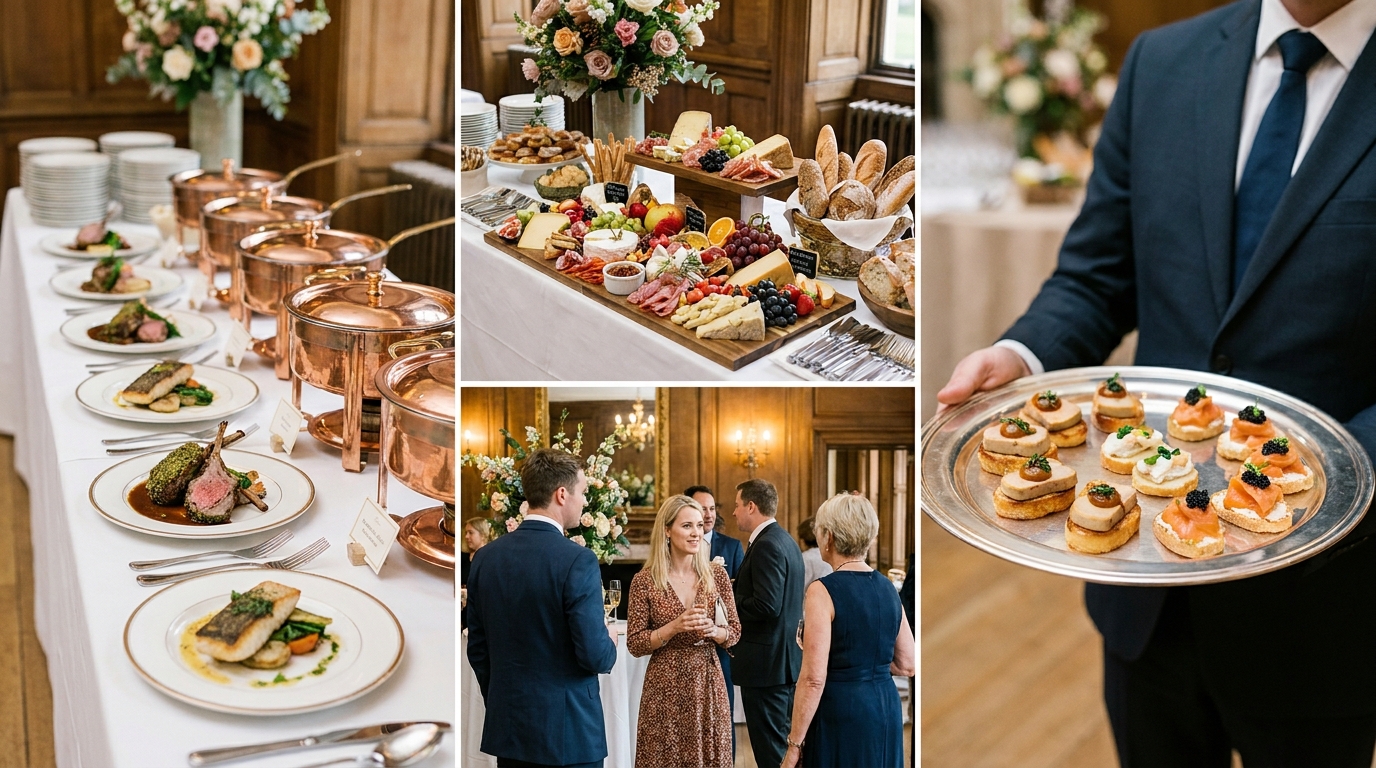
The premium tier. Think plated multi-course dinners or elegant stations— a choice of seared protein mains (beef, chicken, fish, a vegetarian Wellington), refined sides, canapés on arrival (mini beef Wellington, tuna tartare, caprese skewers), and a dessert table or cake service. Presentation and flawless dietary handling matter as much as the food.
Corporate and office catering
Reliability and ease win here: boxed lunches, sandwich and wrap platters, salad bowls, hot buffet trays, breakfast spreads and meeting snack boxes. Recurring corporate accounts — a weekly team lunch, a monthly board meeting — are some of the steadiest catering revenue you can build.
Cocktail and canapé receptions
Tray-passed hors d'oeuvres and grazing stations for stand-up events — sliders, skewers, mini tacos, bruschetta, arancini, a charcuterie display, oyster or carving stations. High perceived value with controllable, portion-managed cost.
Buffet and family-style
Crowd-friendly and labor-efficient: a few mains, generous sides, salads and bread, served buffet or family-style. The workhorse of mid-size events — pasta bars, taco bars, carvery, a curry buffet.
Holiday and party catering
Seasonal spreads for office parties, birthdays, graduations and holidays — themed menus (a holiday roast, a summer BBQ, a grazing table) that are easy to upsell with a drinks or dessert package.
Budget-friendly catering
Don't ignore the value end —pasta bars, taco bars, BBQ, sandwich and salad platters, baked-potato bars feed large groups affordably and convert a huge slice of search demand ("how to feed 50 guests on a budget").
Service styles: plated vs buffet vs tray-passed vs family-style vs stations
The service style is a cost and experience lever:
Plated— most formal, highest labor and staffing, best for weddings and galas.
Buffet— efficient and generous, ideal for mid-to-large events; guests serve themselves.
Tray-passed— elegant for stand-up receptions; controls portions and pace.
Family-style— warm and social, shared platters at the table.
Stations / grazing— interactive and premium (carving, pasta, taco, dessert stations); great for upsell and "wow."
Offering two or three styles widens who can book you, from a 200-guest plated wedding to a 30-person office buffet.
Sample catering packages
Sell tiers, not a price list — a clear three-tier structure books faster because it frames the decision:
SILVER (per person)— 1 main · 2 sides · salad · bread · soft drinks
GOLD (per person)— 2 mains · 3 sides · salad · canapé on arrival · dessert
PLATINUM (per person)— 3 mains or live stations · premium sides · passed canapés · dessert table · coffee & beverage service
Add-ons: bar/beverage package · extra canapés · dietary platters · cake service · staffing · linens. Most clients trade up a tier or add at least one upsell when the options are laid out clearly.
How to price a catering menu (per person and packages)
Catering is priced per head, then bundled into packages with a minimum guest count (or minimum spend). Build each package from food cost upward, then layer labor, equipment, rentals, delivery and a healthy margin— events carry far more overhead than a dine-in cover. A useful approach is to set the per-person food cost, multiply to hit your target food-cost percentage, then add a flat event/service fee. Publish clear per-person prices and minimums so clients can self-qualify and book without a dozen emails. For the pricing logic, see our menu pricing guide and menu engineering.
How to feed a large group on a budget
For cost-conscious clients, lead with high-yield, low-cost crowd-pleasers: a pasta or taco bar, BBQ with two proteins and generous sides, a baked-potato or burrito bar, or sandwich and salad platters. Price a simple per-person buffet, keep the protein count tight (it's your biggest cost), and bulk up with affordable sides, bread and salad. It's the practical answer to "how can I feed 50 guests cheaply" — and a big, winnable search that brings in real enquiries.
The most profitable catering items and upsells
Margins are strongest on buffets and stations (less labor per cover than plated) and on add-ons: bar and beverage packages, dessert tables, premium carving or pasta stations, and staffing. Pasta, rice and potato-based dishes carry excellent margins; canapés let you charge premium prices for small, controlled portions. Build these as easy upsells on every package — they lift the average contract value with little extra effort and turn a $30/head booking into a $50/head one.
Dietary and allergen accommodations
Events almost always include guests with dietary needs, and getting it wrong is a safety and reputation risk that can lose you the referral. Offer clear vegan, vegetarian, gluten-free, halal and kosher options, collect dietary counts at booking, and label everything clearly on the day with separate serving utensils to avoid cross-contact. Our guides to inclusive special-diet menus and allergen compliance cover how to do it safely.
How to present and design a catering menu
A catering menu is a sales document, so design it to convert. Lead with the packages, show clear per-person pricing, make dietary options visible, include real photos of your spreads, and add a simple way to enquire or book. A shareable digital catering menu beats a PDF — it's always current, easy to browse on a phone, and can route straight to a quote request without the host downloading anything. Photograph your hero spreads with the AI food photography playbook.
Digital catering menu, online ordering and quotes
Caterers lose bookings to slow back-and-forth. A digital catering menu lets clients browse packages, see pricing, filter for dietary needs and request a quote in minutes — and you update it without resending files or worrying about an out-of-date PDF circulating. Set it up with our QR code menu guide.
Common catering menu mistakes
A loose à la carte list instead of packages — clients can't decide.
Hidden pricing— slows or kills the booking.
No clear minimums— wasted enquiries for tiny events.
Ignoring dietary counts— a safety and reputation risk.
A stale PDF— out-of-date prices and dishes circulating.
Build your catering menu free
Intermenu turns your catering offer into a shareable digital menu — tiered packages, per-person pricing, dietary filters and a quote request — that clients can browse and book from. Build your catering menu free with Intermenu →
Frequently Asked Questions
What should be on a catering menu?
Appetizers/canapés, mains, sides, desserts and beverages, organized by event type and service style, and sold as tiered per-person packages with clear add-ons.
How do you price catering per person?
Build each package from food cost up, add labor, equipment, rentals, delivery and margin, then set a per-person price with a minimum guest count or spend.
How can I feed 50 guests on a budget?
Lead with high-yield, low-cost crowd-pleasers — a pasta or taco bar, BBQ, baked-potato bar or sandwich/salad platters — priced as a simple per-person buffet with a tight protein count.
What is the most profitable food to cater?
Buffets and stations (lower labor per cover), pasta/rice/potato-based dishes, and upsell add-ons like bar packages, dessert tables and premium stations.
Buffet, plated or drop-off — which should I offer?
Plated for formal events, buffet for mid-to-large groups, tray-passed for receptions, and budget drop-off for cost-conscious clients. Offering a couple of styles widens who can book you.
How do I share a digital catering menu or quote?
Build it in Intermenu and share a link or QR code, so clients browse packages, filter dietary options and request a quote — and you update it anytime without resending files.