
In-Room Dining Menu — How to Design One That Sells (2026)
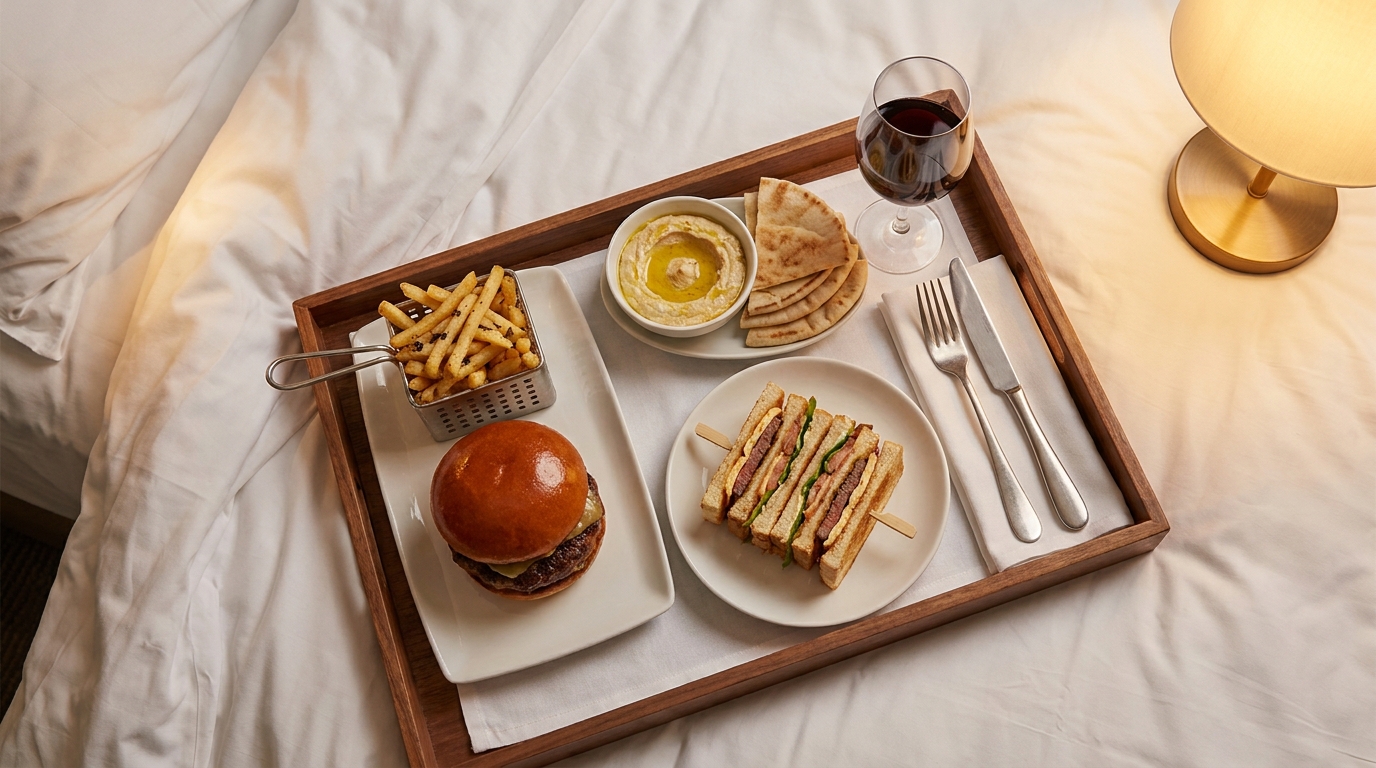
In-room dining used to print money. Today, most hotels lose money on it — wrong items, wrong packaging, wrong pricing for the shift. Here is the operator playbook for an in-room dining menu that travels well, holds margin, and works in every guest's language.
TL;DR — Key Takeaways
In-room dining lost its margin because hotels kept printing the same 1990s menu while delivery apps reset guest expectations.
18–25 items is the sweet spot. Too few looks lazy; too many slows the kitchen and pushes orders into the all-day-breakfast trap.
Travel-tested items only. Burgers, club sandwiches, flatbreads, salads with dressing on the side. Eggs over easy, soufflés, and crispy seafood will arrive cold and ruin a review.
Pricing tolerates 25–40% over restaurant menu prices— beyond that, guests stop ordering and ring DoorDash instead.
The laminated card is finished. A mobile in-room menu that updates instantly, shows real photos, and speaks the guest's language is the only version that still works in 2026.
Why in-room dining still matters in 2026 — and why it loses money for most hotels
In-room dining is the most personal F&B experience a hotel sells. It is also the most under-managed. CBRE's hotel research tracks F&B profit margins growing modestly across the category — but in-room dining and the mini-bar are the two revenue lines that have stagnated as hotels invest in lobby concepts and rooftops instead. The reasons are structural: room service is harder to scale, runs longer hours, has a single delivery channel that costs labor every trip, and competes head-on with the guest's phone.
Most hotels do not respond to this with menu work. They respond by quietly hoping it goes away — same printed card, same 80 items, same kitchen mandate to "do whatever the guest asks." The result is a menu that costs money to keep on the bedside table and disappoints the guests who do order from it.
A modern in-room dining menu is short, photographed, multilingual, and built specifically for the constraints of a tray traveling a long corridor. That is the version this guide walks through.
What to include on an in-room dining menu — the 6 category framework
You do not need 80 items. You need six well-built categories that cover the realistic order moments — early breakfast, mid-day light bite, late afternoon snack, dinner, late-night, and beverages. Run the menu against this framework and cut anything that does not earn its slot.
Comfort classics
The most reliable orders in hotel history. A great burger, a club sandwich done well, a margherita flatbread with hot honey. These are forgiving in transit, scale across cuisines, and convert across guest demographics from business travelers to families. Hotel experts repeatedly point at the cheeseburger and club sandwich as the items "hard to get wrong" — and they are right. If your menu has only one perfect dish, this is the section where it should sit.
Build the section around: elevated burger (wagyu, plant-based option), classic club, margherita flatbread, grilled chicken sandwich, truffle fries as a hero side.
Light & healthy bites
The fastest-growing section in luxury hotels. Guests checking in late, business travelers eating in bed during a conference call, wellness-focused diners. These items travel well because they are usually composed cold or warm-cold.
Build around: pan-seared salmon salad with vinaigrette on the side, Mediterranean mezze platter (hummus, tzatziki, olives, warm pita in a separate envelope), cheese & charcuterie board, grain bowl with protein add-ons.
Late-night & shareables
Pub-grub bestsellers convert at 11pm in a way fine-dining concepts never will. The kitchen team available after 10pm is also smaller, so the menu has to be designed for them.
Build around: truffle & parmesan fries, crispy calamari with dipping sauce, chicken quesadilla, loaded nachos, a single late-night flatbread or pizza.
Decadent desserts
The single highest-margin section of the menu and the one guests most forget to order. The warm chocolate lava cake is on every successful in-room menu in the world for a reason — it travels, it photographs well, and it has a 20% food cost.
Build around: warm chocolate lava cake with ice cream, New York cheesecake with berry compote, crème brûlée (yes, it travels), a fresh fruit plate as the lighter option.
All-day breakfast staples
Guests order breakfast at 11pm. Make peace with it. A small all-day breakfast section captures the late-arrival traveler who slept through the buffet.
Build around: smashed avocado on sourdough, two-egg breakfast (scrambled only — never over-easy or poached for room service), Belgian waffle, yogurt with granola and berries.
Beverages
This is your real margin section. A 35-50% pour cost on alcohol and a 90%+ margin on coffee make this category disproportionately profitable. Run it tight: 4 wines by the glass, 3 beers, 2 signature non-alcoholic drinks, a serious coffee program.
A sample in-room dining menu
CLASSICS— Wagyu Burger · Classic Club · Margherita Flatbread · Grilled Chicken Sandwich · Truffle Parmesan Fries
LIGHT & HEALTHY— Pan-Seared Salmon Salad · Mediterranean Mezze Platter · Quinoa Bowl with Grilled Chicken · Cheese & Charcuterie
LATE-NIGHT— Crispy Calamari · Chicken Quesadilla · Loaded Nachos · Late-Night Cheese Pizza
ALL-DAY BREAKFAST— Smashed Avocado Toast · Two-Egg Breakfast Scramble · Belgian Waffle · Yogurt Bowl
DESSERT— Warm Chocolate Lava Cake · NY Cheesecake · Crème Brûlée · Seasonal Fruit Plate
BEVERAGES— Sparkling/Red/White by the glass · 3 Local Beers · Single-Origin Coffee · Espresso · Fresh Juice · Bottled Still & Sparkling
That is 24 items. It will outperform an 80-item menu in revenue per order and in operational sanity.
How many items should a room service menu have?
The sweet spot for most full-service hotels is18–25 items, plus a tight beverage list. Below 15 the menu feels thin and guests treat it as a fallback rather than a real choice. Above 30 the kitchen slows, prep waste climbs, and you start carrying SKUs that order three times a week. The same decision-fatigue principles that drive menu engineering for restaurants apply more aggressively to in-room dining, because the guest is alone with the menu and a phone full of alternatives.
The exception is a luxury or resort property running 24-hour service where a "midnight menu" of 8–10 items appears after 10pm. Treat it as a separate menu, not as bloat on the main one.
Items that travel — and the ones that do not
A useful test before adding any dish: imagine it sitting under a metal cloche for 12 minutes in a service elevator. Will it still be the dish the chef intended?
Travels well: burgers (kept simple, no fried egg), club sandwiches, flatbreads/pizzas (held in a vented box), composed salads with dressing separate, mezze and cheese platters, soups in vacuum flasks, pasta with cream or olive-oil sauces, lava cake, cheesecake.
Does not travel: eggs over easy or poached (set or break), soufflés (collapse), crispy seafood (steam-softens in five minutes), fries (lose crunch in three), most stir-fries (lose wok hei), cappuccino foam (collapses by the elevator), well-done steak (continues cooking under the cloche to gray).
Hotel guides have flagged this for years — items like eggs and crispy fried dishes simply do not survive the trip and consistently generate low review scores. Industry coverage from Hotel Management repeatedly returns to the same list. Cut them. If a guest wants eggs over easy at 9am, they can take the elevator to the restaurant.
Pricing — the 25–40% in-room markup, and when guests stop ordering
Guests accept a markup on in-room dining because they are paying for the service and the convenience. The accepted range is roughly25–40% above your restaurant menu prices. Below 25% you give up margin without converting more orders. Above 40% you trigger the "I'll just order DoorDash" response — which is exactly what most hotels have triggered, accidentally, by holding 1990s markups (60–80%) into a delivery-app world.
A useful sanity check: pull up a typical guest's likely DoorDash result for your zip code. Your in-room price should sit within 15–25% of the delivered cost on Doordash for a comparable item. If it is double, guests will choose DoorDash, and the ten minutes they wait at the lobby for a stranger's hand-off becomes a worse first impression than your in-room option would have been.
Use the dynamic menu pricing psychology playbook — anchor pricing, $.95 endings, no dollar signs — on in-room menus too. Most hotels do not.
Packaging — the silent killer of in-room margin
The dish that wins a review is the one that arrives the way it left the kitchen. Packaging is more than half of that. Three rules:
Hot and cold separately. The CDC's food safety guidance on temperature control applies in transit too. A salad on the same tray as a hot burger ends up warm; a burger on the same tray as a cold drink ends up cold.
Vented containers for anything crispy. A closed tin traps steam and turns fries into napkin material in three minutes. A vented flatbread box buys you ten.
Sauces, dressings, garnishes packed separately. Anything that would weep, melt, or wilt in transit goes in a small pot delivered alongside.
If packaging is a fight with procurement, frame it in margin terms. A $0.40 packaging upgrade that lifts your in-room dining review score by half a point pays for itself in repeat orders within a quarter.
From paper card to QR — modernizing in-room ordering
The bedside laminated card is one of hospitality's last paper holdouts. In 2026 it is also one of the most expensive ones. Reprints cost money. Updates take weeks. Photos look cheap. Allergens are an afterthought. And the card cannot show the menu in the guest's language — a problem that the complete guide to multilingual restaurant menus goes into in depth.
A modern in-room QR menu fixes most of this at once. The guest scans the QR on the nightstand or the TV, the menu loads in their language automatically, real photos drive orders to high-margin items, dietary filters keep allergens visible, and an 86'd item disappears the moment the kitchen marks it sold-out. We cover the full setup in the QR code in-room ordering guide— what to ask the vendor, where to put the QR, how to handle the phone-call fallback for guests who prefer it.
The cost story matters too. The QR card is printed once. The menu behind it is software, updated for free as often as you want.
Common in-room dining mistakes
Too many items. An 80-item menu signals indecision, not generosity.
Items that do not travel. Crispy seafood, over-easy eggs, soufflés. Cut them.
One static price across breakfast and late-night. Lava cake at 11pm should not cost the same as at 11am — pricing tolerance is higher late.
Pricing 60%+ above restaurant menu. Guests have phones. They will order DoorDash.
No photos. Photography lifts orders on the photographed dish around 25–30% — see how photos on a menu increase sales. On a laminated card you cannot use them. On a digital menu you can.
Allergens listed as a footnote. A guest with a peanut allergy at 11pm cannot interpret an asterisked footer. They will not order. Use structured per-dish allergen tags from the start — the allergen tagging guide for multilingual menus shows the working version.
Static menu in one language. International business travelers and families are the largest in-room dining spend group. Running the menu in only English locks out half of them.
Build your in-room dining menu free with Intermenu
Intermenu turns a paper room-service card into a live, mobile-first QR menu — translated into 15 guest languages automatically, tagged for diet and allergens, with AI-generated photos for every dish and one update that propagates to every room. The mini-bar, the late-night menu, the all-day breakfast — all in the same place, all editable in seconds.
Build your in-room dining menu free with Intermenu →
Frequently Asked Questions
What should an in-room dining menu include?
Six categories: comfort classics, light & healthy bites, late-night & shareables, decadent desserts, all-day breakfast staples, and a tight beverage section. Aim for 18–25 items total.
Is room service profitable for hotels?
It can be, but the average hotel runs in-room dining at break-even or worse. F&B margins across hotels sit around 29% per CBRE's hotel industry tracking, but in-room dining has lagged the lobby concepts that hotels are investing in. The path back to profit is a shorter, photographed, dynamically priced menu — not a longer printed card.
Why is hotel room service so expensive?
Because hotels carry the labor of a runner, the cost of bespoke packaging, and the inefficiency of one delivery channel per order. A 25–40% markup over restaurant prices is the defensible range; beyond that you push guests to DoorDash.
What food travels well for hotel room service?
Burgers, club sandwiches, flatbreads, composed salads with dressing on the side, soups, lava cake, cheesecake, mezze platters. Avoid eggs over easy, soufflés, crispy fried seafood, anything depending on a perfectly aerated foam.
Should you tip on hotel room service?
Most hotels include a service charge and a delivery fee on the bill — guests should check before tipping additionally. From an operator perspective, surfacing both charges clearly on the menu helps guests order with confidence.
What is the markup on hotel mini-bar items?
Typically 300–500% over wholesale, which is a different category from in-room dining and has its own profitability dynamics — and its own decline as guests increasingly bring their own snacks.
Can in-room dining replace a hotel restaurant?
For a small or boutique property, yes — many limited-service hotels operate without a full restaurant and run a tight in-room menu instead. For full-service properties, in-room dining complements rather than replaces. The economics work out only when the menu is built for the channel rather than copy-pasted from the restaurant card.
Related guides
Optimizing hotel F&B menu management for 2026 success— the cluster pillar
QR code in-room ordering — replace the paper card— the digital setup
Hotel breakfast buffet menu — engineering for profit— the other big in-hotel meal
The complete guide to multilingual restaurant menus— translation across 15 languages
Menu engineering 2026 — how to design a menu that sells— pricing psychology and golden-triangle
How photos on a menu increase sales by ~30%— why the laminated card cannot compete