
Hotel Lobby Bar Menu — What Guests Actually Order (2026)
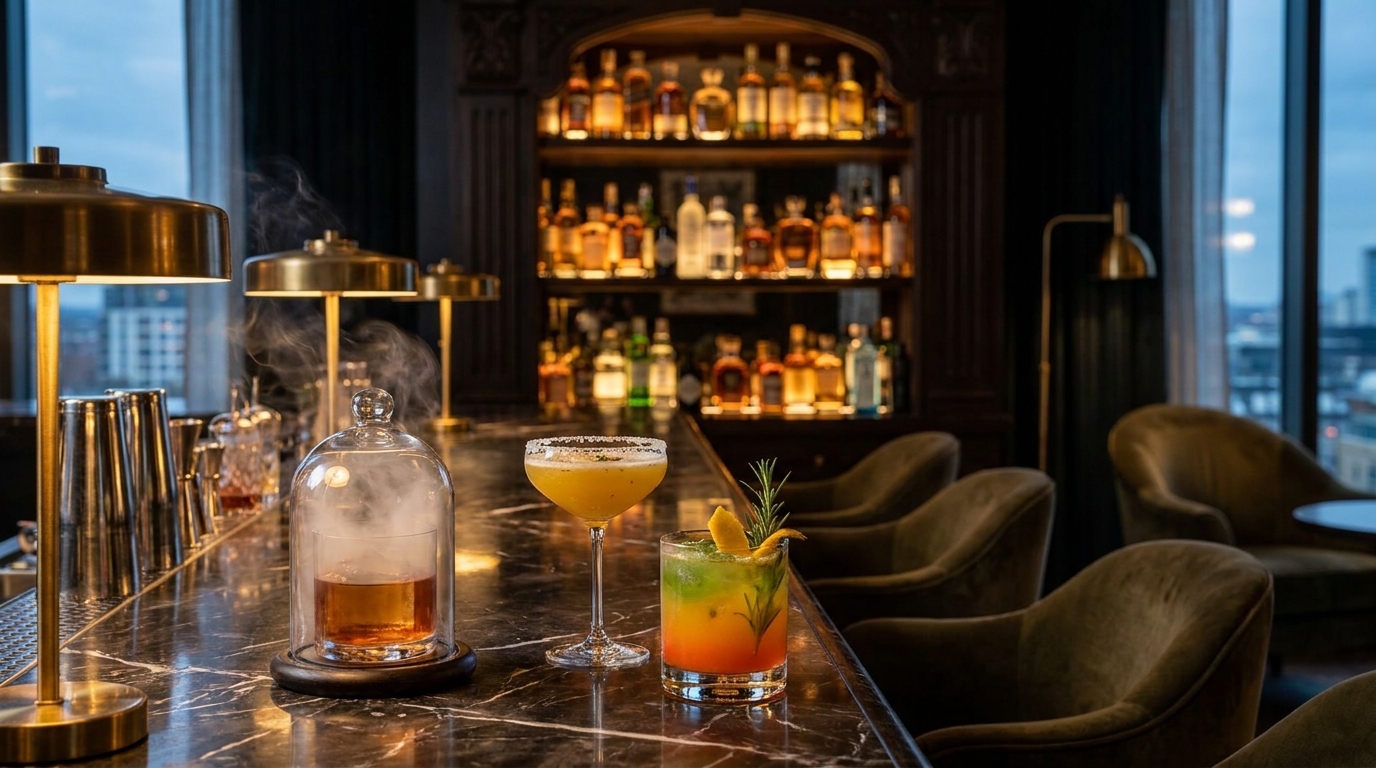
Hotel lobby bars over-curate. Twenty-four cocktails, eight gins, two pages of cocktails nobody orders. The hotel bar menu that converts in 2026 is tighter than that, with one local signature, a real zero-proof section, and a digital menu that works in every guest's language.
TL;DR — Key Takeaways
10–14 cocktails is the sweet spot. A 24-cocktail list signals indecision. Guests order the same handful.
Three signature drinks, one tied to the city. The local cocktail is the highest-margin and most-remembered item on the menu.
A real zero-proof section, not a footnote. Mocktails are now ordered, not endured. Build them like cocktails.
Bar food has to travel from the kitchen. Pick items that hold 6–10 minutes on a tray.
Multilingual + photo-driven menus are the single biggest conversion lift on an international-guest bar. The printed leather menu cannot do this.
The hotel lobby bar audience — who actually orders, when
The hotel lobby bar is the most under-engineered F&B revenue stream in most properties. The kitchen is closed, the restaurant is winding down, the lobby is the only social space left — and the bar program is the same one the previous F&B director set up in 2019.
Three audiences drive the lobby bar order mix:
The 5pm business traveler— checked in, dropped bags, wants a single drink before dinner. Orders classics: gin & tonic, Old Fashioned, glass of red. Tips well.
The 9pm international couple— dinner elsewhere, back at the hotel, one nightcap. Orders a signature or a digestif, often photographed for social.
The 11pm late-arrival— checked in late, hungry, kitchen closed. This guest decides whether your bar food program is worth running.
A menu that ignores any of these segments leaves money on the bar. The fix is not adding items. It is tightening the menu and naming what each section is for.
What a hotel lobby bar menu should include
Signature cocktails — three, not ten
Three signature drinks is the maximum that guests will read carefully. Two of the three should be approachable variations on classics (a smoked Old Fashioned, a passionfruit margarita) and the third should be the local one — a cocktail tied to the city or the region, named so a guest will mention it later. This is the single highest-margin drink on the menu and the most-remembered item. Skip it and the bar becomes interchangeable with every other hotel bar the guest has visited.
Classic cocktails — eight, the ones guests actually order
The classics list is where the hotel bar wins or loses. The list that converts:
Gin & Tonic (with a real garnish; the airport-hotel version costs you the next G&T)
Old Fashioned
Negroni
Manhattan
Espresso Martini (consistently cited by sources like Wine Enthusiast as the single biggest cocktail gainer of the last decade — list it)
Aperol Spritz
Margarita
Whiskey Sour
That is eight cocktails. Adding a ninth (a Mai Tai, a Pisco Sour, a Cosmopolitan) is fine if your concept supports it. Adding a tenth, eleventh, twelfth is where most hotel bars lose the plot — the kitchen ends up holding garnishes for cocktails nobody orders, prep waste climbs, and the menu reads like a list rather than a curation.
Beer & wine — focused, not exhaustive
Beer:3 bottled (one local, one international lager, one craft) + 1 draft. Skip the 12-tap craft beer wall — that is a sports bar, not a lobby bar.
Wine by the glass:6 wines per the sommelier-program standard — 2 whites, 2 reds, 1 rosé, 1 sparkling. Sommelier-focused publications like Sommelier Business cover the by-the-glass program structure in depth. The deeper how to build a wine by-the-glass list playbook applies here too: target 20–25% pour cost, anchor pricing with one premium pour, and rotate the local wine quarterly.
Zero-proof / mocktails — a real section, not a footnote
The biggest beverage trend of the decade — covered repeatedly in Hotel Management's beverage coverage. Zero-proof drinkers are a real share of every audience, and they remember a hotel bar that treated them well. Build the section as four mocktails that mirror the structure of the alcoholic menu: a citrus-forward zero-proof spritz, a smoky non-alcoholic Old Fashioned riff, a tropical mocktail, and a single dramatic option (a clarified milk punch, an aged sparkling shrub). The same bartender effort, the same garnish program, the same glassware. Price at 60–70% of the alcoholic cocktail, not at the cost of juice.
Bar food that travels from the kitchen
The bar is rarely contiguous with the kitchen. Food has to travel — sometimes through a back corridor — and arrive in the condition the chef intended. Pick six items, all of which survive a 6–10 minute hold:
Truffle parmesan fries (holds in a vented basket)
Crispy calamari (holds in a paper-lined basket with sauce on the side)
Beef sliders (3 mini, served on a small board)
Charcuterie board (composed cold; trivial to send)
Burrata with prosciutto (composed cold)
A signature flatbread (vented box, 8 minutes max)
That is enough. Add a single dessert (a warm cookie, a cheese plate) and the food menu is done.
A sample 4-star hotel lobby bar menu
SIGNATURES— Smoked Old Fashioned · Passionfruit Margarita · [Local Signature]
CLASSICS— Gin & Tonic · Negroni · Manhattan · Espresso Martini · Aperol Spritz · Margarita · Whiskey Sour · Old Fashioned
ZERO-PROOF— Sparkling Citrus Spritz · Smoky NA Old Fashioned · Coconut Lime Cooler · Aged Strawberry Shrub
BEER— Local Lager · Craft IPA · International Lager · Draft Pilsner
WINE BY THE GLASS— Sparkling · 2 Whites · Rosé · 2 Reds (incl. one local)
BAR FOOD— Truffle Parmesan Fries · Crispy Calamari · Beef Sliders · Charcuterie · Burrata & Prosciutto · Signature Flatbread · Warm Cookie & Vanilla Ice Cream
That is 11 cocktails, 4 zero-proof, 4 beers, 6 wines, 7 food items — a complete lobby bar menu without bloat. Most hotels run twice this and convert less.
How many cocktails should a hotel bar list?
The data-backed answer is10–14 cocktails total (signatures + classics combined). Below 8 the menu feels thin and signals a low-effort program. Above 16 and decision fatigue suppresses orders — guests revert to "I'll just have a glass of wine" because they can't pick.
The bartender economics tell the same story. A 12-cocktail list with strong execution outperforms a 24-cocktail list with mediocre execution every time. Garnishes stay fresh, the bartender's muscle memory is sharper, the recipe book stays sane. This is the same principle as reducing menu items on a restaurant menu— cut to the items that earn their slot.
Pricing — the hotel-bar pour cost reality
Industry pour cost benchmarks:
By-the-glass wine:20–25%
Cocktails:18–22% (premium spirits push higher; rail spirits push lower)
Beer:22–28% (depends on draft vs bottle mix)
Pricing above these pour costs is normal at hotel bars — guests accept a 10–20% premium over a free-standing cocktail bar nearby in exchange for the convenience and the venue. Pricing above that triggers a noticeable shift to "I'll get a drink at that place down the street". The hotel that prices a Negroni at $22 when the same drink is $14 a block away loses a real share of the lobby crowd.
A useful sanity check before reprinting the menu: walk three blocks in any direction and price the same Negroni at each comparable bar. Your price should sit 10–20% above the average, not 50% above.
The "signature local cocktail" that pays for itself
This is the highest-leverage item on the menu. A cocktail that ties to the city or the region — a Barcelona Spritz, a Tokyo Highball with local whisky, a Lisbon-themed Vinho Verde sour — becomes the item guests order without asking, photograph for social, and remember after the trip.
Build it deliberately. One regional spirit, one regional flavor (a fruit, a herb, a tea), a memorable name, and a presentation that travels in a photo. Train every bartender to recommend it within the first 30 seconds of an order. Price it 15–20% above the standard cocktail tier — the margin holds because guests buy the story as much as the drink.
The local signature is also the cocktail that translates well across languages — a Tokyo Highball is unambiguously a Tokyo Highball in any language, and that recognition factor matters when the menu runs across the international guest mix described in the multilingual hotel menus guide.
Bar menu design — typography, photos, the 60-second scan test
The traditional leather hotel bar menu has aesthetic value and bad ergonomics. Three problems compound:
It can't show photos. Photographs lift cocktail orders the same way they lift food orders — covered in detail in how photos on a menu increase sales. Without them, the signature cocktail loses to the gin & tonic almost every time.
It can't be re-translated. Hotel bars routinely see 5+ guest languages on a single night. A leather menu in English is operationally elegant and commercially limiting.
It can't be updated. A run-out on Aperol turns into 90 minutes of awkward bartender conversations before someone tells the front desk to update the menu — which then takes a week.
A hybrid wins: keep the leather card for atmosphere; embed a QR for the working menu. The leather card lists 6 signatures and the wine flight; the QR opens the full menu in the guest's language with photographs. Bartenders point at one or the other depending on the guest's age and apparent preference.
Multilingual bar menus for international guests
Hotel bars at properties with international traffic — airport hotels, downtown business hotels, resorts — routinely see 5–10 guest languages on a single night shift. The traditional menu handles one or two. The QR menu handles all of them automatically.
The big risk in multilingual cocktail menus is dish-name handling. A "Negroni" is a Negroni in every language; a "Smoked Bourbon Old Fashioned" needs careful translation that keeps the spirit named correctly and explains "smoked" in a way that lands in Mandarin or Arabic. The complete guide to multilingual restaurant menus covers the dish-name strategy in depth — the same principles apply on a cocktail menu.
QR ordering at the bar — when it works, when it kills the vibe
QR ordering at a lobby bar is a divisive topic. Done well it speeds service during peak; done poorly it kills the conversation that is the whole point of the lobby bar.
The version that works: QR for the menu, bartender for the order. The guest scans, browses in their language, sees the photos, decides — then orders from the bartender like they always did. The bartender keeps the conversation and the upsell; the menu does the language and the photo work.
The version that kills the vibe: QR for order placement, payment through the menu, no bartender interaction. Lobby bars are not fast-casual restaurants. The bartender conversation is the product. Strip it out and you lose tip share and repeat visits.
For properties that genuinely need QR ordering at the bar — high-volume rooftop, pool bar, busy weekend afternoons — the QR code in-room ordering guide covers the technical setup. The lobby bar use case is a lighter version of the same architecture, optimized to keep the bartender in the order loop.
Common hotel bar menu mistakes
24+ cocktails. Cut to 10–14.
No signature local cocktail. The single biggest miss.
Mocktails as a footnote. A real zero-proof section is now table stakes.
A draft beer wall. This is a sports bar, not a lobby bar.
Wine by-the-glass list of 12. Six is the sommelier-program standard.
Bar food that does not travel. Crispy fried fish at minute 9 is a complaint waiting to happen.
Menu in English only. International guests will order what they can read — and skip everything else.
Build your hotel bar menu free with Intermenu
Intermenu turns your lobby bar menu into a live, photo-driven QR menu — translated into 15 guest languages, with cocktail recipes maintained in one place and the pour cost / margin model visible to F&B. The QR sits next to the leather card; the bartender keeps the conversation.
Build your hotel bar menu free with Intermenu →
Frequently Asked Questions
How many cocktails should a hotel bar menu have?
10–14 cocktails total (3 signatures + 8–11 classics). Below 8 reads thin; above 16 triggers decision fatigue and suppresses orders.
What is the pour cost on a hotel cocktail?
18–22% is the industry target for cocktails, 20–25% for by-the-glass wine, 22–28% for beer. Hotel bars typically price at a 10–20% premium over comparable free-standing bars nearby.
What cocktails should a hotel bar always have?
Gin & Tonic, Negroni, Old Fashioned, Manhattan, Espresso Martini, Aperol Spritz, Margarita, Whiskey Sour. Plus three signatures — including one tied to the city.
Should a hotel bar have a zero-proof section?
Yes. Build it like the cocktail menu — four real mocktails with the same bartender effort, garnish program, and glassware. Price at 60–70% of the alcoholic cocktail tier.
Do hotel bars make money?
Generally yes — beverage margins are the strongest in F&B. The hotel bar that under-performs is almost always over-curated (too many cocktails) and under-marketed (no signature, no photos, English-only menu).
Should I use QR ordering at my hotel bar?
QR for the menu (photos, languages, currency) is now standard. QR for full order placement is divisive — at a lobby bar, the bartender conversation is the product, so most properties keep ordering through the bartender.
How often should a hotel bar refresh its menu?
Twice a year for cocktails (one summer rotation, one fall/winter rotation), quarterly for the wine-by-the-glass list, monthly for the local-signature drink if you want guests to come back for what's new.
Related guides
Optimizing hotel F&B menu management for 2026 success— the cluster pillar
In-room dining menu — how to design one that sells— what the bar hands off to at 11pm
Bar menu ideas — cocktails, food & examples that sell— the deeper bar menu playbook
The complete guide to multilingual restaurant menus— handling international guests
How photos on a menu increase sales by ~30%— why the leather card isn't enough
Menu engineering 2026— the pricing and curation discipline