Dietary Labels & Filters: Show Vegan, Halal & Gluten-Free Clearly
Clear dietary labels lift orders; vague ones lose them. Here's the standard icon set, the allergen rules, the honest wording, and why digital filters beat printed icons.
TL;DR — Key Takeaways
Menu dietary labels are a conversion tool, not a legal formality. Clear icons and honest wording give cautious guests the confidence to order; missing or vague labels push them to the plainest option or to a competitor.
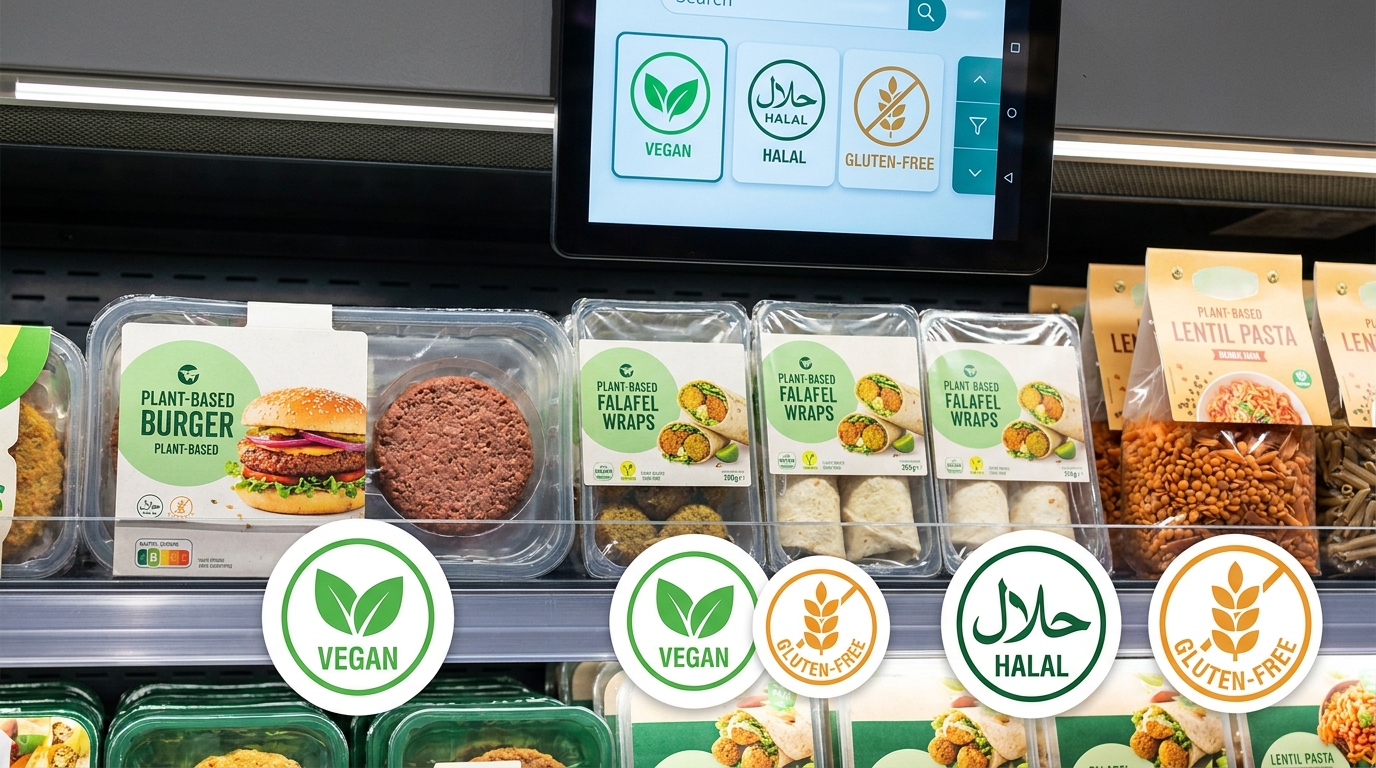
There's a widely-understood icon vocabulary— a green leaf for vegan, a crossed wheat stalk for gluten-free, marks for halal, kosher, and major allergens. Consistency beats cleverness.
You also have legal obligations: the US recognizes 9 major allergens (the "Big 8" plus sesame since 2023) and the EU requires declaration of 14. Labeling is partly compliance, partly conversion.
On a printed menu, labeling everything for everyone creates clutter that buries your best dishes. Digital filters solve this— each guest sees only what they can eat, in their own language.
Why are dietary labels a conversion tool, not a legal chore?
Most operators think of menu dietary labels as a compliance task — a box to tick so nobody sues. That framing misses the bigger point: labels change what guests order.
Picture a guest who avoids gluten scanning your menu. If nothing is marked, they don't relax and explore — they retreat to the one dish they're sure about, or they ask a server, or they quietly decide your restaurant is "too risky" and suggest somewhere else next time. A clear label does the opposite: it removes doubt, and a guest without doubt orders more — appetizer, main, side, dessert — instead of one cautious plate.
This is why labeling sits at the heart of an inclusive menu (see the special-diet pillar). It's the interface between the careful work you do in the kitchen — sourcing halal meat, preventing gluten cross-contamination — and the guest's decision to trust it. Get the label right and that work converts into orders. Leave it implicit and the work is invisible.
What's the standard dietary icon set?
Guests already recognize a common visual vocabulary, so use it rather than inventing your own. The widely-understood conventions:
Vegan / plant-based— green leaf. Pairs well with "plant-based" wording, which tests better than "vegan."
Vegetarian— leaf or "V". Distinguish clearly from vegan.
Gluten-free— crossed wheat stalk. Add "option available" where relevant.
Halal— halal mark or "H". State certified vs. sourced.
Kosher— kosher mark or "K". Show certifying agency where applicable.
Nut / specific allergen— crossed peanut or allergen glyph. Map to the legally-required allergens.
Dairy-free— crossed milk or droplet. Often overlaps vegan.
Spicy— chili. Not dietary, but guests expect it.
Two rules make an icon set work: be consistent (the same icon means the same thing everywhere), and provide a key so first-time guests can decode it. The specifics of halal and gluten-free claims are covered in How to Create a Halal Menu and Gluten-Free Menu Design.
Icons, text, or color — what actually works?
The best labeling uses all three together, because each covers the others' weaknesses:
Icons are fast to scan but ambiguous alone — a leaf could mean vegan or vegetarian. They're a shorthand, not a full message.
Text is precise ("gluten-free," "contains nuts") but slow to scan and easy to skip in dense menus.
Color speeds recognition (a consistent green for plant-based, a warning color for allergens) but fails for color-blind guests if used alone.
The reliable combination is icon + short text label + supporting color, with bold or larger type for safety-critical information. That way a skimming flexitarian catches the green leaf, a celiac guest reads the exact wording, and a color-blind guest still gets the text. Never rely on color as the only signal.
What allergen labeling rules must you follow?
Beyond conversion, dietary labeling carries legal duties, and they vary by region:
United States: federal law recognizes9 major allergens— milk, eggs, fish, crustacean shellfish, tree nuts, peanuts, wheat, and soybeans (the "Big 8"), plus sesame, added as the 9th in 2023. These must be disclosed when present.
European Union: food-information rules require declaration of14 allergens, including cereals containing gluten, crustaceans, eggs, fish, peanuts, soybeans, milk, nuts, celery, mustard, sesame, sulphites, lupin, and molluscs.
Elsewhere: many countries follow similar lists; check your local regulator.
Because requirements differ — and because Intermenu serves restaurants across many markets — the safe approach is to capture allergen data for every dish and present whatever each jurisdiction requires. For the deeper compliance picture, see our allergen compliance guide. Labeling is where dietary preference (vegan, halal) and legal allergen duty meet on the same menu line.
"Contains" vs. "option available": how do you word it honestly?
Vague wording is where trust breaks and liability begins. Precise wording protects guests and you. Keep these distinctions sharp:
"Gluten-free"vs."gluten-free option available"— the first says the dish is safe; the second says it can be made safe on request. For a celiac guest, the difference is medical.
"Contains nuts"vs."may contain traces of nuts"— declare presence directly; use trace language only for genuine cross-contamination risk.
"Prepared in a kitchen that handles wheat"— an honest disclosure that lets at-risk guests decide for themselves.
"Vegan" vs. "vegetarian" vs. "plant-based"— never imply a dairy-containing dish is vegan; lead non-vegan-facing copy with "plant-based" for craveability while keeping an accurate tag.
The principle: say exactly what is true, and make the safe-versus-conditional distinction unmissable. Honesty isn't a liability shield bolted on after the fact — it's the thing that makes guests trust you enough to come back.
Why do digital filters beat printed icons?
Here's the structural problem with printed labels: to fully serve everyone, you'd need to print a row of icons on every single line — vegan, vegetarian, gluten-free, halal, kosher, dairy-free, plus allergens. Do that and the menu becomes unreadable noise that buries your stars. Don't do it and some guests are left guessing. Printed menus force a lose-lose.
A digital menu dissolves the trade-off. Instead of showing every label to everyone, it lets each guest filter: tap "vegan" or "gluten-free" or "halal" and see only the dishes that qualify, with the precise wording and any cross-contamination note attached. The menu stays clean for everyone, and each guest gets a personalized, confident view. (This is one of the biggest advantages of QR code menus over print.)
This is exactly where Intermenu is built to shine. Each dish's dietary data — vegan, halal, gluten-free, allergens, kosher category — is stored once as structured data, then:
Filtered per guest, so a gluten-free diner sees only safe dishes;
Translated accurately into 15 languages, so the labels mean the same thing in Arabic, German, or Spanish as they do in English;
Updated instantly, so a recipe change updates every label everywhere, with no reprinting.
The result is the holy grail of dietary labeling: complete information for the guests who need it, zero clutter for the guests who don't.
Frequently Asked Questions
What are menu dietary labels?
Icons, text, and color cues that mark a dish's dietary status — vegan, vegetarian, gluten-free, halal, kosher, dairy-free — and its allergens, so guests can quickly identify what they can safely and confidently order.
What do the common dietary icons mean?
A green leaf marks vegan/plant-based, a crossed wheat stalk marks gluten-free, and crossed glyphs mark specific allergens like nuts. Use a consistent set with a key, and pair every icon with short text.
How many allergens must a restaurant label?
In the US, 9 major allergens (the Big 8 plus sesame since 2023); in the EU, 14. Requirements vary by country, so capture allergen data for every dish and display what your jurisdiction requires.
What's the difference between "gluten-free" and "gluten-free option available"?
"Gluten-free" means the dish as served is gluten-free; "option available" means it can be made gluten-free on request. For celiac guests the distinction is a safety issue, so state it precisely.
Why are digital dietary filters better than printed icons?
Printing every label on every line clutters the menu; leaving them off leaves guests guessing. Digital filters let each guest see only the dishes they can eat, with exact wording and translations — clear for everyone, clutter-free.
Give Every Guest a Menu They Can Trust at a Glance
Clear dietary labels are the difference between a confident order and a guest who leaves. The best system gives each diner exactly the information they need — and nothing they don't.
Intermenu stores each dish's dietary and allergen data once, then filters and translates it for every guest — so vegan, halal, kosher, and gluten-free diners all see a clean, accurate, trustworthy menu in their own language.
See how Intermenu's dietary filters work →